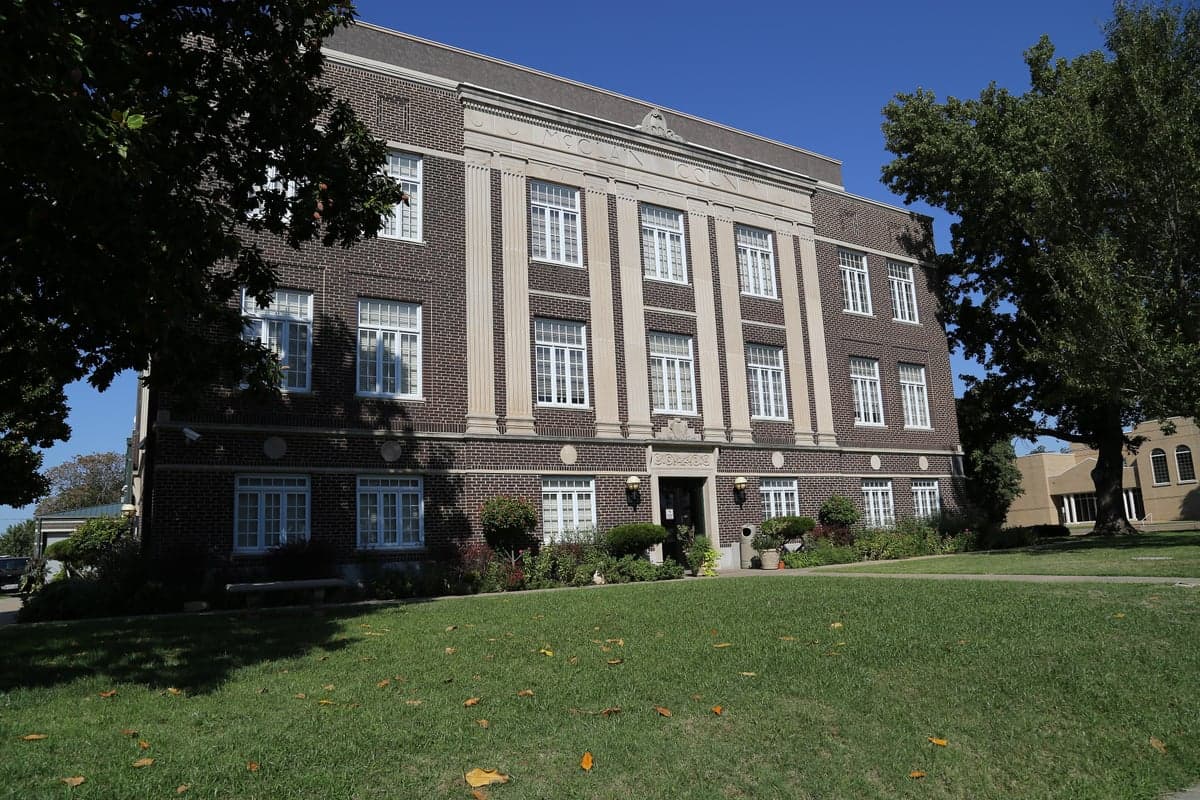
Photo: Wikipedia
Political ClimatePolitical Climate in Purcell, OK
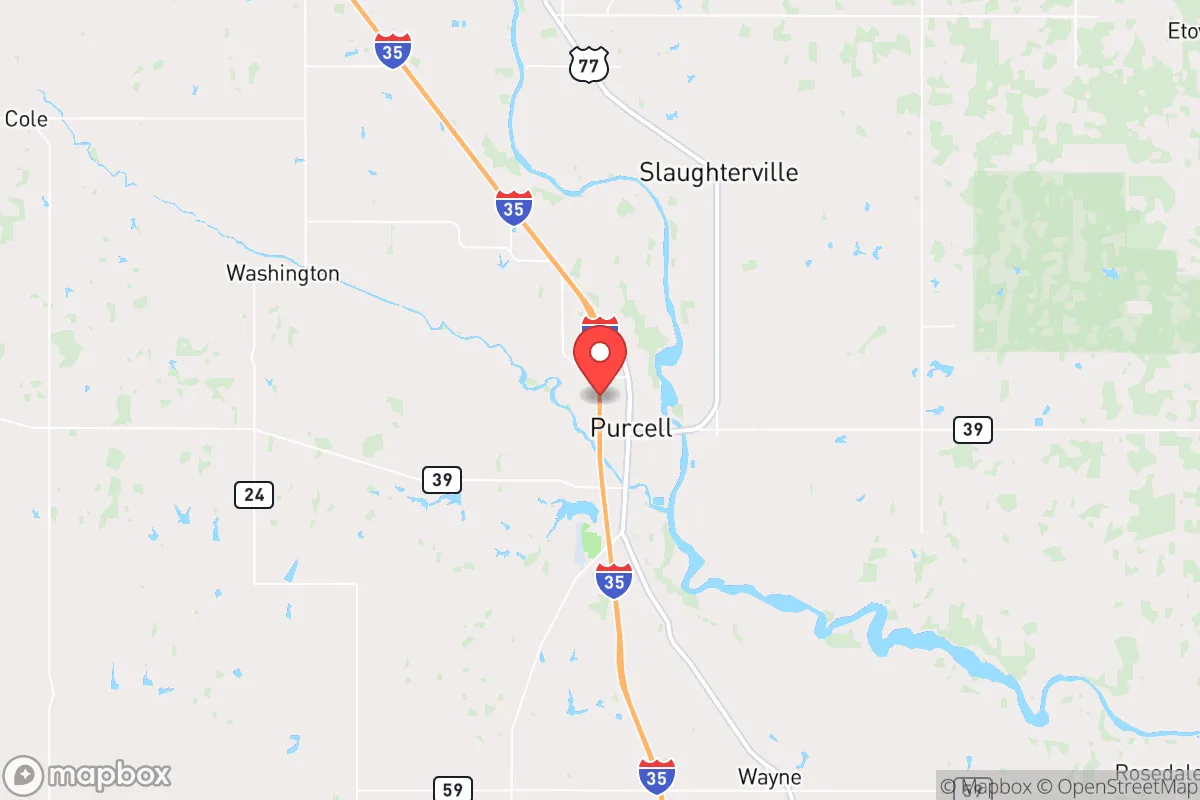
District shown is the primary district for this city’s centroid. Cities may span multiple districts.
Local Political AnalysisPolitical Analysis of Purcell, OK
Purcell leans solidly Republican, with a Cook Partisan Voting Index (PVI) of R+17, making it slightly more conservative than the state of Oklahoma as a whole, which sits at R+18. This isn't a new development—the area has been reliably red for decades, but the margin has tightened a bit in recent cycles as the broader McClain County has seen an influx of folks from the Oklahoma City metro. You used to be able to count on a 30-point Republican win here, but now it's closer to 20, reflecting a subtle shift as younger families and commuters bring a more suburban, less rock-ribbed conservative vibe.
How it compares
Purcell’s R+17 is nearly identical to the state’s R+18, but the real contrast is with the surrounding towns. Drive 15 minutes north to Norman (Cleveland County), and you’re in a D+5 area—a blue island anchored by the University of Oklahoma. That’s a 22-point swing in just a few miles. Head south to Lexington (R+22) or east to Wayne (R+24), and you’ll find the old-school, deep-red rural conservatism that Purcell itself is slowly moving away from. The difference is subtle but real: Purcell’s politics are less about “government is the enemy” and more about “keep taxes low and schools decent.” The city council races here are often decided by a few dozen votes, and you’ll see a handful of Democrats on the ballot every cycle—something you won’t find in the deeper red towns.
What this means for residents
For conservative residents, Purcell is a comfortable place to live. The local government is generally pro-business, zoning is minimal, and the county commission is reliably Republican. You won’t see much pushback on Second Amendment issues or property rights. For liberal residents, it’s more of a mixed bag. You’ll find a small but active Democratic club that meets at the library, and the local school board has had some progressive members over the years. But you’re not going to see a Pride parade or a city-funded social program anytime soon. The practical reality is that most people here just want good roads, decent schools, and low taxes—and they vote accordingly. The political climate is less about ideology and more about pragmatism, which is why you’ll see a few Democrats win local offices if they run on a platform of fixing potholes and keeping the water clean.
The biggest cultural distinction between Purcell and the rest of Oklahoma is its relationship with the Chickasaw Nation. The tribe is a major employer and landowner here, and that creates a unique political dynamic. Local Republicans and Democrats alike tend to be pro-tribal sovereignty, because the tribe brings jobs and tax revenue. That’s a different conversation than you’d have in, say, Enid or Lawton, where tribal relations are more contentious. Looking ahead, Purcell’s politics will likely continue to moderate as the metro area expands southward. The old guard is aging out, and the new arrivals are more focused on commute times and school ratings than on national culture wars. It’s still a red town, but it’s a red town that’s learning to live with a little more purple.

State Political ClimatePolitical Climate in Oklahoma
State Political AnalysisPolitical Environment in the State
Oklahoma is one of the most reliably Republican states in the country, with a Cook Partisan Voting Index of R+18, meaning it votes about 18 points more Republican than the national average in presidential elections. The state hasn’t voted for a Democratic presidential candidate since 1964, and over the last 20 years, the GOP has tightened its grip from a competitive lean to an outright lock, driven by the collapse of the old Democratic “Big Tent” in rural areas and the rapid suburbanization of places like Edmond, Broken Arrow, and Norman. The dominant coalition is a mix of evangelical conservatives, oil-and-gas interests, and a growing number of fiscally conservative transplants from bluer states, while the Democratic base is now largely confined to the state’s two urban cores—Oklahoma City and Tulsa—and a handful of tribal communities.
Urban vs. rural divide
The political map of Oklahoma is a textbook case of the urban-rural split. Oklahoma City and Tulsa are the only real blue dots on the map, and even they are purple at best. Oklahoma County (OKC) has trended Democratic in recent cycles, flipping from a 12-point Romney win in 2012 to a narrow Biden loss in 2020, driven by a growing Hispanic population and white-collar professionals in the Midtown and Plaza District neighborhoods. Tulsa County is similar but slightly redder, with the city itself voting blue while the suburbs like Broken Arrow and Jenks are deep red. The rest of the state—the vast rural plains, the Panhandle, and the small towns like Lawton, Enid, and Ponca City—vote Republican by margins of 60 to 80 percent. The most conservative counties are in the far west and southwest, like Texas County and Beaver County, where Trump pulled in over 85% of the vote in 2024. The divide isn’t just about population density; it’s cultural. Rural Oklahomans see the state’s two big cities as increasingly out of step with their values on guns, religion, and government spending, while urbanites view the rural-dominated legislature as out of touch on education and healthcare funding.
Policy environment
Oklahoma’s policy environment is aggressively conservative, with a low-tax, low-regulation posture that’s been baked in for decades. The state has a flat income tax of 4.75% (down from 5% in 2022, with a path to 3.99% by 2027), no estate tax, and a state sales tax that averages around 4.5% but can hit 10% or more when local add-ons are included. Property taxes are among the lowest in the nation, typically 0.5% to 1% of assessed value, which is a major draw for relocators. On education, the state has a robust school choice program: the Oklahoma Parental Choice Tax Credit Act (2023) offers up to $7,500 per child for private school tuition, and the state has one of the highest densities of charter schools in the region. Healthcare is a mixed bag—Oklahoma expanded Medicaid in 2021 via a ballot initiative (State Question 802), but the state legislature has since tried to add work requirements and copays, creating a tug-of-war. Election laws are strict: voter ID is required, early voting is limited to three days (Thursday through Saturday before an election), and absentee ballots require a notary or two witnesses. The state also has a near-total abortion ban (SB 612, 2022) with no exceptions for rape or incest, only to save the mother’s life.
Recent policy direction
Over the last five years, Oklahoma has moved decisively to the right on nearly every front. On guns, the state enacted permitless carry (SB 1080, 2019) and a “Second Amendment Sanctuary” law (HB 2597, 2021) that prohibits state enforcement of future federal gun bans. On parental rights, the “Save Women’s Sports Act” (SB 2, 2022) bans transgender girls from female school sports, and the “Students’ Right to Know Act” (HB 1775, 2021) restricts how race and gender can be taught in public schools. On speech and privacy, the state passed a social media age-verification law (SB 1959, 2024) requiring minors to get parental consent for accounts, and a “bathroom bill” (HB 1442, 2022) requiring schools to designate restrooms based on biological sex. Property rights are strong: the state has a “Stand Your Ground” law and a “Right to Farm” constitutional amendment (State Question 777, 2016) that protects agricultural practices from nuisance lawsuits. On taxation, the trend is toward elimination: the legislature is actively debating a bill to phase out the state income tax entirely by 2030. Voting access has tightened, with a 2023 law (SB 440) banning private funding of election administration and requiring hand-count audits of paper ballots. For a relocator, the practical takeaway is that Oklahoma is a state where the government is actively trying to shrink its footprint on your wallet, your family, and your property, while expanding it on social and cultural issues.
Civil unrest & political movements
Oklahoma has a history of populist and anti-establishment movements, but large-scale civil unrest is rare. The most visible flashpoint in recent years was the 2022 protests over the state’s near-total abortion ban, which drew a few thousand demonstrators to the state capitol in Oklahoma City, but they were dwarfed by the annual “Right to Life” rallies. On the right, the “Oklahoma Freedom Caucus” has become a powerful force in the legislature, pushing for further tax cuts, school choice expansion, and anti-ESG legislation (the state divested $1.5 billion from BlackRock in 2023). Immigration politics are heated but not violent: the state passed a law (HB 4156, 2024) making it a state crime to be in the country illegally, modeled on Texas’s SB 4, though it’s currently tied up in court. There’s no serious secession or nullification movement, but “constitutional sheriff” rhetoric is common in rural counties like Sequoyah County and Adair County. Election integrity controversies flared after 2020, with the state auditor conducting a “forensic audit” of the 2020 election in Canadian County that found no evidence of widespread fraud but still fueled distrust among some GOP activists. For a new resident, the political temperature is warm but not boiling—most Oklahomans are polite about their differences, and the state’s “live and let live” frontier culture means you’re unlikely to face harassment for your bumper stickers, unless you’re in the wrong part of Norman on game day.
Projection
Over the next 5-10 years, Oklahoma is likely to become even more Republican, but with a growing internal tension between the libertarian-leaning business wing and the socially conservative evangelical wing. In-migration is a key factor: the state is attracting a steady stream of relocators from California, Colorado, and Illinois, drawn by low housing costs and no state income tax (if the phase-out happens). These newcomers tend to be fiscally conservative but socially moderate, which could push the GOP primary electorate toward a more “live and let live” stance on issues like marijuana (medical is legal, recreational is still illegal but polling shows majority support) and gambling (tribal casinos are expanding). The urban cores of Oklahoma City and Tulsa will continue to trend blue, but the state’s rural population is shrinking, and the legislature is likely to gerrymander congressional districts to maintain a 5-0 GOP delegation. The wildcard is the tribal nations—the Cherokee, Choctaw, and Chickasaw nations have become major economic and political players, and their push for sovereignty and gaming revenue could create friction with the state government. A relocator moving in now should expect a state that is solidly red, with a low-tax, low-service government, a strong culture of individualism, and a political climate that rewards conservative activism but punishes extremism at the ballot box.
For a new resident, the bottom line is this: Oklahoma is a state where your vote for a Republican primary candidate will almost certainly decide the general election, and where your personal freedoms—on guns, taxes, and property—are broadly protected, but your social freedoms—on abortion, LGBTQ+ issues, and drug policy—are tightly restricted. If you’re a conservative looking for a place where your values are the law of the land, you’ll feel at home. If you’re a liberal, you’ll find a small but resilient community in the cities, but you’ll need to accept that the state government will be actively working against your priorities. The best advice is to pick your neighborhood carefully: Edmond and Yukon are safe bets for conservative families, Norman and the Plaza District in OKC are better for progressives, and Broken Arrow is a solid middle ground for those who want good schools and low taxes without the culture war intensity.
* Values derived from national, state, county, city and local statistics and may differ in a specific area. Last updated: 2026-07-13T01:05:56.000Z
Narrative content on this page is AI-generated and may contain mistakes. Verify any details that matter before acting on them.
ReloMaps may earn a commission from affiliate links at no extra cost to you.

