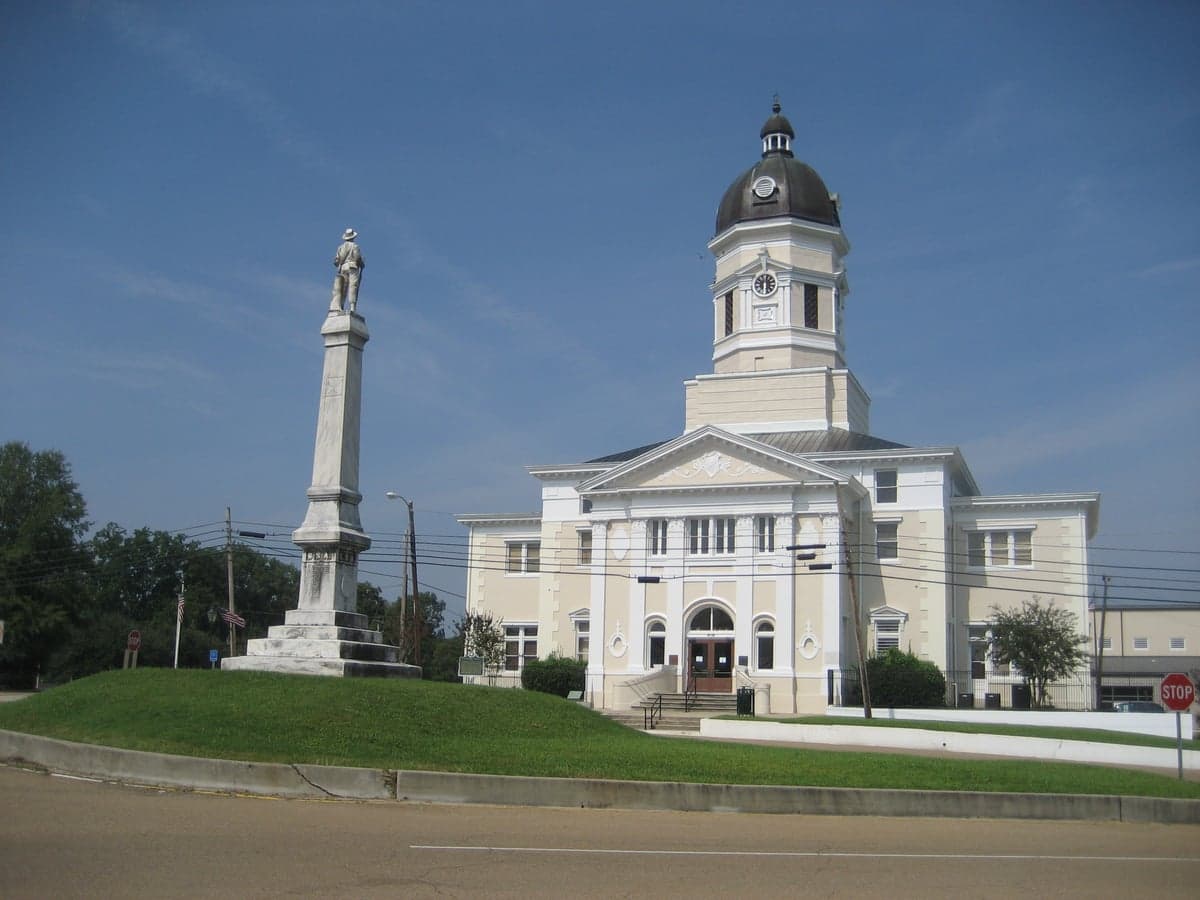

Photo: Wikipedia
Political ClimatePolitical Climate in Port Gibson, MS
District shown is the primary district for this city’s centroid. Cities may span multiple districts.
Inherited from parent county — no local data available.
* Lean and PVI are calculated from the surrounding county’s 2020 and 2024 presidential results, Cook-style — a finer measure here than its congressional district (MS-2).
Political rankings in Mississippi
- Most Conservative Cities in Mississippi
- Most Liberal Cities in Mississippi
- Best Liberal-Leaning Towns in the South
- Best Liberal-Leaning Towns in the Deep South
- Safest Liberal-Leaning Towns in the South
- Safest Conservative-Leaning Towns in the South
- Affordable Small Towns for Conservatives
- Safest Conservative-Leaning Cities in the U.S.
- Most Conservative Counties in Mississippi
- Most Liberal Counties in Mississippi
Local Political AnalysisPolitical Analysis of Port Gibson, MS
Port Gibson is a genuine political outlier in Mississippi, a small town that has held a Democratic lean even as the state around it has shifted hard to the right. With a Cook PVI of D+11, it’s one of the few places in the state where a Democrat can expect to win a local race without a Herculean effort. The town’s politics are deeply rooted in its majority-Black population and its history as a Civil War-era river port, and that identity has kept it from following the same trajectory as the surrounding, heavily Republican counties. You won’t see the same kind of partisan realignment here that you see in places like Vicksburg or Jackson, and that’s not changing anytime soon.
How it compares
The contrast between Port Gibson and the rest of Mississippi is stark. The state as a whole carries a Cook PVI of R+11, meaning it votes about 11 points more Republican than the national average. Port Gibson, by contrast, votes about 11 points more Democratic. That’s a 22-point swing between the town and the state, and it shows up in every election cycle. In 2024, while Mississippi went heavily for Donald Trump, Port Gibson’s precincts in Claiborne County went just as heavily for Kamala Harris. The surrounding areas tell the story: head north to Vicksburg or east to Hazlehurst, and you’ll find a more mixed but still conservative-leaning electorate. Drive south to Natchez, and you’ll find a similar Democratic lean, but Port Gibson is more consistent and more pronounced in its voting patterns. The town’s politics are closer to what you’d see in the Mississippi Delta region than in the rest of the state’s hill country.
What this means for residents
For conservative residents, living in Port Gibson means being in the minority politically, but it’s not a hostile environment. You’ll find that local issues—like the condition of the roads, the school system, and the slow pace of economic development—tend to dominate over national partisan fights. The county government is reliably Democratic, so if you’re a Republican, you’re likely used to being on the losing side of local elections. That said, there’s no real political pressure to hide your views; it’s a small town where people know each other, and politics rarely comes up at the grocery store. For liberal residents, the D+11 lean means you’re in a comfortable bubble compared to the rest of the state. You’ll see Democratic candidates actually campaign here, and local offices are often decided in the primary rather than the general election. The trade-off is that your vote carries less weight in statewide races, since the outcome is effectively predetermined by the rest of Mississippi.
The cultural and policy distinctions here are subtle but real. Port Gibson has a stronger tradition of Black political leadership than most Mississippi towns its size, and that shapes everything from how the police department is run to how the city handles zoning and historic preservation. The town’s motto, "Too beautiful to burn," is a nod to its Civil War survival, and that pride in preservation extends to its politics—there’s a resistance to rapid change, whether that’s new development or new political ideas. Looking ahead, the demographic trends suggest Port Gibson will stay Democratic for the foreseeable future. The population is aging and slowly shrinking, but the racial makeup isn’t shifting dramatically, so the political balance is likely to hold. If anything, the gap between Port Gibson and the rest of Mississippi could widen as rural white voters continue to consolidate behind the GOP. For anyone moving here, the takeaway is simple: this is a place where local politics feel genuinely local, and the national partisan divide, while present, doesn’t define daily life the way it does in many other parts of the state.

State Political ClimatePolitical Climate in Mississippi
State Political AnalysisPolitical Environment in the State
Mississippi is one of the most reliably Republican states in the country, carrying a Cook PVI of R+11, but the real story is how that dominance has shifted shape over the last two decades. The state hasn't voted for a Democratic presidential candidate since Jimmy Carter in 1976, yet the coalition that keeps it red today looks very different than it did twenty years ago—it’s now powered almost entirely by the fast-growing suburbs of the Gulf Coast and the Jackson metro exurbs, while the rural Black Belt Delta counties have become overwhelmingly Democratic. The trajectory is one of consolidation: Republicans have strengthened their grip on state government, holding a supermajority in both legislative chambers, while the minority party has become geographically isolated in a handful of majority-Black counties.
Urban vs. rural divide
The political map of Mississippi is a study in stark geographic polarization. The state’s largest metro, the Jackson area, is a tale of two worlds: the capital city itself is a Democratic stronghold (roughly 80% Black and deeply blue), but the surrounding suburbs in Rankin and Madison Counties are among the most Republican jurisdictions in the entire country—Madison County routinely gives GOP candidates 75-80% of the vote. This is the classic "donut" pattern, and it’s where the state’s growth is concentrated. The Gulf Coast metros of Gulfport and Biloxi lean Republican but are more competitive, with Harrison County often landing in the 55-60% GOP range; it’s a swing area that both parties contest. The Delta region—Greenville, Clarksdale, Cleveland—is the poorest and most reliably Democratic part of the state, with some precincts voting 90%+ for Democrats. Meanwhile, the northeastern hill country around Tupelo and the Pine Belt around Hattiesburg are conservative but with a populist streak, more willing to support moderate Democrats in local races. The rural white counties of the central and southern parts of the state, places like Jones County and Forrest County, are now as Republican as any in the nation, a dramatic flip from the 1990s when they were reliably Democratic at the local level.
Policy environment
Mississippi’s policy environment is defined by a low-tax, low-service philosophy that has been consistent for decades. The state has no income tax on Social Security benefits, a flat 5% personal income tax that is being phased out entirely by 2026, and one of the lowest property tax burdens in the country—the average effective property tax rate is around 0.65%, roughly half the national average. The regulatory posture is strongly business-friendly; it’s a right-to-work state with no state-level minimum wage (it defaults to the federal $7.25), and tort reform caps non-economic damages in most lawsuits. Education policy has shifted rightward in recent years: the state passed a school choice program in 2024 that creates education savings accounts for all students, making it one of the most expansive school choice laws in the nation. Healthcare is a mixed bag—Mississippi is one of the poorest states in the country and has not expanded Medicaid under the Affordable Care Act, leaving roughly 100,000 residents in the coverage gap, though the state did pass a limited expansion bill in 2025 that covers only the most impoverished. Election laws are restrictive by national standards: voter ID is required, early voting was only introduced in 2024 (with no-excuse absentee voting), and the state has one of the shortest early voting windows in the country at just 10 days.
Recent policy direction
The last five years have seen Mississippi move decisively in a conservative direction across nearly every policy domain. On guns, the state passed constitutional carry in 2016 and has resisted any federal encroachment, with a 2024 law prohibiting state agencies from enforcing federal firearm regulations. On parental rights, the 2023 "Parents' Bill of Rights" requires schools to notify parents of any curriculum involving sexuality or gender identity and mandates parental consent for any student name or pronoun changes. The state also passed a near-total abortion ban in 2019 that took effect immediately after the Dobbs decision in 2022, with no exceptions for rape or incest. On speech and privacy, Mississippi passed a law in 2021 requiring age verification for adult websites and has been aggressive in restricting transgender athletes from competing in women's sports. Property rights are strongly protected—the state has a "castle doctrine" law and is one of the few states that requires compensation for regulatory takings. On taxation, the phase-out of the income tax is the headline policy, with the goal of eliminating it entirely by 2026, which would make Mississippi one of only nine states with no income tax. Voting access has been tightened, not loosened: the 2024 early voting law was a modest expansion, but the state still has no online voter registration and requires a notarized absentee ballot application.
Civil unrest & political movements
Mississippi’s political flashpoints are less about street protests and more about institutional battles. The state has a long and painful history of civil rights activism, and that legacy still shapes the political landscape—the Mississippi Freedom Trail markers in Jackson and the Emmett Till Interpretive Center in Sumner draw visitors, and the state legislature finally voted in 2020 to remove the Confederate battle flag from the state flag, a decision that was seen as a watershed moment. The modern activist left is concentrated in Jackson, where the "Jackson Rising" cooperative movement and the work of organizations like the Mississippi Poor People's Campaign keep a progressive flame alive, but they have little statewide influence. On the right, the state has seen a surge of county-level "constitutional sheriff" movements and Second Amendment sanctuary resolutions—over 40 counties have declared themselves Second Amendment sanctuaries. Immigration politics are relatively quiet because the state has one of the smallest foreign-born populations in the country (about 2%), but the legislature passed a law in 2024 requiring local law enforcement to cooperate with federal immigration authorities. Election integrity has been a recurring theme: the state's 2023 gubernatorial race saw the Republican incumbent win by 8 points, but not without allegations of voter suppression from civil rights groups regarding the closure of polling places in majority-Black counties.
Projection
Looking ahead five to ten years, Mississippi’s political trajectory is likely to continue its current path: more Republican, more suburban, and more focused on cultural issues. The state’s population is aging and slowly declining overall, but the growth areas—Madison County, DeSoto County (the Memphis exurbs), and the Gulf Coast—are all trending more conservative. The income tax phase-out will likely make the state more attractive to retirees and remote workers, which could accelerate the suburbanization of its politics. The Democratic Party’s base in the Delta and Jackson will remain solid, but it’s hard to see a path back to statewide competitiveness given the demographic math—the Black population is roughly 38% of the state, and white voters are now voting Republican at levels above 80% in most rural areas. The more interesting question is whether the state’s hard-right turn on cultural issues will create a backlash among the growing number of out-of-state transplants moving to the Gulf Coast, who tend to be more moderate. A decade from now, a new resident should expect Mississippi to be a solidly red state with a Republican supermajority, low taxes, and a policy environment that is increasingly aligned with the national conservative movement—but with a visible and vocal progressive minority concentrated in Jackson and the Delta that will continue to contest every election.
For a new resident, the practical takeaway is straightforward: if you’re conservative, Mississippi offers one of the most welcoming policy environments in the country—low taxes, strong gun rights, school choice, and a government that is actively trying to shrink itself. If you’re liberal, you’ll find a small but committed community in Jackson, Oxford, and the Delta, but you should expect to be in the minority in most policy debates and to see your values reflected in very little of the state’s legislation. The state is not politically static—it’s becoming more suburban, more culturally conservative, and more focused on attracting new residents through its tax and regulatory policies. Whether that’s a feature or a bug depends entirely on your own priorities, but it’s a direction that shows no signs of reversing.
* Values derived from national, state, county, city and local statistics and may differ in a specific area. Last updated: 2026-10-27T04:39:57.000Z
Narrative content on this page is AI-generated and may contain mistakes. Verify any details that matter before acting on them.
ReloMaps may earn a commission from affiliate links at no extra cost to you.

