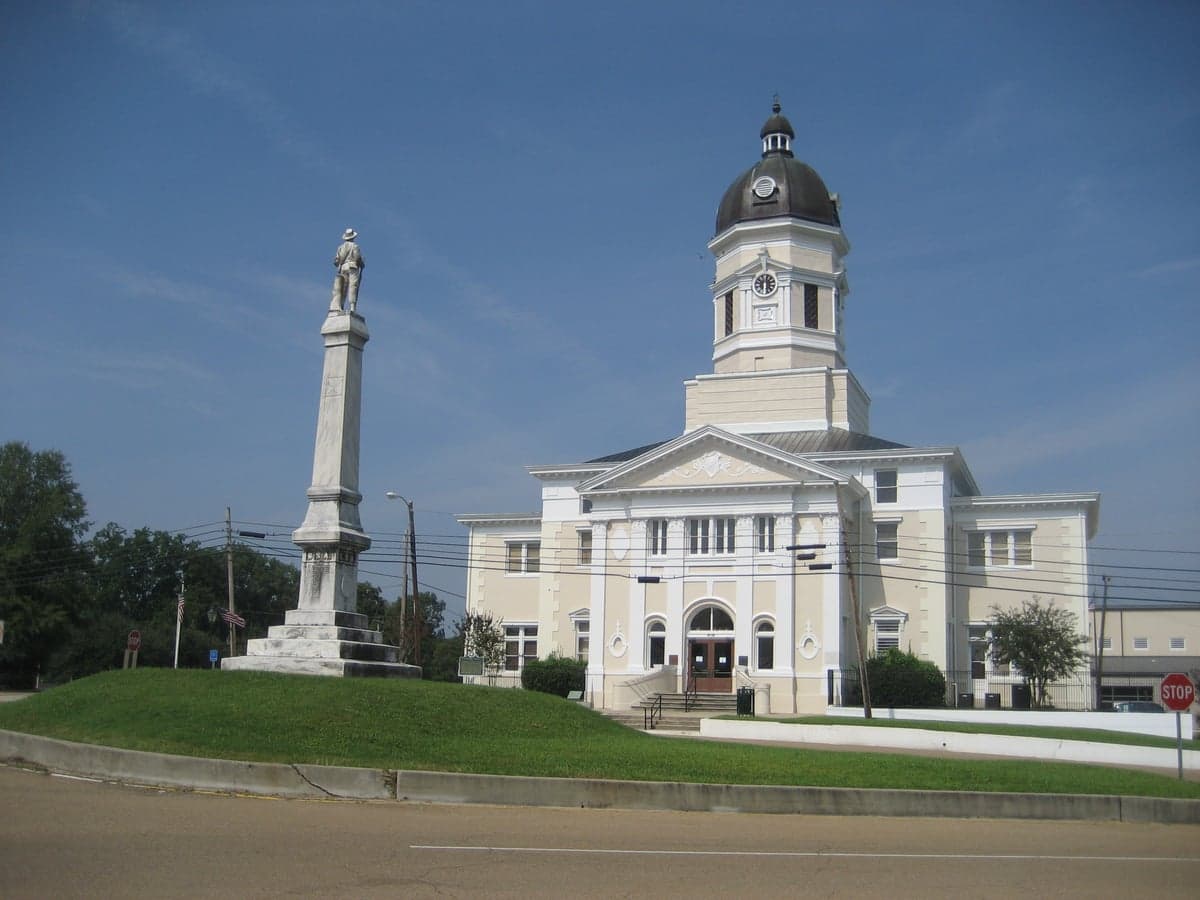
Photo: Wikipedia
Demographics of Port Gibson, MS
Historical data isn't available for Port Gibson, MS. Trends shown are for Claiborne County, MS.
Affluence Level in Port Gibson, MS
A below-average socioeconomic profile. Incomes, home values, and educational attainment trail the U.S., with higher poverty and unemployment.
People of Port Gibson, MS
The people of Port Gibson, Mississippi, today form a small, deeply rooted community of roughly 1,500 residents, defined by a nearly even Black and white population split (36.9% Black, 55.4% white) and a strong local identity tied to the city’s antebellum past. The city is overwhelmingly native-born, with a foreign-born share of just 1.4%, and its character is shaped by generational families who have remained in Claiborne County for over a century. A modest college-educated rate of 24.2% reflects a working-class, church-centered culture where the historic courthouse square and nearby Alcorn State University anchor daily life.
How the city was settled and grew
Port Gibson’s population story begins with European settlement in the late 18th century, when the area was part of Spanish West Florida. The town was formally incorporated in 1803, and its location on the Natchez Trace and the Mississippi River made it a natural trading post. The first major wave of permanent settlers were Anglo-American planters and merchants from Virginia, the Carolinas, and Tennessee, drawn by fertile loess soil ideal for cotton. By the 1830s, these families had built the grand Greek Revival homes along Church Street and Market Street, the historic core that still defines the town’s architectural character today. Enslaved African Americans, who made up the majority of the county’s population by 1850, lived in quarters behind these homes and in the rural areas surrounding the town, laying the foundation for the Black community that remains a central part of Port Gibson’s identity.
The post-Civil War era brought a second wave: freedmen who remained in the area as sharecroppers and tenant farmers, establishing their own neighborhoods. The Hazlehurst Street and Claiborne Street areas became the heart of the Black community, home to churches, small businesses, and the schools that served Black children during segregation. The early 20th century saw little new in-migration; the cotton economy stagnated, and many young people left for Memphis or Chicago. The population peaked around 2,500 in the 1920s and has declined slowly ever since, with the white population shrinking more rapidly after the 1960s as agricultural mechanization eliminated farm jobs.
Modern era (post-1965)
The 1965 Immigration and Nationality Act had virtually no effect on Port Gibson; unlike Mississippi’s Gulf Coast or the Jackson metro, this inland river town never attracted immigrant communities. The modern era instead saw a continuation of out-migration, particularly among young white residents seeking jobs in Jackson (45 miles northeast) or Vicksburg (30 miles north). The Black population, however, remained more stable, anchored by the presence of Alcorn State University in nearby Lorman, which has employed and educated generations of Black Mississippians since its founding in 1871. The university’s faculty and staff have historically settled in the College Hill area on the town’s southern edge, creating a small professional class within an otherwise working-class community.
Today’s demographic balance — 55.4% white, 36.9% Black — reflects a white population that is disproportionately elderly and a Black population that includes more families and working-age adults. The Hispanic share (3.6%) is a very recent development, driven by a small number of Latino workers employed in poultry processing and agricultural support jobs in the broader Claiborne County area; they have settled in rental housing scattered along Main Street and the Highway 61 corridor rather than in a distinct ethnic enclave. East/Southeast Asian residents (0.7%) and Indian residents (0.3%) are present in only tiny numbers, typically professionals at Alcorn State or the county hospital, and no single neighborhood has a visible concentration of either group.
The future
Port Gibson’s population is aging and slowly shrinking, with the 2020 Census showing a 5% decline from 2010. The white population, already elderly, will continue to decline through natural attrition. The Black population is likely to remain stable or grow slightly, supported by Alcorn State’s continued role as a regional employer and by the affordability of housing in the Hazlehurst Street and Claiborne Street neighborhoods, where homes sell for well under $100,000. The Hispanic share, while small, is the only segment showing measurable growth, and it will likely double or triple over the next decade as agricultural and processing jobs attract more workers, though it will remain a single-digit percentage of the total.
The most significant demographic force is not immigration but the continued draw of Jackson and the Mississippi Gulf Coast, which pull away the college-educated 24.2% who leave for better job markets. The town’s cultural identity remains firmly rooted in its antebellum heritage — the "city too beautiful to burn" nickname from the Civil War still appears in local marketing — and this heritage tourism, centered on the Church Street historic district, is the most likely driver of any future population stabilization.
For someone moving to Port Gibson today, the practical reality is a small, affordable, deeply Southern community where church membership and family ties matter more than any demographic trend. The population is becoming slightly more diverse at the margins, but the core character remains a Black-white Southern town with a strong historic preservation ethic. New residents will find a place where neighbors know each other by name, where the cost of living is among the lowest in Mississippi, and where the biggest adjustment is the quiet — and the 45-minute drive to reach a major retail center.

* Values derived from national, state, county, city and local statistics and may differ in a specific area. Last updated: 2026-10-27T04:39:57.000Z
Narrative content on this page is AI-generated and may contain mistakes. Verify any details that matter before acting on them.
ReloMaps may earn a commission from affiliate links at no extra cost to you.

