Photo: Wikipedia
Political ClimatePolitical Climate in Pleasant Hill, MO
District shown is the primary district for this city’s centroid. Cities may span multiple districts.
Local Political AnalysisPolitical Analysis of Pleasant Hill, MO
Pleasant Hill, Missouri, is about as reliably red as it gets in the metro area. The town’s Cook Partisan Voting Index (PVI) of R+21 means it votes roughly 21 points more Republican than the national average — a far deeper shade of red than the state of Missouri itself, which sits at R+8. That gap isn’t just a number; it reflects a community where conservative values aren’t just held but are the default expectation in local government, school board meetings, and even casual conversation at the coffee shop on the square. Over the past decade, the lean has only hardened, driven by an influx of families and retirees from the Kansas City suburbs who wanted a quieter, more affordable life but brought their politics with them — and then some.
How it compares
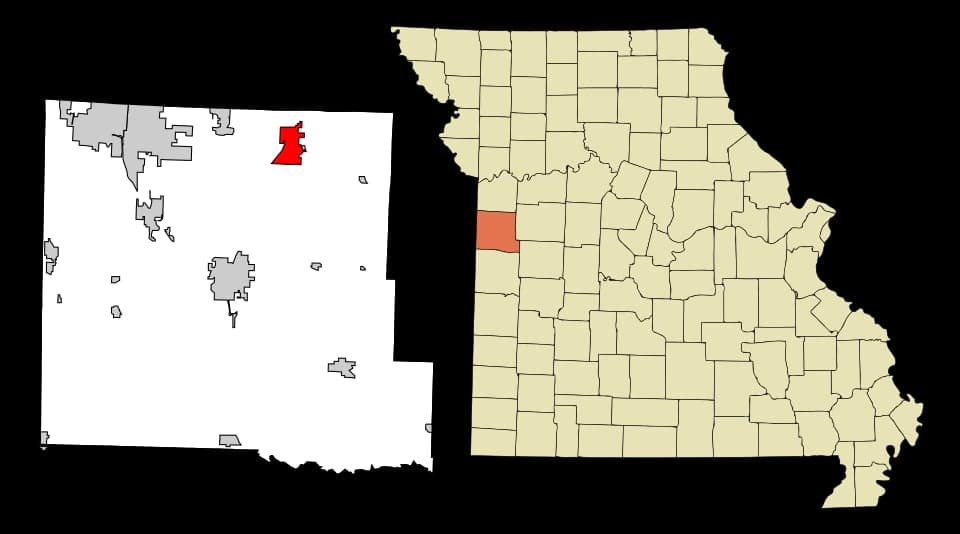
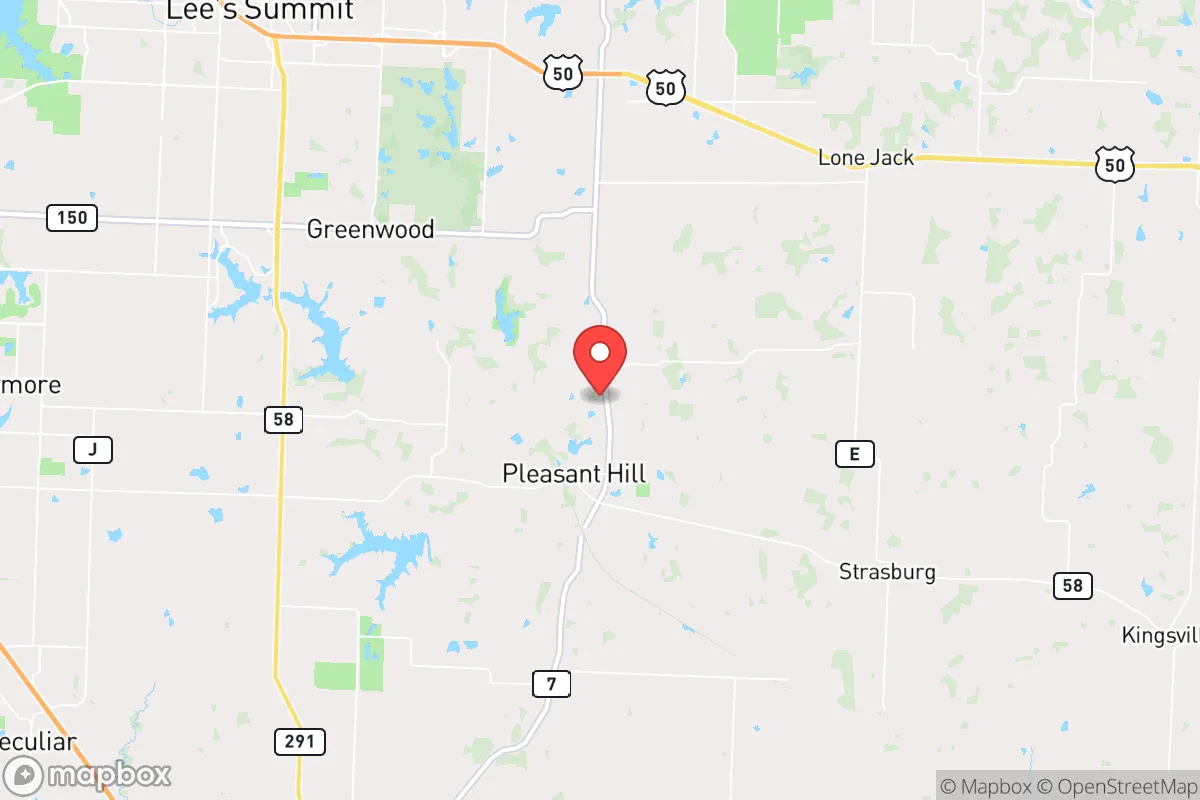
To understand Pleasant Hill’s political climate, it helps to look at its neighbors. Drive 20 minutes north to Lee’s Summit, and you’ll find a much more competitive environment — that city’s PVI is roughly R+5, with pockets like downtown and the Raintree Lake area trending blue in recent cycles. Head east to Warrensburg, home to the University of Central Missouri, and you’ll see a younger, more transient population that nudges the politics toward purple, especially in city council races. Pleasant Hill, by contrast, has none of that. The town’s population is older, whiter, and more rooted in agricultural and trade work than the professional-class suburbs to the north. In the 2024 presidential election, Cass County — which Pleasant Hill anchors — voted 68% Republican, while neighboring Jackson County (Kansas City) went 58% Democratic. That 26-point split is the starkest political boundary in the region, and Pleasant Hill sits squarely on the red side of it.
What this means for residents
For conservative residents, the political climate is a comfortable fit. Local ordinances tend to be minimal — there’s no city income tax, no plastic bag ban, no noise restrictions that would ruffle feathers. The school board has consistently leaned traditional, with curriculum debates rarely making headlines. For liberal residents, the reality is more isolating. There’s no active Democratic club in town, and progressive viewpoints can feel unwelcome at public meetings. That said, the town is not hostile — it’s just homogenous. Most people keep politics out of neighborly interactions, and the local library and community center host events that are genuinely nonpartisan. The practical effect is that if you’re conservative, you’ll feel your vote is well represented; if you’re liberal, you’ll need to drive to Lee’s Summit or Kansas City for any real political community or representation.
One cultural distinction worth noting: Pleasant Hill has a strong “live and let live” streak that tempers its politics. The town’s identity is rooted in self-reliance and small-town practicality, not ideological purity. You’ll find plenty of folks who vote straight-ticket Republican but also support the local farmers market, volunteer at the food pantry, and don’t care who their neighbor votes for. The trajectory I see is a slow, steady reddening — as more conservative-leaning families move out from the core of Kansas City, the R+21 figure may edge toward R+25 by 2030. But the town’s character will likely stay the same: friendly, insular, and quietly certain of its own values, without much appetite for the culture wars that dominate national headlines.

State Political ClimatePolitical Climate in Missouri
State Political AnalysisPolitical Environment in the State
Missouri has been a reliably Republican state for most of the past two decades, carrying a Cook Partisan Voting Index of R+8, meaning it votes about eight points more Republican than the nation as a whole. The state hasn’t backed a Democrat for president since Bill Clinton in 1996, and the GOP now holds supermajorities in both chambers of the state legislature and every statewide office. But this wasn’t always the case—Missouri was a classic bellwether for most of the 20th century, voting for the winner in every presidential election from 1904 to 2004 except 1956. The shift has been driven by a combination of rural realignment, suburban drift, and the collapse of the old Democratic machine in St. Louis and Kansas City.
Urban vs. rural divide
The political map of Missouri is a textbook study in the urban-rural split. The two major metros—St. Louis and Kansas City—are deep blue islands in a sea of red. St. Louis City and County together cast about a quarter of the state’s vote and reliably deliver 60-70% for Democrats. Kansas City’s Jackson County is similarly Democratic, though the suburbs in Clay and Platte counties have become more competitive. The real action is in the fast-growing exurbs and rural areas. St. Charles County, just west of St. Louis, has flipped from a swing county to a solidly Republican stronghold, voting +20 points for Trump in 2024. Greene County (Springfield) is the conservative anchor of the southwest, while Boone County (Columbia) is a notable blue outlier—home to the University of Missouri, it’s the only county outside the two big metros that consistently votes Democratic. The rural “Bootheel” counties in the southeast and the northern plains counties are among the most Republican in the nation, often delivering 75-80% of the vote for GOP candidates. The divide isn’t just about population density—it’s cultural, with the urban cores focused on progressive social policy and the rural areas prioritizing gun rights, agricultural policy, and opposition to federal overreach.
Policy environment
Missouri’s policy environment is shaped by its Republican supermajority and a constitution that gives voters direct power through initiatives. The state has a flat income tax rate of 4.95% (down from 5.4% in 2022, with a trigger to drop to 4.5% if revenue targets are met), and no estate tax. Sales taxes are high, averaging over 8% in most areas, with local add-ons. The state is a “right-to-work” state (though voters repealed the law in 2018 via referendum, the legislature later passed a weaker version), and it has some of the weakest labor union protections in the country. Education policy is a battleground: Missouri has a robust charter school system in St. Louis and Kansas City, but rural districts are struggling with consolidation and funding. The state passed a school choice bill in 2024 that expanded tax-credit scholarships, but it’s still limited compared to states like Florida. Healthcare is a mixed bag—Missouri expanded Medicaid in 2021 via ballot initiative, but the legislature has consistently underfunded the program and added work requirements that are tied up in court. Election laws have tightened: the state now requires photo ID to vote, limits absentee ballot drop boxes, and banned private funding of election administration. On the other hand, Missouri has some of the most permissive gun laws in the country, including permitless carry (passed in 2016) and a “Second Amendment Preservation Act” that purports to nullify federal gun laws.
Recent policy direction
The last five years have seen Missouri move decisively in a conservative direction on nearly every front. In 2021, the legislature passed a near-total abortion ban with no exceptions for rape or incest, which took effect immediately after the Dobbs decision in 2022. A 2024 ballot initiative to restore abortion access failed by a narrow margin, but the issue remains alive. On gun rights, the 2021 Second Amendment Preservation Act (SAPA) was partially struck down by a federal judge in 2023, but the state is appealing, and the law remains a symbolic flashpoint. Parental rights have been a major theme: the 2022 “Parents’ Bill of Rights” requires schools to notify parents of any “sexually explicit” material and prohibits instruction on gender identity in K-3. In 2023, the legislature banned gender-affirming care for minors, overriding a veto from Governor Mike Parson. Property rights are generally strong—Missouri is a “Dillon’s Rule” state, meaning local governments have only the powers explicitly granted by the state, but there’s been a push to limit municipal annexation and eminent domain. On taxes, the 2022 income tax cut was the biggest in state history, and further cuts are likely. Voting access has tightened, but early voting (no-excuse) was expanded in 2022 to a two-week window, a rare bipartisan compromise. The overall direction is clear: Missouri is leaning into cultural conservatism while trying to keep taxes low and regulations light, but the tension between legislative priorities and voter-initiated measures (like Medicaid expansion) suggests the public isn’t always on the same page as the supermajority.
Civil unrest & political movements
Missouri has a history of political flashpoints. The 2014 Ferguson protests, sparked by the police shooting of Michael Brown, were a national watershed and led to a state-level consent decree on police reform in St. Louis County. Since then, the Black Lives Matter movement has remained active in St. Louis and Kansas City, with periodic protests over police shootings and racial justice. On the right, the “Patriot” movement is strong in rural areas, with active “Constitutional Sheriffs” and “Oath Keeper” chapters in the Ozarks and northern Missouri. The 2020 election integrity controversy was intense here—Missouri was one of the first states to create a “election integrity” unit in the attorney general’s office, and there were high-profile audits in St. Louis County that found no significant fraud but fueled ongoing distrust. Immigration politics are less heated than in border states, but there’s a vocal anti-sanctuary city movement; the legislature passed a law in 2023 banning sanctuary policies and requiring local law enforcement to cooperate with ICE. The most visible political movement in recent years has been the fight over abortion—both sides are highly organized, and the 2024 ballot initiative campaign saw massive spending from out-of-state groups. A new resident in St. Louis or Kansas City will see occasional protests and rallies, but in most of the state, political activism is quieter and more focused on local school board meetings and county commission races.
Projection
Over the next 5-10 years, Missouri is likely to remain solidly Republican, but the margins could narrow. The state is growing slowly—about 0.5% per year—and most of that growth is in the conservative exurbs of St. Charles County and the Springfield area. The urban cores of St. Louis and Kansas City are losing population, which hurts Democratic turnout. However, the suburbs are diversifying: St. Louis County’s population is now about 25% Black and growing in Asian and Hispanic communities, which could shift the political calculus in a decade. The biggest wildcard is the ballot initiative process. If Democrats can successfully put abortion rights or marijuana legalization (already passed in 2022) on the ballot, they could drive turnout in urban areas and make statewide races more competitive. The 2024 U.S. Senate race was a 12-point Republican win, but the 2022 governor’s race was only 8 points—still comfortable, but not a blowout. For a new resident, the practical takeaway is that Missouri will continue to be a low-tax, culturally conservative state with strong gun rights and a growing focus on school choice. The urban-rural divide will persist, but the state’s political center of gravity will remain in the exurbs and small towns, not the cities. If you’re moving here, expect a stable, predictable political environment with occasional fireworks over cultural issues, but no major shifts in the overall direction.
For someone relocating to Missouri, the bottom line is this: you’ll find a state that is reliably conservative in its state government, with low taxes and a hands-off regulatory approach, but with deep blue cities that offer a counterbalance on social issues. If you’re a conservative, you’ll feel at home in most of the state, especially in places like Springfield, St. Charles, or Jefferson City. If you’re a liberal, you’ll find your community in St. Louis, Kansas City, or Columbia, but you’ll need to accept that state policy will often run counter to your preferences. The political climate is stable, not volatile—Missouri isn’t a swing state anymore, and it’s not likely to become one soon. What you see now is what you’ll get for the next decade: a red state with blue islands, low taxes, and a legislature that’s willing to push cultural conservatism as far as the courts and the voters will allow.
* Values derived from national, state, county, city and local statistics and may differ in a specific area. Last updated: 2026-10-03T18:54:29.000Z
Narrative content on this page is AI-generated and may contain mistakes. Verify any details that matter before acting on them.
ReloMaps may earn a commission from affiliate links at no extra cost to you.

