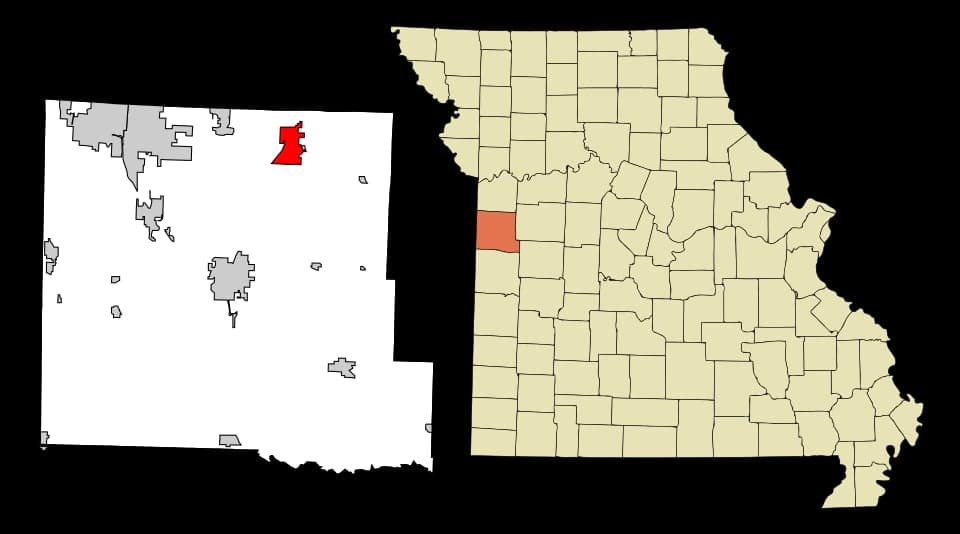
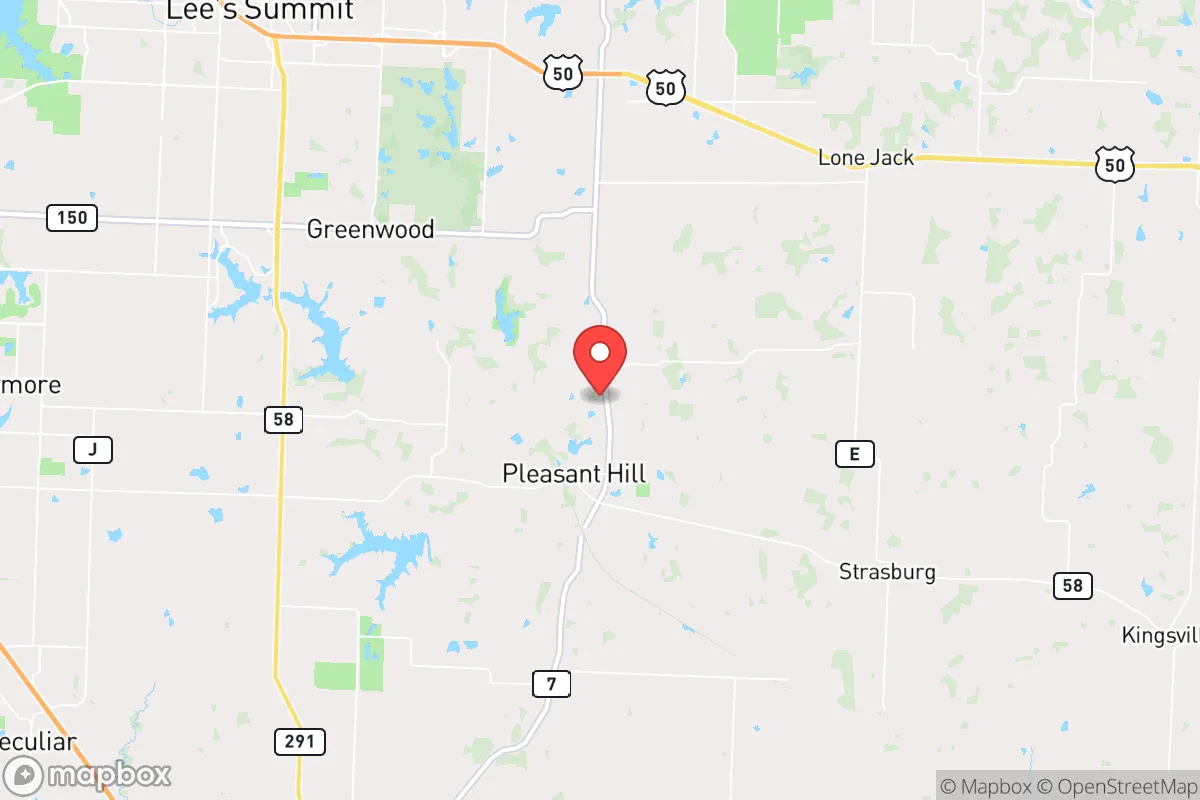
Photo: Wikipedia
Demographics of Pleasant Hill, MO
Affluence Level in Pleasant Hill, MO
A middle-class area roughly in line with national averages across income, home values, education, and employment.
People of Pleasant Hill, MO
The people of Pleasant Hill, Missouri, today number 8,853, forming a predominantly white, family-oriented community with a strong sense of local identity rooted in its railroad and agricultural past. With a foreign-born population of just 0.1% and a 90.4% white demographic, the city remains one of the least ethnically diverse in the Kansas City metro area, though a small but growing Hispanic population (5.3%) represents the most significant recent shift. The city’s character is defined by its quiet, low-crime neighborhoods, a high rate of homeownership, and a population that skews slightly older and less college-educated (28.7%) than the national average, reflecting its working-class and rural heritage.
How the city was settled and grew
Pleasant Hill’s human history begins with its founding in the 1840s by settlers of English, German, and Scotch-Irish descent, drawn by the fertile bottomlands along the Little Blue River. The city’s real growth spurt came after the Civil War, when the Missouri Pacific Railroad established a depot here in 1868, transforming Pleasant Hill into a regional shipping hub for grain, livestock, and timber. The original town plat centered on Downtown Pleasant Hill, where merchants, blacksmiths, and railroad workers built wood-frame homes and storefronts along what is now First and Second Streets. A second wave of German Catholic and Lutheran families arrived in the 1880s, settling the North Side near St. Mary’s Catholic Church and establishing farms that would remain in their families for generations. By 1900, the population had reached roughly 1,500, and the city’s social fabric was largely homogeneous—white, Protestant, and politically conservative—a pattern that held through the Great Depression and World War II.
Modern era (post-1965)
The post-1965 era brought little of the ethnic diversification seen in larger cities. Pleasant Hill’s population grew slowly from about 3,000 in 1970 to 5,000 by 1990, driven almost entirely by white domestic in-migration from rural Cass County and the outer suburbs of Kansas City. The construction of U.S. Highway 58 and the expansion of Missouri Route 7 in the 1980s made the city accessible to commuters, spurring development in the Meadowbrook Addition and Woodland Hills subdivisions, where young families bought affordable ranch-style homes on half-acre lots. These neighborhoods remain overwhelmingly white today, with few non-white residents. The Hispanic population, now 5.3%, began to appear in the 2000s, concentrated in rental properties along Pleasant Hill Road and near the industrial park on the city’s east side, where workers found jobs at the nearby Cargill meatpacking plant in Kansas City. The Black population (0.3%) and East/Southeast Asian population (0.3%) are statistically negligible, with no identifiable ethnic enclaves. The Indian-subcontinent population is 0.0%. The city’s college-educated share (28.7%) lags behind the state average (33%), reflecting a workforce concentrated in manufacturing, logistics, and trades rather than professional services.
The future
Pleasant Hill’s population is projected to grow modestly to roughly 10,000 by 2035, driven by continued white out-migration from the Kansas City core and the appeal of lower housing costs. The Hispanic share is likely to rise slowly, possibly reaching 8-10%, as families move into the Eastgate area near the new elementary school and the South Ridge subdivision, where newer, more affordable homes are being built. However, the city’s overall diversity will remain low by national standards, as the foreign-born population shows no sign of increasing significantly. The cultural identity of Pleasant Hill is evolving from a purely rural railroad town to a bedroom community for Kansas City commuters, but its conservative, family-centric character is likely to persist. Newcomers will find a place where church attendance, high school football, and Fourth of July parades remain central to community life, and where the pace of change is deliberately slow.
For someone moving in now, Pleasant Hill offers a stable, safe, and affordable environment with a clear social code—a place where neighbors know each other, schools are well-regarded, and the population is unlikely to change dramatically in the next decade. It is best suited for families and individuals who value homogeneity, low taxes, and a slower pace of life over urban diversity and cultural amenities.

* Values derived from national, state, county, city and local statistics and may differ in a specific area. Last updated: 2026-10-03T18:54:29.000Z
Narrative content on this page is AI-generated and may contain mistakes. Verify any details that matter before acting on them.
ReloMaps may earn a commission from affiliate links at no extra cost to you.

