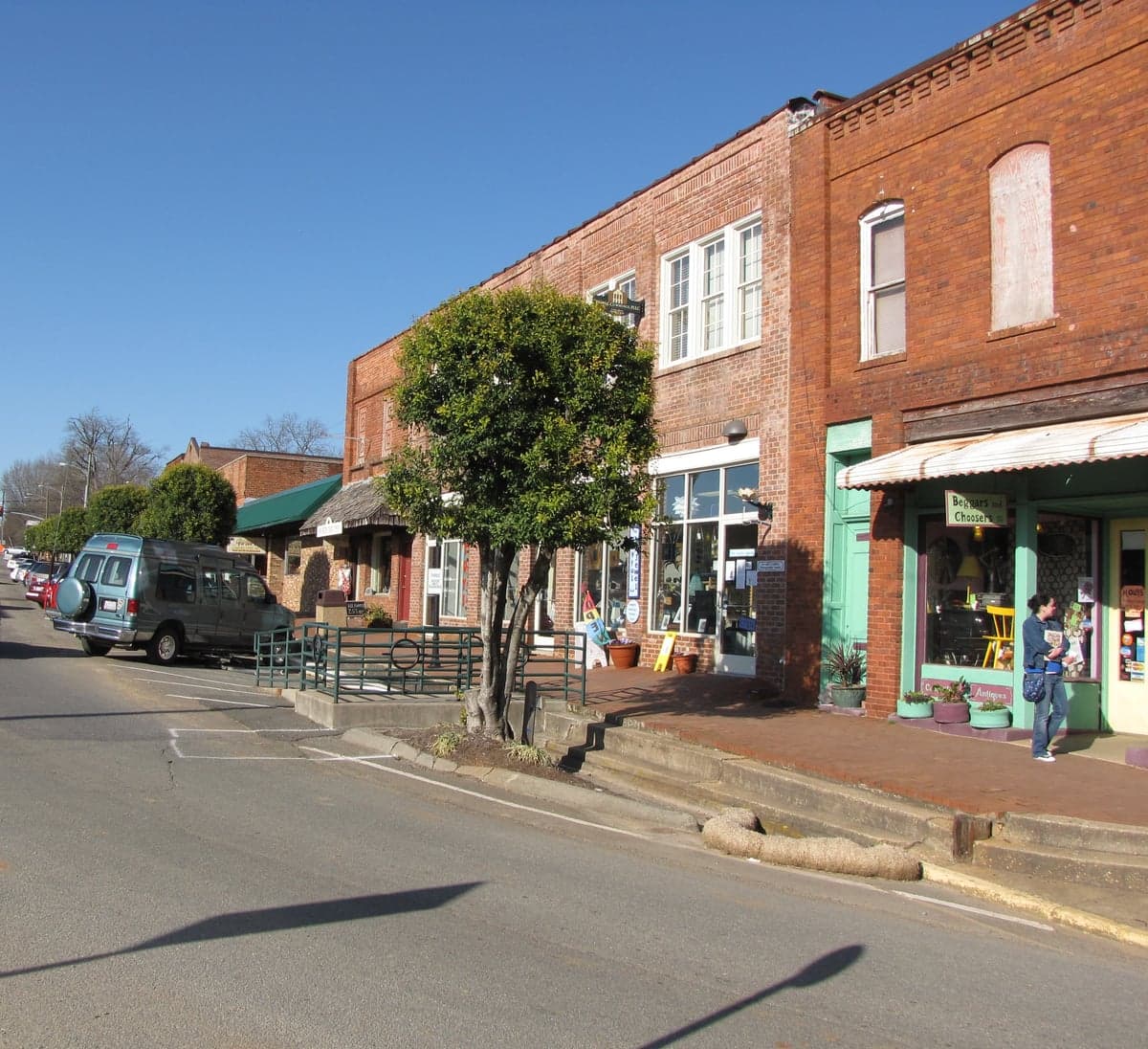
Photo: Wikipedia
Political ClimatePolitical Climate in Pittsboro, NC
District shown is the primary district for this city’s centroid. Cities may span multiple districts.
Inherited from parent county — no local data available.
* Lean and PVI are calculated from the surrounding county’s 2020 and 2024 presidential results, Cook-style — a finer measure here than its congressional district (NC-4).
Political rankings in North Carolina
- Most Conservative Cities in North Carolina
- Most Liberal Cities in North Carolina
- Best Liberal-Leaning Towns in the South
- Best Liberal-Leaning Towns in Appalachia
- Safest Liberal-Leaning Towns in the South
- Safest Conservative-Leaning Towns in the South
- Safest Conservative-Leaning Towns on the East Coast
- Affordable Small Towns for Conservatives
- Most Conservative Counties in North Carolina
- Most Liberal Counties in North Carolina
Local Political AnalysisPolitical Analysis of Pittsboro, NC
Pittsboro has shifted from a sleepy rural county seat into a politically distinct enclave, and the numbers back that up. The town itself carries a Cook Partisan Voting Index (PVI) of D+5, meaning it votes about five points more Democratic than the national average. That’s a stark contrast to the surrounding state of North Carolina, which sits at R+1—a pure toss-up state that leans slightly Republican overall. If you’ve been around here since the 1990s, you’ve watched Pittsboro go from a place where everyone knew everyone’s politics (and most folks kept them quiet) to a town where yard signs for Democratic candidates outnumber Republican ones by a wide margin, especially in the newer subdivisions off Highway 64.
How it compares
Pittsboro’s D+5 lean puts it in a different political universe from most of Chatham County’s rural stretches, where conservative values still hold strong. Drive ten miles west to Siler City, and you’ll find a more working-class, politically mixed community that often votes closer to the state’s R+1 average. Head east toward Cary or Apex, and you’re in Wake County, which is D+2 overall but with pockets of deep blue. The real contrast, though, is with the state as a whole: North Carolina’s R+1 PVI reflects a dead-even split, with rural areas and the Piedmont Triad leaning red while the Research Triangle, Charlotte, and the eastern cities tilt blue. Pittsboro sits right on the edge of that Triangle blue bubble, and its D+5 rating is actually more Democratic than many parts of Raleigh or Durham. That’s a big change from 20 years ago, when the town was reliably red and the county commission rarely saw a contested race.
What this means for residents
For liberal residents, Pittsboro feels like a safe space—local elections are often decided in Democratic primaries, and progressive policies on land use, environmental protection, and public transit get a fair hearing. The town council and county board have moved left in recent cycles, pushing for more affordable housing mandates and renewable energy incentives. For conservative residents, it can feel like swimming against the tide at the local level, but they’re not without influence. The county’s rural precincts still vote Republican, and state-level representation—like in the North Carolina General Assembly—remains firmly in GOP hands, which tempers any local progressive ambitions. In practice, this means you’ll see both “Harris/Walz” and “Trump/Vance” signs on the same street, but the political conversation at the coffee shop or the farmers’ market tends to lean left. Property taxes have crept up as the town invests in parks and sidewalks, a source of friction for longtime homeowners on fixed incomes.
Culturally, Pittsboro’s political shift has brought a few distinct policy distinctions. The town was an early adopter of a plastic bag ban and has a strong local food movement, with the Chatham Mills farmers’ market acting as a de facto community hub. You won’t find a Chick-fil-A in the historic downtown, but you will find a co-op grocery and several farm-to-table restaurants. The county’s school board has become a battleground over library books and curriculum, mirroring state-level fights. Looking ahead, as more remote workers and Triangle commuters move in—drawn by lower home prices and the new Chatham Park development—the D+5 lean could deepen. But the rural-urban divide within Chatham County means Pittsboro will likely remain a blue island in a purple-to-red sea for the foreseeable future, a place where your neighbor’s politics are as predictable as the traffic on 15-501 at rush hour.

State Political ClimatePolitical Climate in North Carolina
State Political AnalysisPolitical Environment in the State
North Carolina is a classic swing state that has been trending rightward in presidential elections, with a Cook PVI of R+1, but it remains deeply competitive and politically complex. Over the last 20 years, the state has shifted from a reliably Republican stronghold in the 2000s to a true battleground, with the GOP winning the presidency here by just 1.3 points in 2024 and Democrats carrying it in 2008. The dominant coalition is a mix of rural conservative voters, suburban moderates, and growing urban liberal populations, creating a state that is neither red nor blue but a patchwork of competing interests.
Urban vs. rural divide
The political map of North Carolina is a textbook case of the urban-rural split. The major metros—Charlotte (Mecklenburg County), Raleigh-Durham (Wake and Durham Counties), and Greensboro-Winston-Salem (Guilford and Forsyth Counties)—are solidly Democratic, driven by tech, finance, and university populations. Charlotte’s banking sector and Raleigh’s Research Triangle Park attract a mix of professionals and transplants who lean left, while Durham is a progressive stronghold with a strong Black political tradition. In contrast, rural and exurban counties like Gaston (west of Charlotte), Johnston (southeast of Raleigh), and Buncombe (Asheville’s home county, which is an island of blue in the mountains) vote heavily Republican. The real battlegrounds are the fast-growing suburban counties like Cabarrus (north of Charlotte) and Union (south of Charlotte), which have flipped from reliably red to competitive as new residents arrive. The coastal counties, including New Hanover (Wilmington), are also shifting, with retirees and remote workers making them more purple.
Policy environment
North Carolina’s policy environment is a mix of conservative governance and pragmatic moderation. The state has a flat income tax rate of 4.5% (down from 7% in 2013), with a scheduled reduction to 3.99% by 2027, making it attractive for high earners. Sales tax is 4.75% statewide, with local add-ons up to 2.5%. Property taxes are low relative to the national average, with a median effective rate of 0.78%. The state is a right-to-work state with no public-sector collective bargaining, and it has a Republican-controlled General Assembly that has consistently passed business-friendly deregulation. Education policy is a flashpoint: the state funds a private school voucher program (the Opportunity Scholarship Program) that has expanded significantly since 2023, and it has a charter school cap that was lifted in 2011. Healthcare is mixed—the state expanded Medicaid in 2023 under a bipartisan deal, but it still has one of the highest uninsured rates in the country. Election laws are moderately restrictive: voter ID is required (passed in 2018, implemented in 2023), early voting is generous (17 days), and same-day registration is not allowed. The state has no abortion ban after 12 weeks (as of 2023), but a 12-week limit with exceptions is in effect, and there is a 72-hour waiting period.
Recent policy direction
Over the last five years, North Carolina has moved decisively to the right on several fronts. In 2023, the Republican supermajority passed a 12-week abortion ban (SB 20), overriding Governor Roy Cooper’s veto, and also enacted a permitless carry law for handguns (HB 189), making it a constitutional carry state. On education, the state expanded its school voucher program to include all families, regardless of income, and passed a Parents’ Bill of Rights (HB 755) in 2023, which requires schools to notify parents about curriculum changes and restricts instruction on gender identity in K-4. On election integrity, the state implemented voter ID and tightened absentee ballot rules (SB 747), including banning the private funding of elections. On property rights, the state has no statewide rent control and has preempted local governments from enacting it. On privacy and surveillance, the state has no broad data privacy law, but it does have a biometric privacy law (2023) that requires consent for facial recognition. On medical and bodily autonomy, the state has a 12-week abortion limit but no restrictions on IVF or contraception. On speech, the state has no hate crime law that covers sexual orientation or gender identity (though it does cover race and religion), and it has a campus free speech law (2017) that protects expressive activity at public universities. The overall direction is toward more conservative governance, but with a pragmatic streak—Medicaid expansion passed with bipartisan support, and the state has not pursued a full abortion ban.
Civil unrest & political movements
North Carolina has a history of visible political activism. The 2020 protests in Charlotte and Raleigh over George Floyd’s death were large but largely peaceful, though there were some property damage incidents. The state has a strong organized left, with groups like the NC NAACP and the Poor People’s Campaign active, and a robust right, including the NC GOP and grassroots groups like the John Locke Foundation. Immigration politics are a flashpoint: the state has no sanctuary city policies, and several counties, including Wake and Mecklenburg, have been sued over their cooperation with ICE. Election integrity controversies have been a major theme since 2020, with the state’s 9th Congressional District race in 2018 being overturned due to absentee ballot fraud (a Republican operative was convicted). The state has also seen debates over Confederate monuments, with the 2015 law (HB 2) that protected them being partially repealed in 2020. A new resident would notice that political bumper stickers and yard signs are common, and that local news covers state politics heavily. The state has a strong tradition of civic engagement, with high voter turnout in presidential years (around 70%).
Projection
Over the next 5-10 years, North Carolina is likely to remain a competitive swing state, but with a slight rightward tilt. The key demographic shift is in-migration: the state is growing by about 100,000 people per year, mostly from the Northeast and Midwest, and these newcomers tend to be more moderate or conservative than the native urban populations. The suburbs of Charlotte and Raleigh are growing fastest, and they are trending purple rather than blue. The rural areas are losing population, which will reduce the GOP’s base but not eliminate it. The state’s Republican supermajority is likely to persist through 2028, given gerrymandered maps, but the governor’s race in 2024 (won by Democrat Josh Stein) shows that statewide races remain competitive. Expect continued fights over abortion, education, and taxes, with the GOP pushing for further tax cuts and voucher expansion, and Democrats focusing on Medicaid and public school funding. The state is unlikely to become a deep red state like Tennessee or a blue state like Virginia—it will remain a battleground, but with a conservative lean in state policy.
For a new resident, the bottom line is that North Carolina offers a low-tax, business-friendly environment with a strong economy and a high quality of life, but it is politically divided. If you lean conservative, you’ll find a state government that aligns with your views on taxes, guns, and education, but you’ll need to navigate liberal cities. If you lean liberal, you’ll find vibrant urban communities and a competitive political landscape, but you’ll face a state government that is often hostile to your priorities. The state is a place where your vote matters, and where the political climate is shaped by constant negotiation between two powerful coalitions.
* Values derived from national, state, county, city and local statistics and may differ in a specific area. Last updated: 2026-11-13T01:55:02.000Z
Narrative content on this page is AI-generated and may contain mistakes. Verify any details that matter before acting on them.
ReloMaps may earn a commission from affiliate links at no extra cost to you.

