Photo: Wikipedia
Demographics of Pittsboro, NC
Affluence Level in Pittsboro, NC
A middle-class area roughly in line with national averages across income, home values, education, and employment.
People of Pittsboro, NC
Pittsboro, North Carolina, is a small town of 4,640 residents that blends historic Southern roots with a growing, educated professional class. The population is 70.0% White, 17.7% Black, and 9.1% Hispanic, with a notably high college attainment rate of 42.6% — well above the national average. The town’s character is defined by its role as the Chatham County seat, a historic courthouse square, and an influx of newcomers drawn to its proximity to the Research Triangle Park (RTP) and the Haw River. Pittsboro today feels like a place in transition: still deeply local, but increasingly shaped by commuters, retirees, and families seeking a slower pace within reach of urban jobs.
How the city was settled and grew
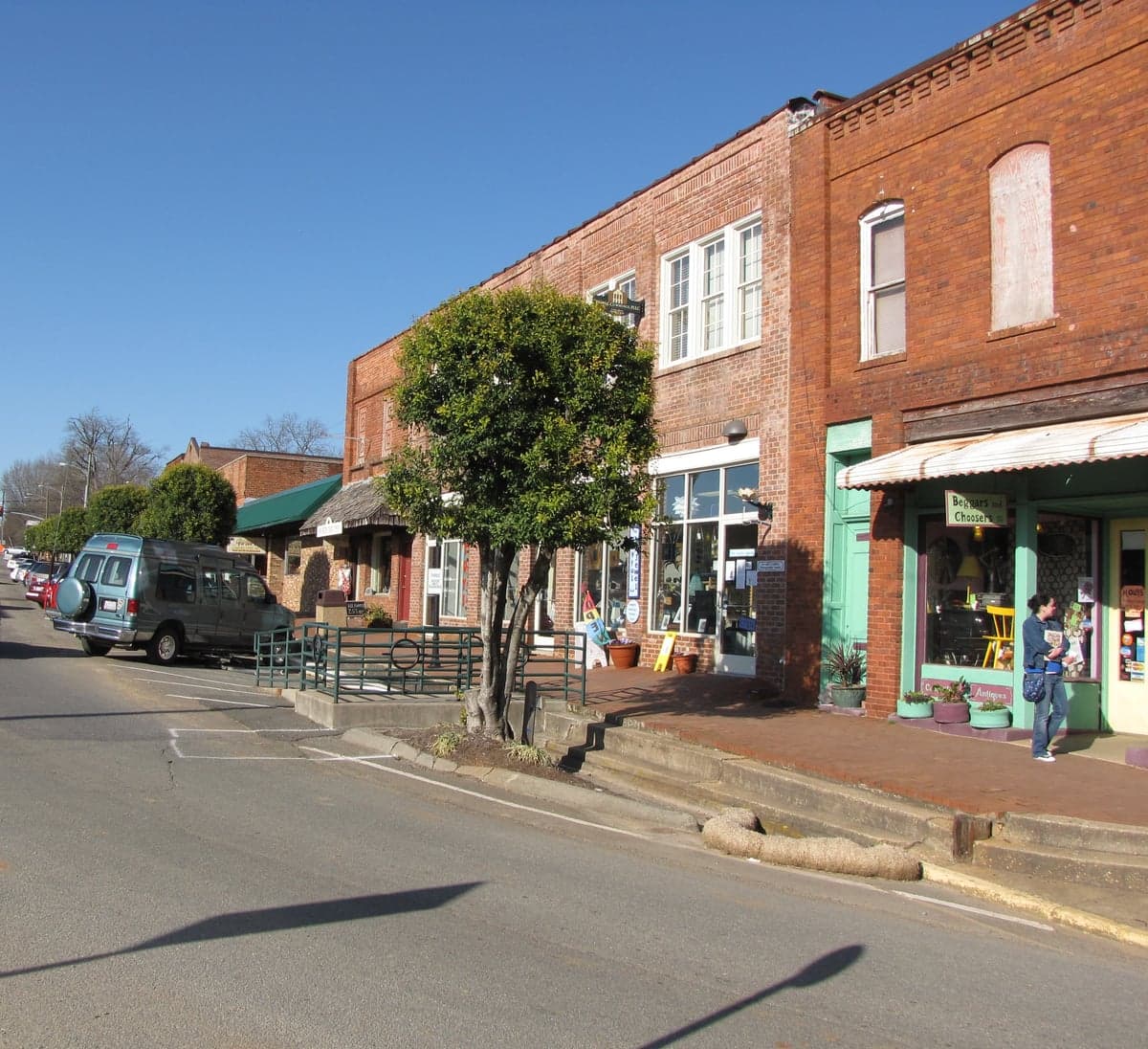
Pittsboro was founded in 1787 as the county seat of newly formed Chatham County, named after William Pitt the Elder. The original population was overwhelmingly English and Scots-Irish farmers who received land grants in the Piedmont region, drawn by fertile soil and the promise of self-sufficient homesteads. The town’s early economy revolved around agriculture — primarily tobacco and cotton — and the county courthouse, which anchored a small commercial district. The historic Downtown Pittsboro district, centered on the 1881 Chatham County Courthouse, was built by these early settlers and remains the town’s symbolic heart. Enslaved Black laborers were also present from the start, working the plantations and farms that surrounded the town; after the Civil War, many of their descendants formed the core of Pittsboro’s Black community, concentrated in the West Pittsboro neighborhood along West Street and around the former Chatham Colored School. By 1900, Pittsboro’s population hovered around 1,000, with a small but stable Black majority in the surrounding rural areas. The arrival of the railroad in the early 1900s brought a modest wave of German and Irish merchants, who settled near the depot in the Railroad District along East Street, but Pittsboro remained a sleepy agricultural hub through the mid-20th century.
Modern era (post-1965)
The 1965 Hart-Cellar Immigration Act had little direct effect on Pittsboro — the town’s foreign-born population today is just 4.8%, and East/Southeast Asian residents are statistically absent (0.0%). Instead, the major demographic shift came from domestic in-migration after 1990, driven by the explosive growth of RTP 30 miles north. Professionals and families, predominantly White and college-educated, began moving to Pittsboro for its lower housing costs, rural character, and proximity to jobs at companies like IBM, GlaxoSmithKline, and SAS. This wave settled primarily in newer subdivisions on the town’s periphery, such as Briar Chapel (a large, master-planned community just south of town) and Governors Village near U.S. 64. These neighborhoods are overwhelmingly White and affluent, with home values often exceeding $400,000. Meanwhile, Pittsboro’s Black population, which had been a larger share historically, declined to 17.7% as younger generations moved to larger cities for opportunity. The Hispanic population grew to 9.1%, largely driven by immigrant labor in construction, landscaping, and agriculture; these families have concentrated in the East Pittsboro area near the Haw River and along U.S. 64 Business, where older, more affordable housing stock exists. The Indian subcontinent population remains tiny at 0.4%, reflecting the town’s limited draw for high-skilled tech immigrants compared to nearby Cary or Morrisville.
The future
Pittsboro’s population is projected to grow significantly over the next decade, driven by continued spillover from RTP and the completion of the Chatham Park development — a massive 7,500-acre mixed-use project that will eventually add tens of thousands of residents. This growth is likely to make the town more White and more affluent, as new housing is predominantly single-family homes priced for professionals and retirees. The Hispanic share may hold steady or grow modestly, supported by service-sector jobs in construction and hospitality, but the Black population share is expected to continue its gradual decline unless affordable housing policies are implemented. The town’s cultural identity is shifting from a quiet, historically Black-and-White Southern county seat to a more diverse, educated, and politically moderate community — though it remains less diverse than the Triangle core. New residents are dispersing across the Chatham Park footprint and into subdivisions like Briar Chapel, while Downtown Pittsboro is seeing revitalization with breweries, boutiques, and farm-to-table restaurants that cater to the incoming demographic. The next 10-20 years will likely see Pittsboro become a bedroom suburb with a preserved historic core, but one where the cost of entry — and the cultural center of gravity — continues to rise.
For someone moving in now, Pittsboro offers a small-town feel with strong access to RTP jobs, but it is not a diverse or globally connected community. The town is becoming whiter, wealthier, and more educated, with a growing professional class that values its historic character and natural surroundings. Newcomers should expect a place that is welcoming but increasingly expensive, where the old Southern rhythms are giving way to a commuter-driven lifestyle.

* Values derived from national, state, county, city and local statistics and may differ in a specific area. Last updated: 2026-11-13T01:55:02.000Z
Narrative content on this page is AI-generated and may contain mistakes. Verify any details that matter before acting on them.
ReloMaps may earn a commission from affiliate links at no extra cost to you.

