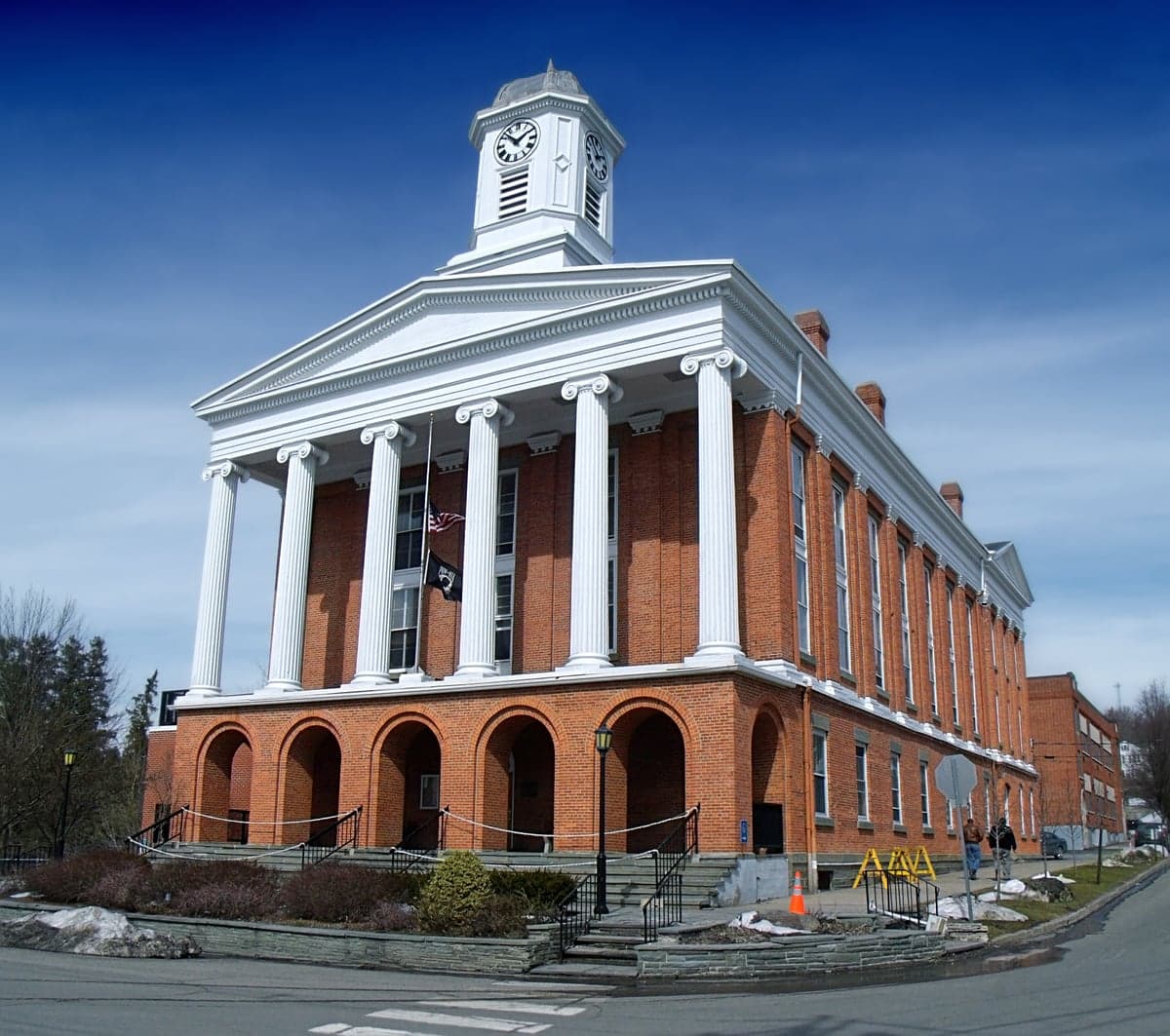
Photo: Wikipedia
Political ClimatePolitical Climate in Susquehanna County
Showing county-level results — no local-only data available.
Lean and PVI are calculated from this county’s 2020 and 2024 presidential results, Cook-style.
Political rankings in Pennsylvania
- Most Conservative Cities in Pennsylvania
- Most Liberal Cities in Pennsylvania
- Best Conservative-Leaning Towns in the Northeast
- Best Conservative-Leaning Towns in the Mid-Atlantic
- Most Affordable Liberal-Leaning Small Towns in the U.S.
- Safest Liberal-Leaning Cities in the U.S.
- Most Conservative Counties in Pennsylvania
- Most Liberal Counties in Pennsylvania
Local Political AnalysisPolitical Analysis of Susquehanna County
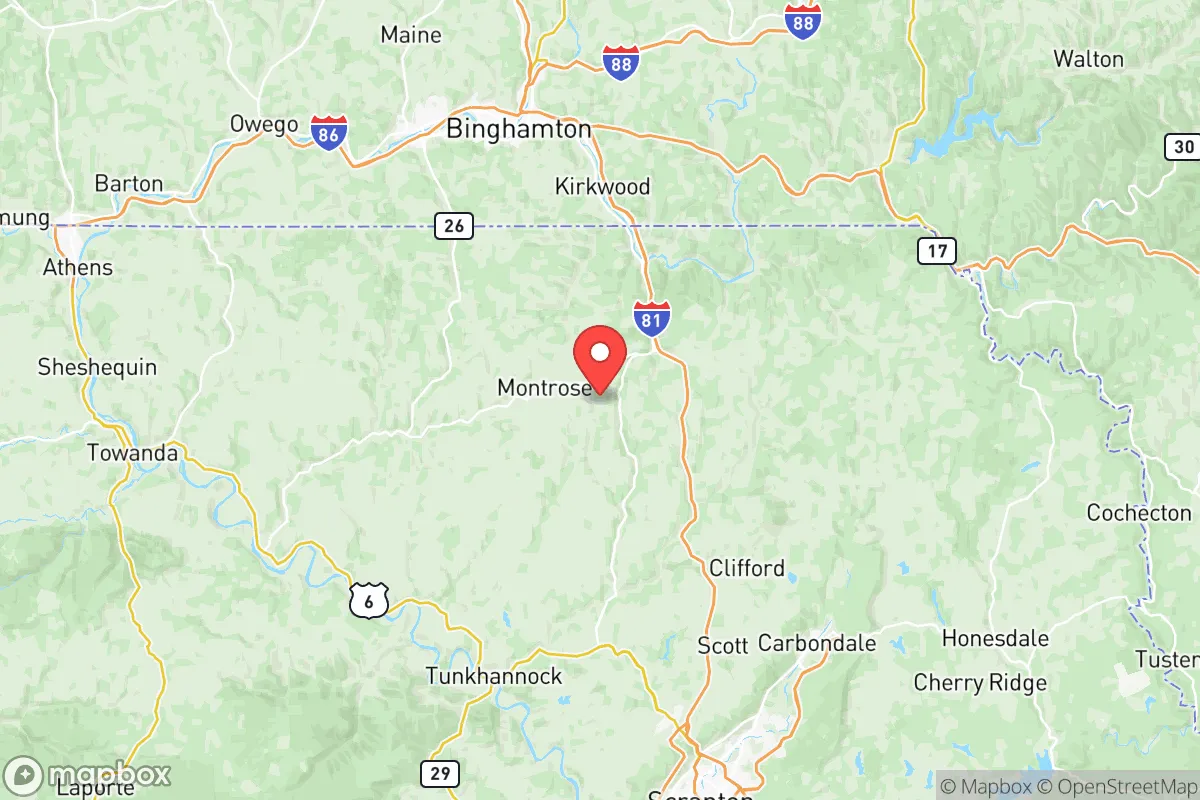
Susquehanna County is one of the most reliably Republican counties in northeastern Pennsylvania, with a Cook Partisan Voting Index (PVI) of R+22, meaning it votes about 22 points more Republican than the national average. This stands in stark contrast to the state of Pennsylvania as a whole, which sits at a Cook PVI of EVEN—a pure swing state. The county has been trending redder for decades, and while it was once a Democratic stronghold in the mid-20th century, it has not voted for a Democratic presidential candidate since Lyndon Johnson in 1964. In 2024, Donald Trump carried the county by a margin of roughly 65% to 33%, a gap that has widened since his 2016 victory here.
How it compares
The political gap between Susquehanna County and the rest of Pennsylvania is stark. While the state as a whole is a battleground where both parties invest heavily, Susquehanna County is a deep-red island. The county's R+22 PVI is more than double the lean of neighboring Wyoming County (R+10) and significantly redder than Lackawanna County (D+8) to the south. However, there is meaningful variation within the county itself. The borough of Montrose, the county seat, is the most moderate area—it has a small but persistent Democratic base, often voting within 5-8 points of the countywide average. In contrast, the townships of Forest Lake and Brooklyn are among the most conservative, regularly delivering 75-80% of their votes to Republican candidates. The swing precincts are in the more populated areas around New Milford and Great Bend, where independent voters and a handful of union households can shift a local race by 5-10 points. The county's trajectory is clear: as older, more moderate Democrats retire or move away, and as younger families move in from the Scranton/Wilkes-Barre area seeking lower taxes and more land, the Republican margin has only grown.
What this means for residents
For conservative residents, the political climate is comfortable and affirming. Local government, school boards, and county commissions are overwhelmingly Republican, meaning policy tends to favor low taxes, limited regulation, and Second Amendment rights. The county's Republican Committee is active and well-organized, with a strong presence at local events and in the Montrose area. For liberal residents, the reality is more isolating. There is no organized Democratic Party presence in most townships, and progressive candidates rarely run for local office. However, the county's small size means that personal relationships often transcend party lines—neighbors help each other regardless of political affiliation. The practical impact is that property taxes remain among the lowest in the state, but public services like road maintenance and broadband expansion are slower to arrive than in more competitive areas. The county's political homogeneity also means that national issues like abortion or gun control rarely dominate local conversation; instead, residents focus on school funding, property taxes, and the local dairy and timber economy.
Culturally, Susquehanna County is distinct from the rest of Pennsylvania in its rural, small-town character. There is no major city, no interstate highway, and no large employer—the economy is driven by agriculture, small manufacturing, and commuting to Scranton or Binghamton, NY. This isolation fosters a strong sense of self-reliance and a wariness of state-level mandates, whether from Harrisburg or Washington. The county's political lean is not just about party affiliation; it reflects a deep-seated preference for local control and a suspicion of centralized authority. For a liberal resident, this can feel stifling, but for a conservative, it feels like home. The trajectory is toward even deeper red, as the county's population slowly ages and younger, more conservative families replace the few remaining Democratic-leaning households. If you're moving here, understand that your vote will likely be in the minority if you lean left, but your voice will still be heard in local town hall meetings—just don't expect to win many elections.

State Political ClimatePolitical Climate in Pennsylvania
State Political AnalysisPolitical Environment in the State
Pennsylvania is the ultimate swing state, with a Cook PVI of EVEN that perfectly captures its knife-edge balance. Over the last 20 years, the state has shifted from a reliably blue-leaning battleground (voting for Democrats in every presidential election from 1992 to 2012) to a true toss-up, with Donald Trump winning it in 2016 and Joe Biden narrowly flipping it back in 2020. The dominant coalition is a three-way standoff: the heavily Democratic, union-heavy Philadelphia and Pittsburgh metros; the increasingly Republican exurbs and rural small towns; and the fast-growing, politically mixed suburbs of the I-95 and I-78 corridors. This isn't a state that's trending decisively in one direction — it's a state where every election is a knife fight, and the outcome depends on which side turns out in places like Erie, Allentown, and Scranton.
Urban vs. rural divide
The political map of Pennsylvania is a textbook case of the urban-rural split. Philadelphia and its collar counties (Montgomery, Delaware, Chester, Bucks) are the engine of the Democratic vote — in 2020, Biden won Philadelphia County by over 80 points, and the four suburban counties gave him a combined margin of roughly 400,000 votes. Pittsburgh and Allegheny County are similarly blue, though with a smaller population. The rural spine of the state — the northern tier from Erie to the Poconos, the central Susquehanna Valley, and the southwestern coal country — is deep red. In 2020, Trump won counties like Tioga, Potter, and Fulton by 70-80 points. The real battlegrounds are the "collar counties" that aren't quite suburbs: places like Luzerne County (Wilkes-Barre), which flipped from Obama to Trump and stayed red; Erie County, which went for Obama twice, then Trump, then Biden; and Northampton County (Bethlehem), which has been a bellwether for decades. The Lehigh Valley (Allentown, Bethlehem, Easton) is the state's most competitive region — a mix of old industrial towns, growing Hispanic populations, and commuters to New York and Philadelphia.
Policy environment
Pennsylvania's policy environment is a patchwork of competing priorities. The state has a flat income tax of 3.07%, one of the lowest in the nation, and a sales tax of 6% (8% in Philadelphia and Allegheny County). Property taxes are high — among the top 10 in the country — and vary wildly by district. There is no state-level right-to-work law, and union membership remains strong in the public sector and construction trades. Education policy is decentralized: school funding was ruled unconstitutional in 2023, and the legislature is still fighting over a new formula. Charter schools are popular in Philadelphia but face resistance from teachers' unions. Election laws are relatively moderate: no-excuse mail-in voting was enacted in 2019 (Act 77), but the legislature has not passed voter ID requirements beyond the existing photo ID law for first-time voters. Gun laws are a flashpoint: Pennsylvania has preemption (localities cannot pass their own gun ordinances), but it also has a universal background check requirement for handguns and a "red flag" law (Act 79 of 2023) that allows temporary seizure of firearms from individuals deemed a threat. There is no permit required to carry a concealed firearm (constitutional carry was not passed, but the state is "shall issue" for permits).
Recent policy direction
Over the past five years, Pennsylvania has moved in a mixed direction that reflects its divided government. On gun and self-defense law, the 2023 red flag law (Act 79) was a major win for gun-control advocates, but the legislature has repeatedly blocked "universal" background checks for long guns and any form of magazine capacity limits. On parental and education rights, the 2022 "Parental Rights" bill (HB 1601) was introduced but never passed; instead, the state has seen a surge in school board activism, with conservative parents winning seats in districts like Central Bucks and Pennridge over curriculum and library content. On medical and bodily autonomy, abortion remains legal up to 24 weeks (codified by a 2023 state Supreme Court ruling), but the legislature has passed a 24-hour waiting period and mandatory counseling. On voting and ballot access, Act 77 (2019) made mail-in voting permanent, but the legislature has not funded pre-canvassing (processing ballots before Election Day), leading to delays in 2020 and 2022. On property rights, the state has no statewide zoning reform, but Philadelphia and Pittsburgh have passed "missing middle" housing bills to allow duplexes and triplexes in single-family zones. On privacy and surveillance, the state has no comprehensive data privacy law, but a 2023 bill (HB 1201) to create a consumer data privacy framework is stalled in committee.
Civil unrest & political movements
Pennsylvania has been a focal point for political activism on both sides. The 2020 election aftermath saw massive protests in Philadelphia and Harrisburg, with Trump supporters gathering at the state capitol to challenge the results. The "Stop the Steal" movement was particularly strong in rural counties like York and Lancaster, where local GOP officials held "audits" of voting machines. On the left, the 2020 George Floyd protests in Philadelphia were among the largest in the country, and the city has seen ongoing activism around police reform and defunding. Immigration politics are less visible than in border states, but the 2023 busing of migrants from Texas to Philadelphia and New York sparked protests and counter-protests. There is no sanctuary state law, but Philadelphia is a "sanctuary city" (limits cooperation with ICE). Election integrity remains a live issue: the 2022 gubernatorial race featured a far-right candidate (Doug Mastriano) who advocated for decertifying voting machines, and the 2024 primary saw a surge in "election integrity" candidates for county commissioner and judge of elections. The most visible flashpoint for a new resident would be the constant political yard signs and the intensity of local school board races — in many suburbs, these are now proxy wars for national politics.
Projection
Over the next 5-10 years, Pennsylvania is likely to remain a swing state, but the demographic trends are slowly favoring Democrats. The Philadelphia suburbs are growing and diversifying, while the rural counties are aging and shrinking. The Hispanic population, concentrated in the Lehigh Valley and Philadelphia, is growing rapidly and leans Democratic, though not as heavily as national averages. The biggest wild card is the exurban shift: counties like Lancaster and York are growing fast with commuters from the I-95 corridor, and these new arrivals tend to be more moderate than the rural base. The state's electoral college votes (19) will remain critical, and the state will likely see more mail-in voting and early voting as both parties adapt. The biggest risk for conservatives is that the Philadelphia suburbs continue to drift left, while the biggest risk for liberals is that rural turnout surges in a high-stakes election. A new resident moving in now should expect a state where every election is close, where local politics are increasingly nationalized, and where the outcome depends on a few thousand votes in places like Erie and Northampton.
For a new resident, the bottom line is that Pennsylvania offers a genuinely competitive political environment where your vote matters. Conservatives will find a state with low income taxes, strong gun rights (with some restrictions), and a vibrant school choice movement, but they will also face a Democratic governor (Josh Shapiro) and a state Supreme Court that leans left on abortion and voting rights. Liberals will find a state with strong union protections, legal abortion, and a growing urban base, but they will also face a Republican-controlled legislature that blocks most progressive priorities. The practical takeaway: if you want to live in a place where politics is a contact sport and your vote actually decides elections, Pennsylvania is the best state in the country. If you want a settled political environment where one party dominates, look elsewhere.
* Values derived from national, state, county, city and local statistics and may differ in a specific area. Last updated: 2026-11-18T06:27:31.000Z
Narrative content on this page is AI-generated and may contain mistakes. Verify any details that matter before acting on them.
ReloMaps may earn a commission from affiliate links at no extra cost to you.

