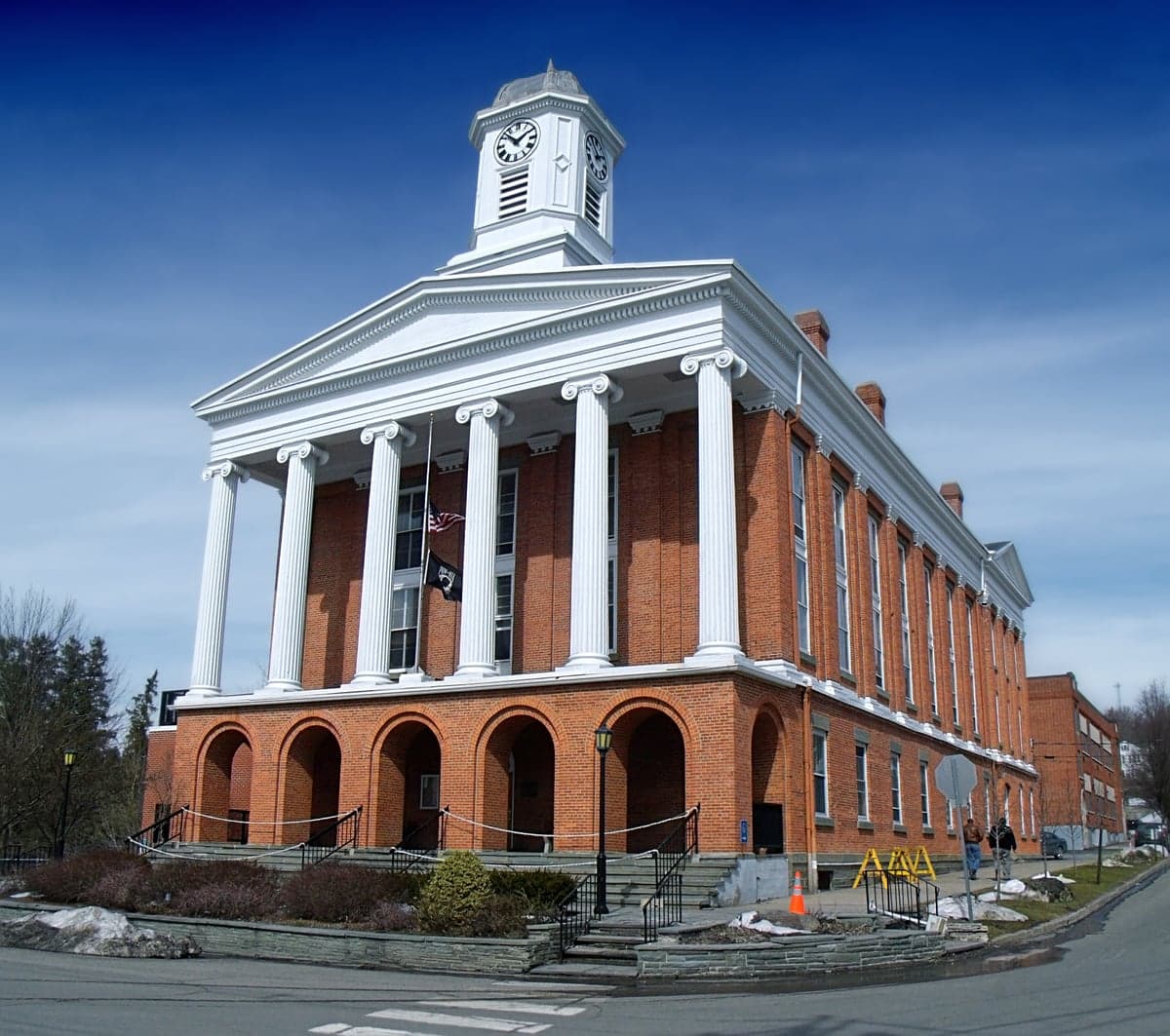
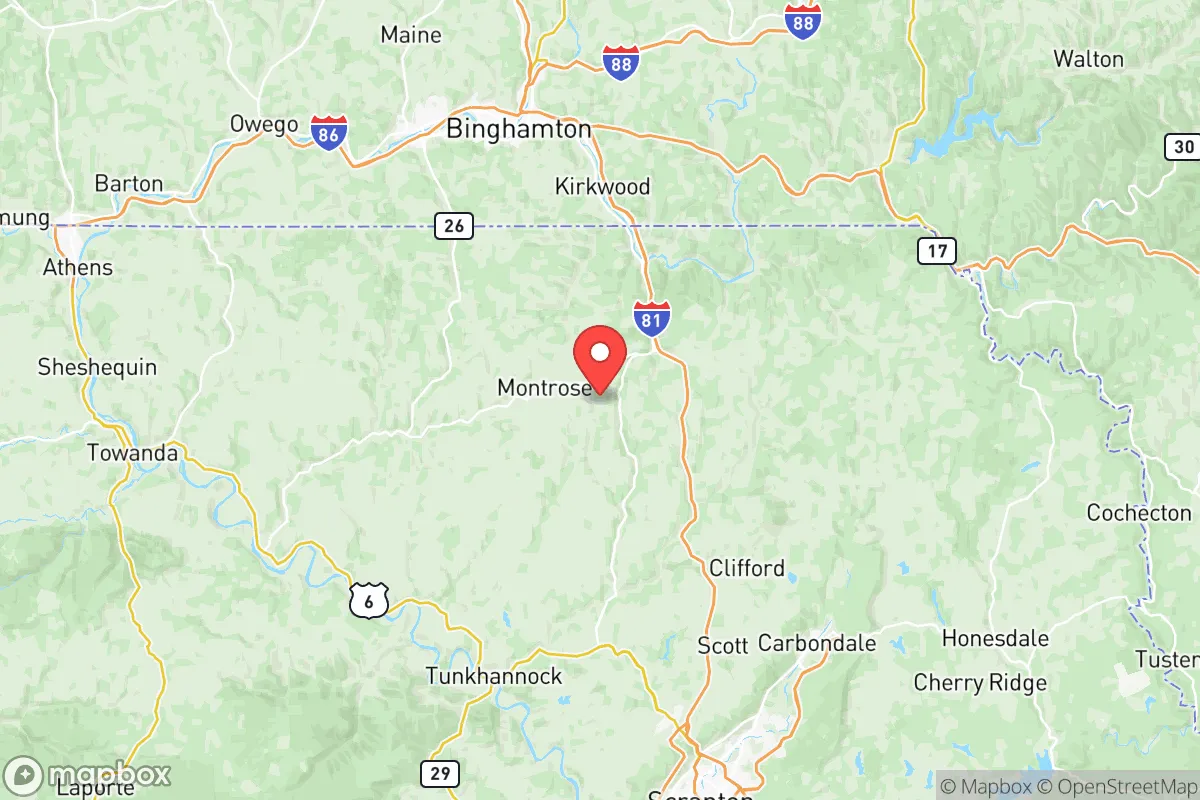
Photo: Wikipedia
Demographics of Susquehanna County
Affluence Level in Susquehanna County
A middle-class area roughly in line with national averages across income, home values, education, and employment.
People of Susquehanna County
The people of Susquehanna County, Pennsylvania today number 38,349, forming one of the most ethnically homogeneous populations in the northeastern United States. With a population that is 94.5% white and only 0.8% foreign-born, the county retains a distinctly rural, northern Appalachian character shaped by centuries of settlement from the British Isles and Germany. This is a place where family roots run deep, where the landscape of rolling hills and small towns like Montrose, Forest City, and Susquehanna Depot still bears the imprint of the 19th-century waves that built it, and where the population is slowly aging and declining rather than diversifying.
Settlement & growth (pre-1960)
Long before European settlers arrived, the region that is now Susquehanna County was part of the hunting and trading territory of the Susquehannock people, an Iroquoian-speaking nation. By the early 1700s, the Susquehannock had been largely displaced by warfare and disease, and the land became contested between the Haudenosaunee (Iroquois Confederacy) to the north and the Lenape to the south. European incursion was slow: the area was part of the Connecticut Susquehanna Company's claim in the late 1700s, and the first permanent white settlers—primarily of English and Scots-Irish stock—arrived in the 1780s and 1790s, pushing up the Susquehanna River valley from the south.
The county was formally created from Luzerne County in 1810, and its early economy was built on subsistence farming, lumber, and small-scale milling. The first major settlement was Montrose, established as the county seat in 1812 on a hilltop site chosen for its central location. The early population was overwhelmingly of English and Scots-Irish descent, with a smattering of German families who had migrated north from Berks and Lancaster counties. These were not immigrants fresh off the boat but second- and third-generation Americans moving inland from the older coastal settlements.
The transformative wave came with the arrival of the railroad. The Erie Railroad pushed through the northern tier of the county in the 1840s and 1850s, and the town of Susquehanna Depot (now simply Susquehanna) boomed as a major rail repair and maintenance center. This industrial growth drew a new wave of immigrants: Irish laborers arrived in the 1850s to build the tracks, followed by German and Italian workers who staffed the rail yards and the growing number of coal mines and stone quarries in the region. The town of Forest City, in the county's northeast corner, became a hub for the anthracite coal industry, attracting a substantial population of Welsh, Irish, and later Eastern European miners. By 1900, the county's population had peaked at over 42,000, with small but distinct ethnic enclaves in the industrial villages: Irish in Susquehanna Depot, Italians in Hallstead and Great Bend, and a scattering of Polish and Slovak families in the mining patches around Forest City and Lanesboro.
Agriculture remained the backbone of the county's identity, particularly dairy farming. The rolling hills and fertile valleys around Brooklyn, Hop Bottom, and Harford were settled by families of English and German descent who established prosperous farms that many of their descendants still operate today. The region also became a destination for a small number of African American families in the late 19th century, primarily domestic workers and laborers who settled in Montrose and Susquehanna, though their numbers never exceeded a few hundred. The county's population held relatively steady through the early 20th century, but the decline of the coal industry after World War I and the contraction of rail operations in the 1950s triggered a slow, steady outmigration that has never fully reversed.
Modern era (post-1965)
The 1965 Hart-Cellar Act, which reshaped American immigration by opening doors to Asia, Africa, and Latin America, had virtually no impact on Susquehanna County. The foreign-born population today stands at just 0.8%, one of the lowest rates in Pennsylvania. The county did not attract the post-1965 immigrant waves that transformed nearby urban centers like Scranton or Binghamton, New York. Instead, the modern demographic story is one of domestic outmigration and gradual aging.
The county's Hispanic population, at 2.3%, is the largest minority group, but it is a recent and still-small presence. Most Hispanic residents are of Puerto Rican or Mexican descent, drawn by low housing costs and seasonal agricultural work, and they are concentrated in and around Montrose and the southern townships near the Lackawanna County line. The East/Southeast Asian population, at 0.4%, is tiny and consists mostly of a handful of families in the medical and academic sectors, with no discernible enclave. The Black population, at 0.2%, has actually declined from its already-small historical numbers, as younger African American residents have left for urban job markets. The Indian subcontinent population is effectively zero.
The most significant demographic shift since 1965 has been domestic: the county has become a destination for a modest number of retirees and second-home buyers from the New York City and northern New Jersey metropolitan area, drawn by cheap land and the rural aesthetic. This "exurban" migration has concentrated in the southern tier of the county, particularly around New Milford and Harford, where lakefront properties and wooded lots have attracted families seeking a weekend retreat or a lower-cost retirement. These newcomers are overwhelmingly white and middle-to-upper-middle-class, and they have not significantly altered the county's racial composition. Meanwhile, the county's native-born young people continue to leave for college and careers in Scranton, Wilkes-Barre, and beyond, contributing to a population that has declined from a post-war peak of roughly 40,000 to its current 38,349.
The future
Susquehanna County is not becoming more diverse. The demographic trajectory points toward continued slow population decline, further aging, and a white share that remains above 94% for the foreseeable future. The county's college-educated share, at 19.8%, is well below the state average, and the lack of major employers—the largest industries are healthcare, education, and manufacturing—means that few educated newcomers are drawn to the area. The county's Hispanic population may grow modestly as agricultural and service-sector jobs attract more families, but it is unlikely to exceed 5% in the next decade.
The most notable trend is the continued in-migration of remote workers and retirees from the New York metro area, accelerated by the post-2020 shift to hybrid work. These newcomers are concentrated in the southern half of the county, particularly around Clifford and Lenox townships, where fiber-optic internet has been expanded. They tend to be politically moderate to conservative, fitting comfortably into the county's existing cultural landscape. The northern industrial towns—Susquehanna, Forest City, Hallstead—continue to lose population as the rail and coal economies recede into memory.
For someone moving in now, Susquehanna County offers a stable, culturally traditional rural environment where community ties are strong and change comes slowly. The population is overwhelmingly white, native-born, and aging, with little of the ethnic or religious diversity found in suburban or urban Pennsylvania. The county is not a place of demographic dynamism or growth, but for those seeking a quiet, affordable, and historically rooted corner of the Northeast, it remains what it has been for two centuries: a landscape of small farms, small towns, and families who have been here for generations.

* Values derived from national, state, county, city and local statistics and may differ in a specific area. Last updated: 2026-11-18T06:27:31.000Z
Narrative content on this page is AI-generated and may contain mistakes. Verify any details that matter before acting on them.
ReloMaps may earn a commission from affiliate links at no extra cost to you.

