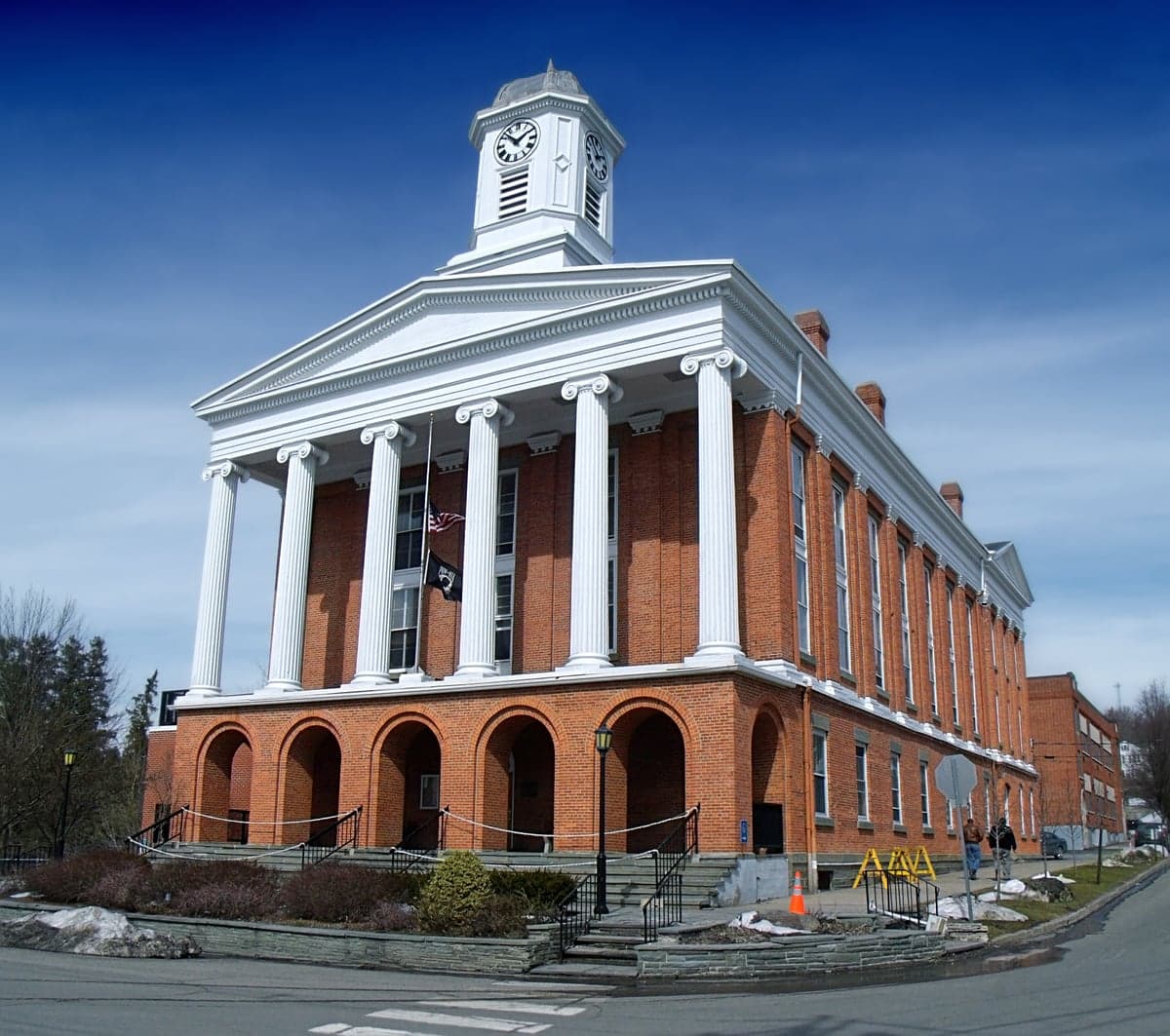
Photo: Wikipedia
Personal Sovereignty in Susquehanna County
Strong independent fundamentals that actively favor personal liberty and low regulation.
What does Personal Sovereignty tell us?
Personal Sovereignty measures your capacity for self-reliance and independence with minimal government friction. Higher scores mean fewer barriers between you and the way you want to live... but it assumes you have the space you need and good neighbors.
What does this tell us?
Personal Sovereignty measures your capacity for self-reliance and independence with minimal government friction. Higher scores mean fewer barriers between you and the way you want to live... but it assumes you have the space you need and good neighbors.
State Policy
Energy independence: Net exporter (274% of energy produced in-state)
Personal Liberty
Homesteading

Personal Liberty Analysis
Susquehanna County, Pennsylvania, offers one of the strongest personal sovereignty environments in the Northeast, combining low property taxes, minimal zoning in rural townships, and a deeply rooted culture of self-reliance that aligns with conservative values. The county’s 832 square miles of rolling hills and farmland, anchored by the boroughs of Montrose, Susquehanna Depot, and Forest City, present a landscape where individual autonomy is the default rather than the exception. For relocation-minded readers who prioritize freedom from overreach, this corner of the Endless Mountains region stands out as a place where the state’s relatively light touch on rural areas meets a community that expects residents to handle their own affairs.
Tax burden and regulatory posture: how Susquehanna County compares to neighboring areas
Susquehanna County’s tax burden is among the lowest in Pennsylvania, a state that already ranks favorably for property taxes compared to New York or New Jersey just across the border. The county’s average effective property tax rate hovers around 1.2% of assessed home value, significantly lower than the 1.8% average in neighboring Lackawanna County to the south. There is no county-level sales tax beyond the state’s 6% rate, and no local income tax in most municipalities—only a handful of boroughs like Montrose and Hallstead impose a small earned income tax of around 0.5%. The regulatory posture is decidedly hands-off: the county has no countywide zoning ordinance, leaving land-use decisions to individual townships. This means that in townships like Franklin, Dimock, and Springville, residents can operate home businesses, keep livestock, or build accessory structures with minimal bureaucratic friction. The Pennsylvania Uniform Construction Code applies to new construction, but enforcement is often delegated to local code officials who tend to be pragmatic rather than punitive. For a reader accustomed to the permit-heavy environments of the Philadelphia or New York City suburbs, Susquehanna County feels like a release valve.
Self-defense and gun law specifics: what the Second Amendment landscape looks like here
Pennsylvania is a shall-issue state for concealed carry permits, and Susquehanna County’s sheriff’s office processes applications with efficiency—typically within two weeks. The county is home to a robust gun culture, with no county-level restrictions beyond state law, meaning no assault weapon bans, no magazine capacity limits, and no waiting periods beyond the state’s 48-hour handgun purchase delay. Open carry is legal without a permit for anyone who can legally possess a firearm, and the county’s rural character means that seeing a holstered sidearm in a grocery store or diner in Montrose or Forest City is unremarkable. The Pennsylvania Castle Doctrine provides a strong presumption of self-defense in one’s home or vehicle, with no duty to retreat. For those considering homesteading or living on larger parcels, the ability to discharge firearms on private property is generally unrestricted, provided the discharge is not reckless or within 150 yards of an occupied dwelling. The county’s proximity to New York (the border runs along its northern edge) means that residents must be vigilant about crossing state lines with firearms, but within Susquehanna County itself, the legal environment is as permissive as any in the Northeast outside of New Hampshire.
Self-reliance and homesteading viability: lot sizes, zoning, and off-grid feasibility
Susquehanna County is one of the most homesteading-friendly areas in Pennsylvania, largely because of its permissive land-use regulations and affordable land prices. Minimum lot sizes in rural townships like Dimock, Franklin, and New Milford typically start at one acre for residential use, but many parcels are sold in 5- to 20-acre increments, allowing for substantial gardening, small-scale livestock, and even timber management. There is no countywide ban on off-grid living: residents can install solar panels, wind turbines, or rainwater collection systems without special permits, provided they comply with basic state health regulations for well water and septic systems. The Pennsylvania Department of Environmental Protection requires a permit for any well that serves a dwelling, but the process is straightforward and costs under $500. Zoning in the county’s 40 townships is minimal; most townships have only basic subdivision and land development ordinances, meaning that building a barn, workshop, or greenhouse rarely requires more than a simple building permit. For those seeking true self-reliance, the area’s agricultural heritage means that feed stores, hardware co-ops, and livestock auctions are common in towns like Susquehanna Depot and Montrose. The county’s growing season runs roughly from May to October, and the soil in the river valleys is fertile enough for serious vegetable production. Off-grid feasibility is high, though winter heating costs are a real consideration—wood stoves are the norm in many older homes, and firewood permits on state game lands are inexpensive.
Personal liberties: parental rights, medical autonomy, speech, and property
Susquehanna County’s personal liberties environment reflects the broader Pennsylvania tradition of local control and limited government intervention. Parental rights are strong: the county’s school districts—including Montrose Area, Susquehanna Community, and Elk Lake—allow for homeschooling with minimal oversight, requiring only a notarized affidavit and annual portfolio review. Medical autonomy is generally respected, with the county’s healthcare providers in Montrose and Forest City operating under standard state licensing but without the aggressive vaccine mandates or public health orders seen in urban areas during the COVID-19 era. The county commissioners did not impose mask mandates or business closures during the pandemic, and local resistance to state-level health orders was vocal and organized. Free speech is protected by the Pennsylvania Constitution, and the county’s public meetings—particularly the township supervisor sessions—are venues where residents regularly speak for hours on local issues without time limits or content restrictions. Property rights are the bedrock of the county’s identity: the absence of countywide zoning means that a landowner in Springville or Dimock can use their property for nearly any lawful purpose, from auto repair to sawmilling, without needing a variance or special use permit. The Pennsylvania Right to Farm Act provides additional protection for agricultural operations, shielding farmers from nuisance lawsuits if they follow standard practices. For a reader who values the ability to live without asking permission, Susquehanna County delivers a level of personal sovereignty that is increasingly rare in the United States.
Overall, Susquehanna County ranks among the top-tier areas for personal sovereignty in the Northeast, comparable to rural upstate New York counties like Allegany or Steuben but with lower taxes and a more permissive regulatory culture. The county’s combination of low property taxes, minimal zoning, strong gun rights, and a homesteading-friendly land market creates an environment where individual autonomy is not just tolerated but expected. For a conservative-leaning individual or family seeking to escape the regulatory density of the I-95 corridor, Susquehanna County offers a practical, affordable, and legally sound alternative—one where the government’s primary role is to stay out of the way.

* Values derived from national, state, county, city and local statistics and may differ in a specific area. Last updated: 2026-11-18T06:27:31.000Z
Narrative content on this page is AI-generated and may contain mistakes. Verify any details that matter before acting on them.
ReloMaps may earn a commission from affiliate links at no extra cost to you.

