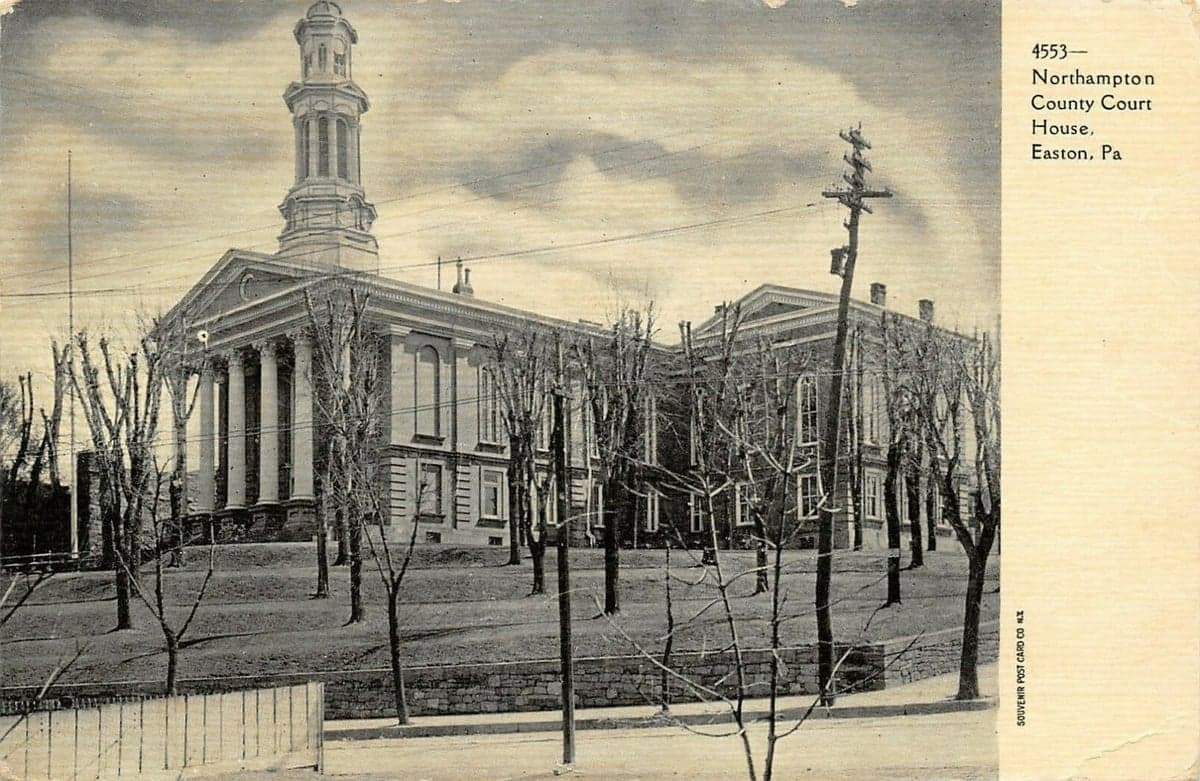
Photo: Wikipedia
Personal Sovereignty in Northampton County
Strong independent fundamentals that actively favor personal liberty and low regulation.
What does Personal Sovereignty tell us?
Personal Sovereignty measures your capacity for self-reliance and independence with minimal government friction. Higher scores mean fewer barriers between you and the way you want to live... but it assumes you have the space you need and good neighbors.
What does this tell us?
Personal Sovereignty measures your capacity for self-reliance and independence with minimal government friction. Higher scores mean fewer barriers between you and the way you want to live... but it assumes you have the space you need and good neighbors.
State Policy
Energy independence: Net exporter (150% of energy produced in-state)
Personal Liberty
Homesteading

Personal Liberty Analysis
Northampton County, Pennsylvania, offers a nuanced personal sovereignty environment that balances the state's established legal frameworks with significant local variation across its diverse municipalities. While Pennsylvania is not a libertarian stronghold, the county provides meaningful room for individual autonomy, particularly in its more rural townships and boroughs, where lighter regulatory touch and community-oriented governance prevail. For those prioritizing personal freedom, the key is understanding how the county's patchwork of local ordinances and state-level laws interact to shape daily life, from tax burden to self-defense rights and the feasibility of self-reliant living.
Tax burden and regulatory posture across Northampton County
Pennsylvania's tax structure is generally favorable for those seeking to minimize government overhead, with a flat state income tax of 3.07% and no tax on retirement income, including Social Security and pensions. Northampton County itself adds a local earned income tax of roughly 1.0% to 1.5%, depending on the municipality, and property taxes are moderate by Northeast standards—averaging around 2.5% of assessed value, though rates vary significantly between districts. Boroughs like Nazareth and Hellertown tend to have lower property tax rates than the county average, while Bethlehem and Easton, with their larger municipal budgets, impose higher combined burdens. The regulatory posture is similarly varied: rural townships such as Lower Mount Bethel and Washington Township maintain minimal zoning and business licensing requirements, making them attractive for small-scale entrepreneurship and home-based enterprises. In contrast, Bethlehem and Easton enforce stricter building codes, rental inspections, and business permitting processes, reflecting their urbanized character. The county's overall regulatory environment is moderate—not as light as parts of the Deep South or rural Midwest, but far less intrusive than neighboring New Jersey or New York.
Self-defense and gun law specifics in the Lehigh Valley
Pennsylvania is a "shall-issue" state for concealed carry permits, meaning that if you meet basic criteria—no felony convictions, no involuntary mental health commitments—the county sheriff must issue the permit. Northampton County Sheriff's Office processes applications efficiently, typically within 30 days, and the permit is valid for five years. Open carry is legal without a permit for anyone who can legally possess a firearm, though it is restricted in Philadelphia and during declared emergencies. The state preempts local firearm ordinances, so no municipality in Northampton County can enact its own gun bans or magazine capacity limits, a critical protection for gun owners. This preemption has been tested: in 2021, the borough of Bangor attempted to pass a resolution declaring itself a "Second Amendment Sanctuary," a symbolic gesture that nonetheless signals strong local support for gun rights. Shooting ranges and gun clubs are common in the county's rural areas, particularly around Wind Gap and the Blue Mountain region, providing ample opportunity for practice and training. For self-defense, the state's Castle Doctrine applies to both homes and vehicles, with no duty to retreat in any place where the individual is lawfully present. Stand-your-ground protections are robust, though Pennsylvania courts have interpreted them narrowly in some cases involving public spaces. Overall, Northampton County offers a gun-friendly environment that aligns with conservative values, especially when compared to nearby New Jersey's restrictive regime.
Self-reliance and homesteading viability: lot sizes, zoning, and off-grid feasibility
Homesteading and self-reliant living are genuinely viable in Northampton County, but feasibility depends heavily on location. Rural townships like Lower Mount Bethel, Washington Township, and Moore Township allow agricultural zoning with minimum lot sizes of 2 to 5 acres, enabling small-scale farming, livestock keeping, and gardening without excessive bureaucratic hurdles. In these areas, raising chickens, goats, and even a few cattle is typically permitted by right, though larger operations may require a nutrient management plan under state law. Off-grid living is legally possible but practically constrained by Pennsylvania's Uniform Construction Code (UCC), which mandates certain building standards even for owner-built homes. Solar panels are permitted statewide, and net metering is available, but connecting to the grid is often required for financing and insurance. Composting toilets and rainwater collection are allowed under state plumbing codes, but local health departments may impose additional requirements, particularly in areas with well and septic systems. The boroughs of Bangor and Pen Argyl offer more affordable land prices than the county's urban core, with parcels under $10,000 per acre still available in some outlying areas. However, zoning in Bethlehem and Easton effectively prohibits most homesteading activities, with strict limits on livestock, garden size, and accessory structures. For those serious about self-reliance, the northern and western townships of the county provide the best balance of affordability, permissive zoning, and access to the broader Lehigh Valley economy.
Personal liberties: parental rights, medical autonomy, speech, and property
Pennsylvania law generally respects parental rights in education and healthcare decisions. Homeschooling is straightforward under the state's "home education program" statute, requiring only a notarized affidavit, annual evaluations, and a portfolio review—no standardized testing mandates or curriculum approval from the district. This makes Northampton County a viable location for families seeking educational autonomy. Medical autonomy is more constrained: Pennsylvania has not enacted broad medical freedom legislation, and vaccine mandates for school attendance remain in place, though religious and medical exemptions are available. The state does not have a right-to-try law for experimental treatments, but it does allow direct primary care agreements, which can reduce reliance on insurance-based medicine. Property rights are well-protected under Pennsylvania's eminent domain laws, which require just compensation and a public purpose, though the state's "quick-take" provisions for infrastructure projects have drawn criticism from property rights advocates. Free speech protections are robust, with no state-level equivalent of California's AB 5 or New York's social media laws that restrict online expression. Northampton County's local governments generally do not engage in content-based regulation of speech, and public comment periods at municipal meetings are typically open and uncensored. For those who value personal liberty across multiple dimensions, the county offers a solid baseline, with the understanding that Pennsylvania is not a "free state" in the mold of New Hampshire or Idaho, but rather a moderate commonwealth where individual freedoms are balanced against collective regulation.
Overall, Northampton County presents a mixed but generally favorable sovereignty profile for conservative-leaning individuals and families. Its tax burden is low by Northeast standards, its gun laws are among the most protective in the region, and its rural townships offer genuine homesteading opportunities. The county's proximity to New York City and Philadelphia—both under two hours away—provides economic access without the regulatory overreach of those jurisdictions. For those comparing it to other areas, Northampton County offers a more freedom-oriented environment than any county in New Jersey or New York, but less than rural counties in Virginia, West Virginia, or Ohio. The key is choosing the right municipality: stick to the rural townships and smaller boroughs for maximum autonomy, and avoid the urban centers where regulatory density is higher. With careful selection, Northampton County can serve as a solid base for a self-directed, liberty-respecting life in the Northeast corridor.

* Values derived from national, state, county, city and local statistics and may differ in a specific area. Last updated: 2026-06-22T21:42:36.000Z
Narrative content on this page is AI-generated and may contain mistakes. Verify any details that matter before acting on them.
ReloMaps may earn a commission from affiliate links at no extra cost to you.

