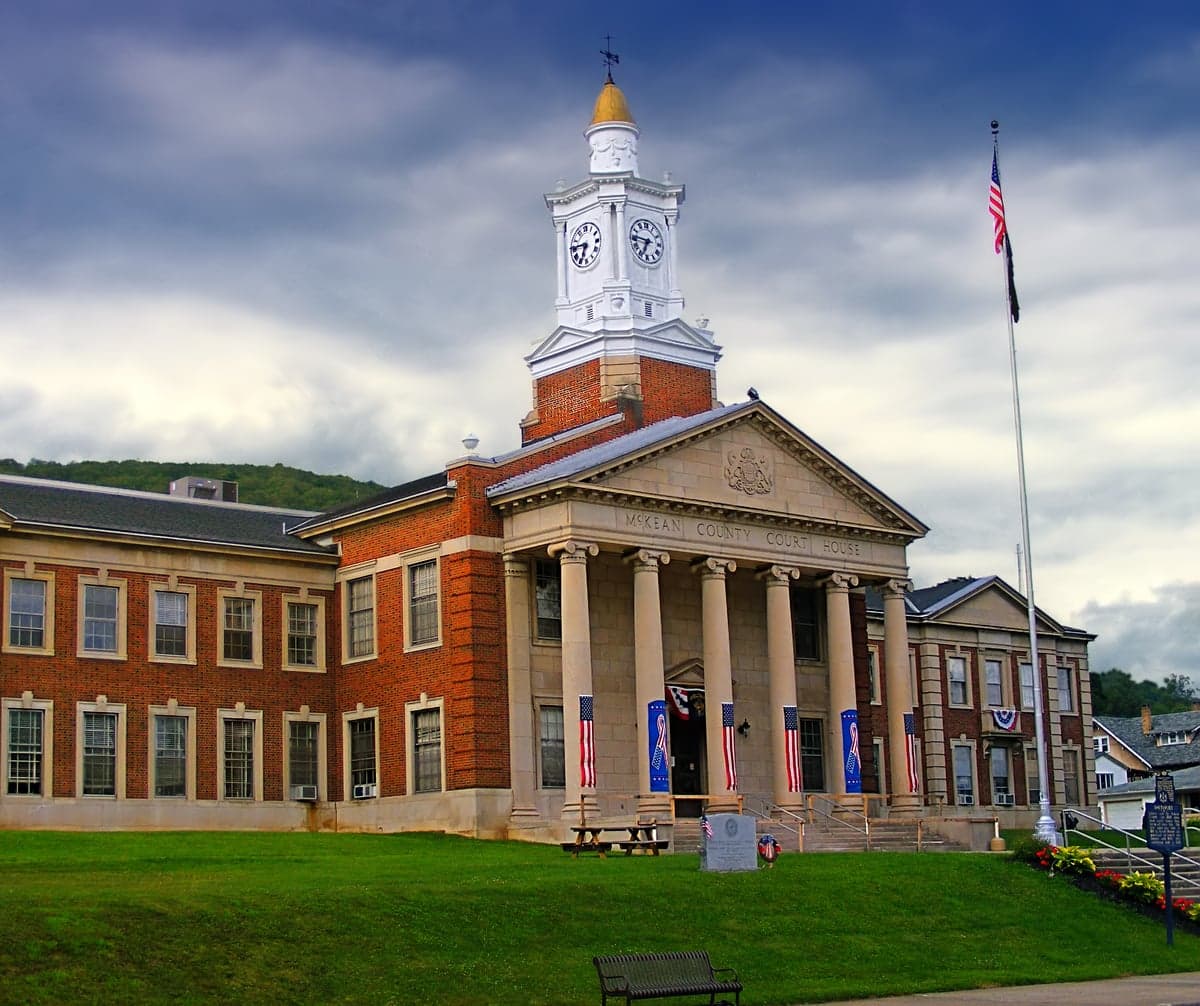
Photo: Wikipedia
Political ClimatePolitical Climate in Mckean County
Showing district-level results — no local-only data available.
Local Political AnalysisPolitical Analysis of Mckean County
McKean County is one of the most reliably Republican areas in Pennsylvania, with a Cook Partisan Voting Index of R+19 — meaning it votes about 19 points more Republican than the national average. That puts it far to the right of Pennsylvania as a whole, which sits at EVEN on the same index. The county hasn't voted for a Democratic presidential candidate since Lyndon Johnson in 1964, and in 2024, Donald Trump carried it by roughly 40 points. But that blanket red label hides some real local variation, especially between the county seat and the smaller boroughs.
How it compares
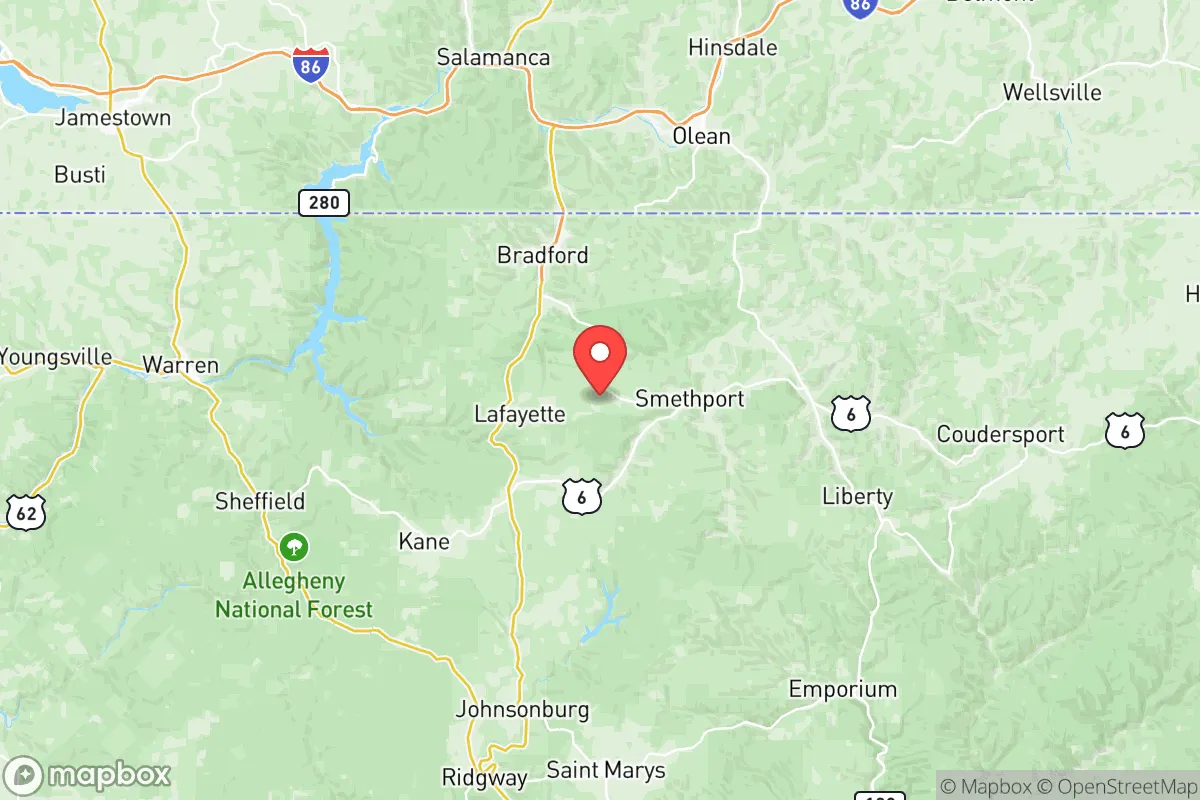
Pennsylvania's statewide PVI of EVEN reflects a genuine battleground — Philadelphia and its suburbs pull left, while the central and northern tiers pull right. McKean County is in the latter camp, but it's not a monolith. Bradford, the largest city and county seat, is the most Democratic-leaning area, with precincts around the University of Pittsburgh at Bradford and the downtown core occasionally breaking 40-45% for Democratic candidates. In contrast, Smethport, Port Allegany, and Kane are deep red, often delivering 70% or more for Republican nominees. The swing precincts are in the rural townships just outside Bradford — places like Foster Township and Lafayette Township — where economic anxiety and fracking policy can shift a few points, but the overall tilt remains solidly conservative. Statewide, McKean's R+19 is roughly comparable to neighbouring Warren County (R+18) and a bit more Republican than Elk County (R+16).
What this means for residents
For conservative residents, McKean County is a comfortable place politically. Local offices — county commissioners, sheriff, district attorney — are almost always held by Republicans, and the county's state legislative delegation (Senator Cris Dush, Representative Martin Causer) is staunchly conservative. Gun rights, low taxes, and opposition to state-level environmental regulations on natural gas are mainstream positions. For liberal residents, it's a different story. There's no organized Democratic Party presence to speak of outside of a small Bradford-area group, and progressive candidates rarely bother to campaign here. Socially, the county is culturally conservative — church attendance is high, and issues like abortion or LGBTQ+ rights are rarely debated in public forums. That said, the county's small size means politics doesn't dominate daily life the way it does in a swing suburb. Most people get along fine regardless of party, and the biggest local fights tend to be about school funding or the opioid crisis, not national culture wars.
Culturally, McKean County stands apart from Pennsylvania's more urbanized regions. It's one of the few counties in the state where the Second Amendment Sanctuary movement passed unanimously in 2020, and local officials routinely push back against Philadelphia-centric state policies. The economy — dominated by healthcare (UPMC Kane, Bradford Regional Medical Center), manufacturing (Zippo/Case, Metaldyne), and natural gas — shapes political priorities. Residents here are far more concerned with energy jobs and rural broadband than with transit or urban development. The trajectory is toward deeper red: as younger, more mobile residents leave for cities, the remaining population skews older and more conservative. For anyone moving here, the political reality is straightforward — if you're conservative, you'll feel at home; if you're liberal, you'll be in a small minority, but the county's quiet, live-and-let-live culture means it's rarely a source of conflict.

State Political ClimatePolitical Climate in Pennsylvania
State Political AnalysisPolitical Environment in the State
Pennsylvania is the ultimate swing state, with a Cook PVI of EVEN that perfectly captures its 50/50 split. Over the last 20 years, it has shifted from a reliably blue-leaning state in presidential races (voting Democratic from 1992 through 2012) to a true battleground where margins are razor-thin — Trump won it in 2016 by 44,000 votes, Biden flipped it back in 2020 by 80,000, and the 2024 race was again decided by less than two points. The dominant coalitions are the urban-suburban Democratic strongholds of Philadelphia and Pittsburgh versus the sprawling, ancestrally Democratic but now deeply Republican rural and exurban counties. This isn't a state that's drifting; it's a state that's locked in a trench war between two roughly equal halves.
Urban vs. rural divide
The political map of Pennsylvania is a study in contrast. Philadelphia and its collar counties (Montgomery, Delaware, Chester) deliver massive Democratic margins — Philly alone gave Biden over 600,000 votes in 2020, a 80-20 split. Pittsburgh and Allegheny County are similarly blue, though with a smaller population base. The rest of the state is a sea of red. Lancaster County, once a moderate Republican stronghold, has shifted hard right, with Trump winning it by 18 points in 2024. Erie County on Lake Erie is the classic bellwether — it voted for Obama twice, flipped to Trump in 2016, then went back to Biden in 2020, and is now a perennial toss-up at the county level. The Scranton/Wilkes-Barre area (Lackawanna and Luzerne counties) tells the story of the state's realignment: Lackawanna, Joe Biden's home county, still leans blue but by shrinking margins, while Luzerne has become a Republican stronghold after decades of Democratic dominance. The Harrisburg metro (Dauphin County) is a microcosm — the city itself is heavily Democratic, but the surrounding suburbs and rural areas are solidly red, creating a purple county overall.
Policy environment
Pennsylvania's policy landscape reflects its divided government. The state has a flat income tax rate of 3.07%, one of the lowest in the nation, and a sales tax of 6% (8% in Philadelphia and Pittsburgh). Property taxes are high, averaging about 1.5% of home value, which is a major concern for homeowners. The regulatory posture is moderate — not as business-friendly as Texas or Florida, but far less burdensome than New York or California. Education policy is a flashpoint: the state funds schools primarily through local property taxes, creating massive disparities between wealthy suburbs and poor rural districts. A 2023 Commonwealth Court ruling declared the funding system unconstitutional, but the legislature has yet to enact a fix. Election laws are relatively accessible: no-excuse mail-in voting was enacted in 2019 (Act 77) and has become a partisan battleground, with Republicans pushing for stricter ID requirements and Democrats defending mail-in access. The state has no voter ID law for in-person voting, though first-time voters must show ID.
Recent policy direction
The last five years have seen Pennsylvania lurch in both directions simultaneously, depending on the issue. On gun rights, the state is a mixed bag: it has preemption laws that prevent local municipalities from enacting their own gun restrictions, but it also requires background checks for all handgun sales (including private sales) and has a "red flag" law that was proposed but not passed. In 2022, the legislature passed a constitutional amendment to expand gun rights, but it was blocked by the courts. On parental rights and education, the state has seen heated battles over school board control, with conservative parents winning seats in districts like Central Bucks and Pennridge to push back on critical race theory and LGBTQ curriculum. The state does not have a school choice voucher program, though a 2024 proposal (HB 2169) to create one passed the House but died in the Senate. On medical and bodily autonomy, abortion remains legal up to 24 weeks, with no additional restrictions beyond the standard medical requirements. The 2022 election saw Governor Josh Shapiro win on a platform of protecting abortion access, and the legislature has not passed any new restrictions. On voting and ballot access, Act 77's no-excuse mail-in voting remains in place, but a 2024 court ruling (McLinko v. Commonwealth) upheld the requirement that mail-in ballots be received by 8 PM on Election Day, rejecting a push to count late-arriving ballots. The state also has a strict voter ID law for first-time voters, but no general ID requirement.
Civil unrest & political movements
Pennsylvania has been a flashpoint for political activism on both sides. The 2020 election aftermath saw massive protests in Philadelphia over police brutality (George Floyd) and counter-protests by Trump supporters. The "Stop the Steal" movement was particularly active in Lancaster and York counties, where local GOP officials faced pressure to overturn results. In 2022, a group of armed protesters demonstrated outside the home of a Philadelphia judge who had ruled on a gun rights case. Immigration politics are less visible here than in border states, but Philadelphia is a sanctuary city, and the state has seen a surge in migrant arrivals from the southern border via busing from Texas, creating tensions in the city's shelter system. Election integrity remains a live issue: the 2024 primary saw a controversy in Luzerne County when a batch of mail-in ballots was discovered uncounted, leading to a state investigation and renewed calls for stricter procedures. The "Audit the Vote" movement has a strong presence in rural counties, with groups like the Pennsylvania Election Integrity Network pushing for hand-counting of ballots.
Projection
Over the next 5-10 years, Pennsylvania is likely to remain a toss-up, but the demographic trends favor a slight shift to the right. The state's population is aging and shrinking in rural areas, while the Philadelphia and Pittsburgh metros are growing slowly. The key wildcard is the Lehigh Valley (Allentown, Bethlehem, Easton), which is becoming more diverse and Democratic-leaning as it absorbs New Jersey transplants. Meanwhile, the northern tier counties (Tioga, Bradford, Susquehanna) are becoming even more Republican as younger residents leave and retirees move in. The 2030 redistricting cycle will be critical: if Republicans control the legislature and governorship, they could draw maps that lock in a 13-4 or 14-3 congressional delegation advantage. The state's electoral college votes (19) will remain a top target for both parties. For a new resident, expect continued gridlock in Harrisburg on major issues like education funding, energy policy (the state is a major natural gas producer), and election laws. The political temperature will stay high, but the state's institutions are resilient enough to absorb the pressure.
For a conservative relocator, Pennsylvania offers low taxes, strong gun rights (with some limits), and a vibrant conservative culture in the suburbs and rural areas. For a liberal relocator, the state provides strong abortion protections, a functional Democratic machine in the cities, and a high quality of life in the Philly and Pittsburgh suburbs. The practical takeaway: you'll live in a state where your vote genuinely matters, but you'll also live in a state where half your neighbors disagree with you on fundamental issues. If you can handle that tension, Pennsylvania is a great place to put down roots. If you can't, you'll find the political climate exhausting.
* Values derived from national, state, county, city and local statistics and may differ in a specific area. Last updated: 2026-09-12T06:11:52.000Z
Narrative content on this page is AI-generated and may contain mistakes. Verify any details that matter before acting on them.
ReloMaps may earn a commission from affiliate links at no extra cost to you.

