Photo: Wikipedia
Demographics of Mckean County
Affluence Level in Mckean County
A middle-class area roughly in line with national averages across income, home values, education, and employment.
People of Mckean County
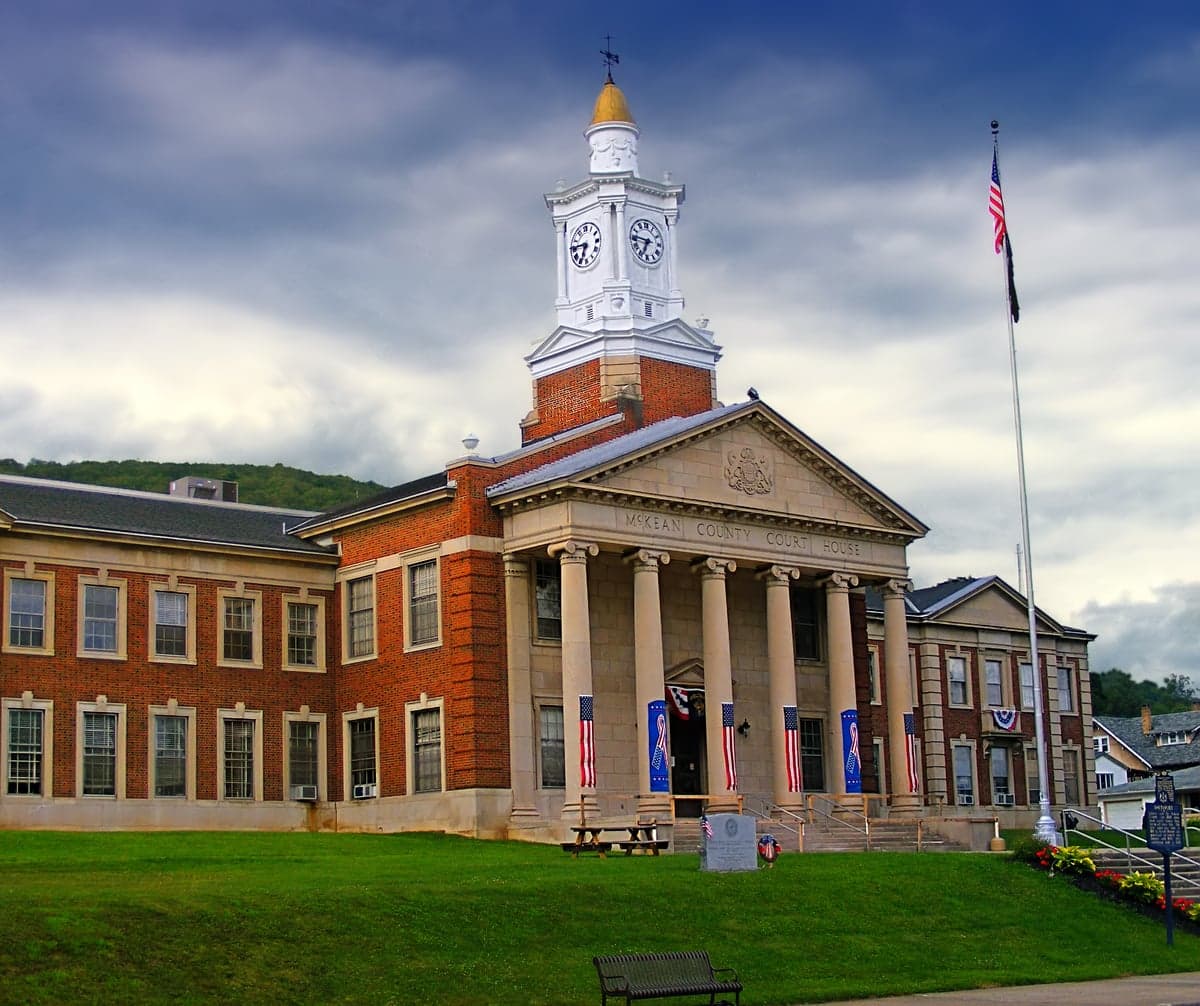
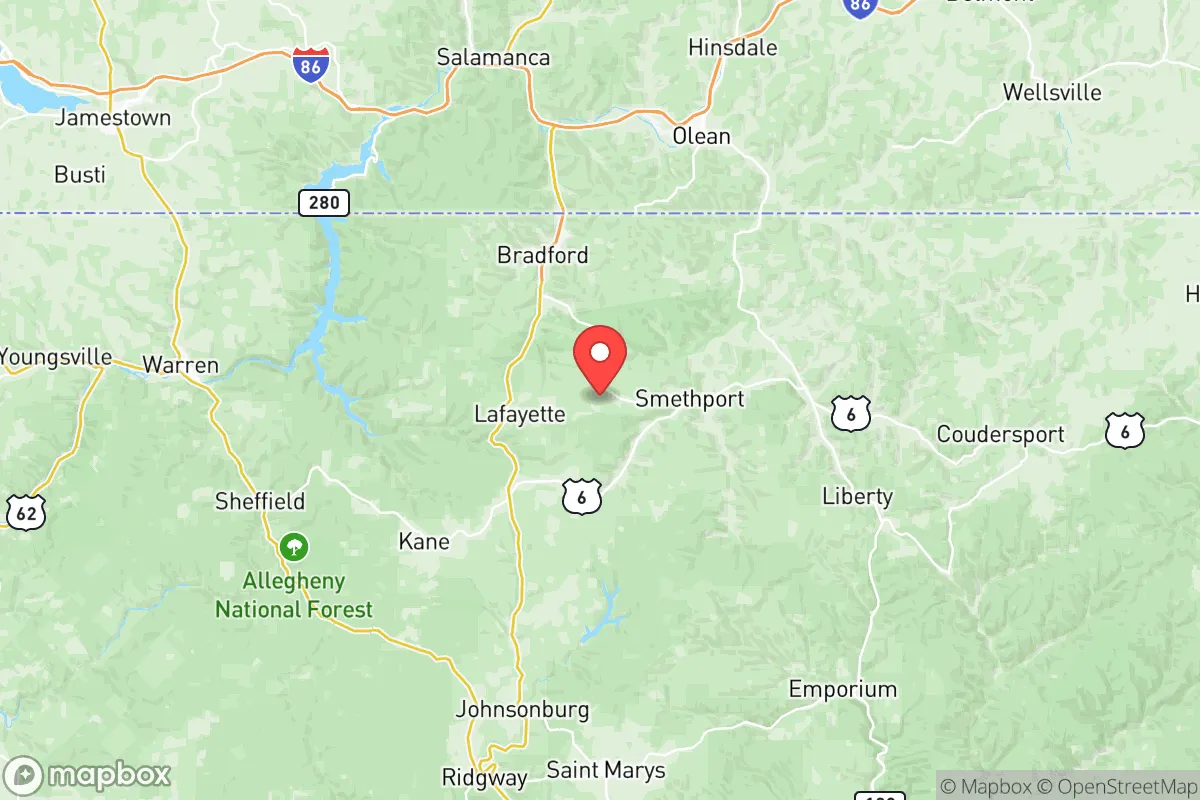
McKean County, Pennsylvania, is home to roughly 40,149 residents, a population that is 92.5% white and notably older than the national average, with a foreign-born share of just 1.0%. This is a region shaped by the boom-and-bust cycles of extractive industry—first timber, then oil and gas, and later manufacturing—leaving a legacy of small, tight-knit communities like Bradford, Kane, and Smethport. The county’s identity is rooted in its rural, working-class character, with a strong sense of local independence and a population that has been steadily declining for decades.
Settlement & growth (pre-1960)
Before European settlement, the area now known as McKean County was part of the hunting grounds of the Seneca Nation, one of the six nations of the Iroquois Confederacy. The Seneca used the Allegheny River and its tributaries for travel and trade, but permanent villages were sparse due to the rugged, forested terrain. The first European incursion came during the French and Indian War, when French forts were established along the Allegheny, but no lasting settlement occurred until after the American Revolution.
The county was formally created in 1804 from parts of Lycoming County, named after Governor Thomas McKean, a signer of the Declaration of Independence. The first permanent settlers were primarily of English and Scots-Irish descent, arriving in the 1810s and 1820s. They pushed up the Allegheny River valley, establishing small farming hamlets. The earliest of these was Smethport, founded in 1807 and designated the county seat in 1826. These initial settlers were subsistence farmers, but the dense old-growth forests of hemlock and white pine soon revealed the region’s true economic potential.
The timber boom of the mid-19th century transformed McKean County. From the 1840s through the 1880s, waves of immigrants arrived to work in the logging camps and sawmills. Germans and Irish were the largest groups, with the Irish often taking the most dangerous jobs as river drivers, floating logs down the Allegheny to sawmills in Pittsburgh. The town of Kane, founded in 1863 by General Thomas L. Kane, became a major lumber center and attracted a significant Swedish and Norwegian population, who worked as skilled lumbermen. Mount Jewett, founded in 1854, also grew as a railroad and lumber hub, drawing a mix of German and Irish laborers.
The discovery of oil in the 1860s brought a second, even more explosive wave of growth. The Bradford oil field, discovered in 1871, was one of the largest in the world at the time. Bradford exploded from a village of a few hundred to a city of over 15,000 by 1880. This oil boom attracted a diverse influx: Poles, Italians, Slovaks, and Lithuanians arrived in large numbers between 1875 and 1910, settling in dense ethnic neighborhoods in Bradford’s “Oil City” district. These immigrants worked in the oil fields, refineries, and related industries. Eldred, founded in 1833, also saw growth from oil-related industry, though it remained smaller. The oil boom peaked around 1900, and production declined steadily thereafter, but the ethnic enclaves remained.
By the early 20th century, the county’s population had stabilized. The timber industry had largely exhausted the forests, and oil production was in decline. A smaller wave of Italian and Eastern European immigrants continued to arrive through the 1920s, primarily to work in the remaining manufacturing and railroad jobs. The Great Depression hit the region hard, and population growth stalled. After World War II, the county saw a modest influx of returning veterans and their families, but no major new immigrant groups arrived. The population peaked at around 56,000 in 1950, then began a slow, steady decline as the resource-extraction economy contracted.
Modern era (post-1965)
The 1965 Hart-Cellar Act had virtually no impact on McKean County. The county’s foreign-born population today is just 1.0%, and the vast majority of those are naturalized citizens who arrived decades ago. The county did not experience the post-1965 waves of immigration from Latin America, Asia, or the Middle East that reshaped much of the United States. Instead, the dominant demographic story since 1965 has been out-migration and aging.
The collapse of the domestic oil industry in the 1980s and the closure of major manufacturing plants, including the Kendall Refinery in Bradford (which closed in 1997), triggered a sustained population decline. Young adults left for jobs in larger cities like Erie, Buffalo, and Pittsburgh. The county’s population fell from 50,000 in 1970 to 40,149 in 2024. The population is now significantly older than the state average, with a median age of approximately 45 years.
Racial and ethnic diversity remains extremely low. The county is 92.5% white. The largest minority group is Black residents at 2.2%, a population that is largely concentrated in Bradford, where a small, historically rooted Black community has existed since the oil boom era. Hispanic residents make up 1.8%, a recent and very small increase driven by a handful of families working in the healthcare and service sectors, primarily in Bradford and Kane. East/Southeast Asian residents account for 0.4%, and Indian-subcontinent residents are 0.1%, both negligible numbers. The county has no identifiable ethnic enclaves formed after 1965.
Suburbanization has been minimal. The county’s towns—Bradford, Kane, Smethport, Mount Jewett, and Eldred—have remained compact, walkable communities. There has been no significant exodus to unincorporated suburbs; instead, the population has simply thinned out in the rural townships. The prison industry has provided some economic stability: the Federal Correctional Institution at McKean, located near Bradford, opened in 1989 and employs several hundred people, attracting a small number of staff from outside the region. The University of Pittsburgh at Bradford, established in 1963, has also brought a modest influx of faculty and students, but most graduates leave after completing their degrees.
The future
The demographic trajectory for McKean County is one of continued contraction and aging. The county’s population is projected to decline to roughly 35,000 by 2040, according to state estimates. The birth rate is below replacement level, and out-migration of young adults is expected to persist. The county will become even older and whiter, as the small minority populations are also aging and not being replenished by new arrivals.
There is no sign of a reversal in diversity trends. The foreign-born share is likely to remain below 1.5% for the foreseeable future. The county does not have the economic draw—large employers, affordable housing stock in desirable settings, or proximity to a major metro area—to attract significant new immigrant populations. The small Hispanic and Black populations may grow slightly if healthcare and service-sector jobs expand, but this will be incremental.
The cultural identity of the county is likely to remain rooted in its rural, working-class, and predominantly white heritage. There is a strong sense of local history and pride, particularly in the oil and lumber legacies. Newcomers who move to the area tend to be retirees seeking low cost of living, or individuals employed in the prison, healthcare, or education sectors. The county is not becoming more diverse or cosmopolitan; it is consolidating around its existing character.
For someone moving in now, McKean County offers a quiet, affordable, and safe rural environment with a strong sense of community, but it is a place where the population is shrinking and aging. The kind of place it is becoming is a quieter, older version of itself—a region that is preserving its past rather than reinventing its future. New residents should expect a homogeneous, slow-paced lifestyle with limited economic opportunity but deep roots and a low cost of living.

* Values derived from national, state, county, city and local statistics and may differ in a specific area. Last updated: 2026-09-12T06:11:52.000Z
Narrative content on this page is AI-generated and may contain mistakes. Verify any details that matter before acting on them.
ReloMaps may earn a commission from affiliate links at no extra cost to you.

