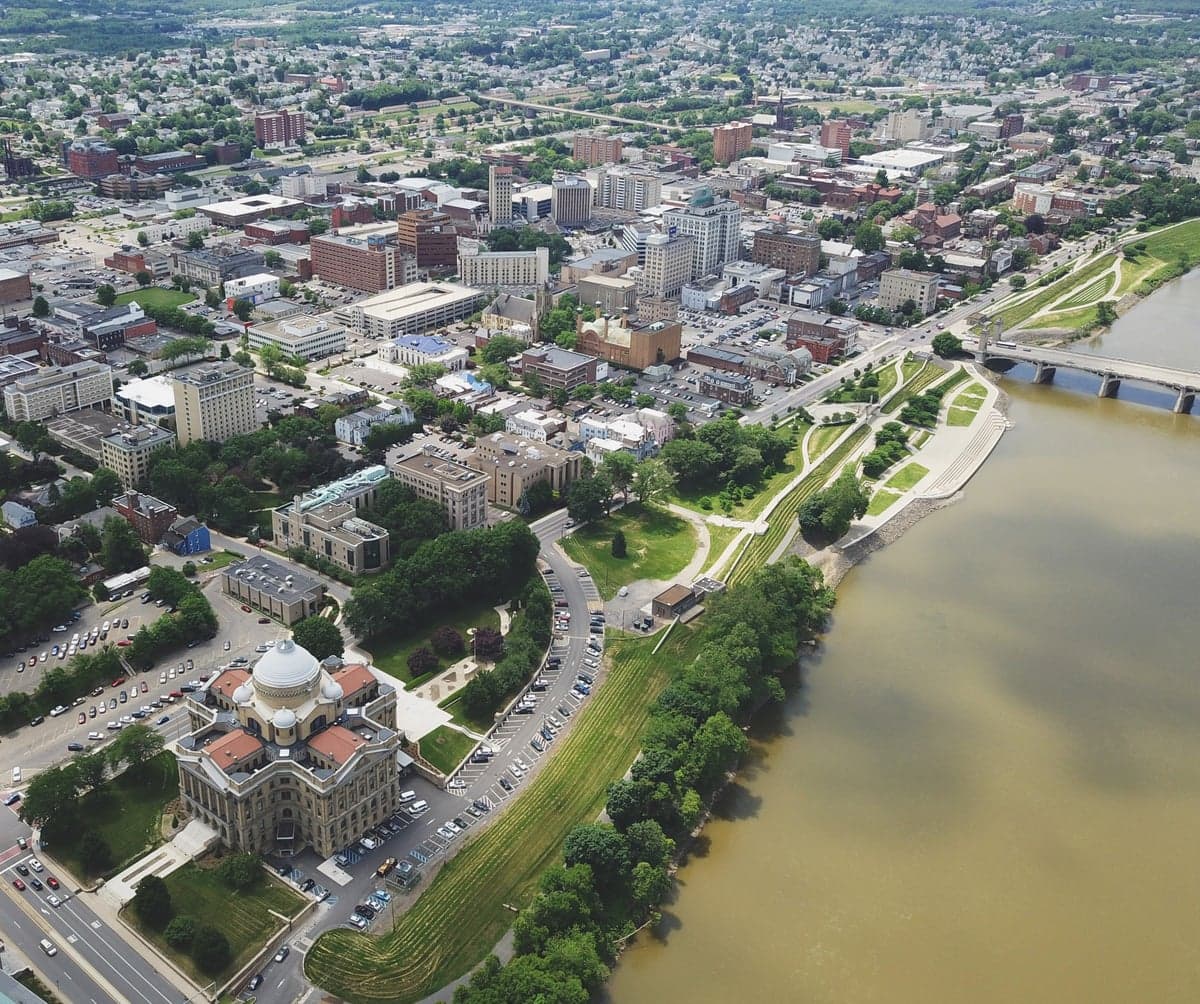
Photo: Wikipedia
Political ClimatePolitical Climate in Luzerne County
Showing district-level results — no local-only data available.
Local Political AnalysisPolitical Analysis of Luzerne County
Luzerne County has shifted from a Democratic stronghold to a reliably Republican-leaning county over the past two decades, now carrying a Cook PVI of R+4. This means the county votes about four points more Republican than the national average, while Pennsylvania as a whole sits at EVEN. The change is most visible in the county's largest city, Wilkes-Barre, which still votes Democratic but by much narrower margins than it did in the 1990s, while the surrounding suburbs and rural townships have swung hard to the right.
How it compares
Pennsylvania's statewide EVEN rating reflects a true battleground, with Philadelphia and its suburbs pulling left and the rest of the state pulling right. Luzerne County's R+4 places it squarely in the red-leaning camp, but with important internal variation. The city of Wilkes-Barre itself leans Democratic, typically voting around 55-60% for Democratic candidates in recent presidential elections, down from 65-70% in the 2000s. The borough of Kingston, just across the Susquehanna River, is a genuine swing area — it voted for Obama twice, then flipped to Trump in 2016 and 2020 by slim margins. Towns like Dallas and Back Mountain are solidly Republican, often voting 65-70% for GOP candidates. The rural townships of Fairmount and Ross are among the most conservative in the county, regularly hitting 75%+ Republican. Meanwhile, Hazleton in the southern part of the county has become a fascinating microcosm: its growing Latino population has made it more competitive for Democrats, though it still leans right overall. The key difference from the state as a whole is that Luzerne lacks the deep-blue urban core that Philadelphia provides — Wilkes-Barre simply doesn't have the population to offset the surrounding red townships.
What this means for residents
For conservative residents, Luzerne County feels like home turf. Local elected offices — from the county commissioners to the district attorney — are held by Republicans, and the county's political culture reflects that. Gun rights are broadly supported, taxes are kept relatively low, and development tends to favor business interests. For liberal residents, the picture is more mixed. You'll find like-minded neighbors in Wilkes-Barre and Kingston, but you'll also encounter a lot of "Trump 2024" signs and conservative talk radio. The county's Democratic Party is active but often plays defense, focusing on holding Wilkes-Barre and trying to flip a few swing precincts in Kingston and Plains Township. The practical effect is that policy debates here are less about progressive reforms and more about keeping things stable — the county government's biggest fights are usually over budget shortfalls and infrastructure, not culture war issues.
Culturally, Luzerne County retains a strong blue-collar identity that cuts across party lines. The region's coal mining and manufacturing history means that even Republicans here tend to be pro-union on economic issues, while Democrats are often more socially conservative than their national counterparts. You'll see a lot of "pro-union, pro-gun" voters who split tickets. The county's political trajectory seems likely to continue its slow rightward drift, driven by out-migration of younger, college-educated voters to Philadelphia and New York, and the aging of a population that remembers the region's industrial heyday. But don't expect it to become a deep-red county anytime soon — the Democratic base in Wilkes-Barre and Hazleton, combined with the union tradition, keeps it competitive in local races. For newcomers, the advice is simple: politics is a common topic of conversation here, but it's rarely hostile. People disagree without being disagreeable, and most folks are more interested in talking about the Penguins or the Eagles than the latest congressional vote.

State Political ClimatePolitical Climate in Pennsylvania
State Political AnalysisPolitical Environment in the State
Pennsylvania is the ultimate swing state, with a Cook PVI of EVEN, meaning it’s a perfect 50-50 toss-up in presidential elections. Over the past 20 years, the state has shifted from a reliably blue-leaning battleground to a hyper-competitive purple state, driven by the collapse of Democratic support in the rural southwest and northern tier, while the Philadelphia suburbs and Pittsburgh’s core have become more Democratic. The result is a state that feels like two different countries politically, and whichever way the wind blows in a given cycle determines the national outcome.
Urban vs. rural divide
The political map of Pennsylvania is a textbook case of the urban-rural chasm. Philadelphia and its inner-ring suburbs like Montgomery County and Delaware County are the engine of the Democratic vote, delivering margins of 70-80% in the city and 60-65% in the suburbs. Pittsburgh’s Allegheny County is similarly blue, though less extreme. The rest of the state is overwhelmingly red. The I-81 corridor from Harrisburg north through Scranton and Wilkes-Barre is a key swing region, where working-class voters have trended sharply Republican since 2016. The Pennsylvania Wilds and the northern tier counties like Tioga and Bradford are deep red, often voting 70% Republican. The Lancaster and York areas are reliably conservative, driven by a mix of Amish and evangelical voters. The Lehigh Valley (Allentown, Bethlehem, Easton) is a true bellwether, often flipping between parties and reflecting the state’s overall mood.
Policy environment
Pennsylvania’s policy environment is a mixed bag that reflects its divided government. The state has a flat income tax of 3.07%, one of the lowest in the nation, and a sales tax of 6% (8% in Philadelphia and Pittsburgh). Property taxes are high, averaging about 1.5% of home value, which is a major pain point for homeowners. The state has no statewide gun permit requirement for open carry, and concealed carry permits are issued on a “shall-issue” basis, with no local discretion. Education policy is decentralized, with strong local school boards and a growing charter school movement, though teacher unions remain powerful. Election laws are moderate: no-excuse mail-in voting was passed in 2019, but voter ID is required for first-time voters and for in-person voting (though not strictly enforced for mail ballots). The state has a Republican-controlled legislature and a Democratic governor (Josh Shapiro as of 2026), creating a perpetual tug-of-war over budgets, abortion, and energy policy.
Recent policy direction
Recent legislation shows a state pulling in both directions. On gun rights, Pennsylvania passed a preemption law in 2022 that prevents local municipalities from enacting their own gun ordinances, nullifying Philadelphia’s attempt to ban assault weapons. On parental rights, the legislature passed a bill in 2023 requiring schools to notify parents of any changes to a child’s health or emotional well-being, but Governor Shapiro vetoed it. On education, the state expanded school choice with a $100 million tax credit scholarship program in 2024, but a full voucher bill failed. On abortion, the state remains a legal haven in the region, with no gestational limits and Medicaid funding for the procedure, though a 24-hour waiting period and parental consent for minors remain on the books. On voting, the 2020 election saw massive use of mail-in ballots, leading to a Republican push for stricter ID requirements and signature verification, which has stalled in the legislature. On energy, Pennsylvania is the second-largest natural gas producer in the U.S., and the state has resisted a carbon tax, though it joined the Regional Greenhouse Gas Initiative (RGGI) in 2022, only for a court to block it in 2023. The property rights landscape is mixed: the state has strong eminent domain protections, but the Marcellus Shale boom has led to disputes over mineral rights and fracking setbacks.
Civil unrest & political movements
Pennsylvania has seen its share of political flashpoints. The 2020 election was a major battleground, with Trump’s campaign challenging mail-in ballots in Philadelphia and Allegheny counties, leading to the “Zombie Election” narrative that persists in conservative circles. The January 6th investigation had deep roots here, with several Pennsylvania activists charged. On the left, the Black Lives Matter protests in Philadelphia in 2020 were among the largest in the country, leading to property damage and a lasting debate over police funding. The anti-fracking movement is active in the Pittsburgh area, with groups like Food & Water Watch pushing for a statewide ban, though it has little traction in the legislature. Immigration politics are less heated than in border states, but Philadelphia is a sanctuary city, and the state has a law prohibiting local police from asking about immigration status. The Second Amendment sanctuary movement has spread to over 30 counties, where local sheriffs refuse to enforce any future federal gun bans. The election integrity debate remains raw, with Republican-led audits in counties like Lycoming and York continuing to question the 2020 results.
Projection
Over the next 5-10 years, Pennsylvania is likely to remain a toss-up, but with a slight rightward drift. The in-migration from New York and New Jersey is boosting the Philadelphia suburbs, which are becoming more Democratic, but the exodus from the rural areas is accelerating, making those counties even redder. The Lancaster and York areas are growing fast, driven by conservative families fleeing the Northeast’s high taxes, which will solidify the red base. The Lehigh Valley will remain the key swing region, with its mix of Hispanic, white working-class, and suburban voters. The Democratic Party is losing ground with non-college whites, especially in the southwest, while the Republican Party is struggling to make inroads with suburban women and college-educated voters. The 2026 gubernatorial election will be a major test: if a Republican wins, expect a wave of conservative legislation on school choice, energy deregulation, and election reform. If a Democrat holds the seat, the gridlock will continue. The state’s aging population (it has the third-oldest median age in the U.S.) means that healthcare and property taxes will become dominant issues, and the party that addresses them best will win.
For a new resident, the bottom line is that Pennsylvania offers a balanced political environment where your vote truly matters. If you’re conservative, you’ll find a strong community in the rural areas and suburbs, but you’ll have to accept that the state government is often divided and that major cities are deeply blue. If you’re liberal, you’ll feel at home in Philadelphia or Pittsburgh, but you’ll be frustrated by the legislature’s resistance to progressive policies. The practical takeaway is that where you live within the state matters more than the state itself. A family moving to Lancaster County will experience a very different political reality than one moving to Montgomery County. The state’s political climate is a mirror of the nation’s, and that’s both its strength and its challenge.
* Values derived from national, state, county, city and local statistics and may differ in a specific area. Last updated: 2026-07-17T04:58:48.000Z
Narrative content on this page is AI-generated and may contain mistakes. Verify any details that matter before acting on them.
ReloMaps may earn a commission from affiliate links at no extra cost to you.

