Photo: Wikipedia
Political ClimatePolitical Climate in Lebanon County
Showing district-level results — no local-only data available.
Local Political AnalysisPolitical Analysis of Lebanon County
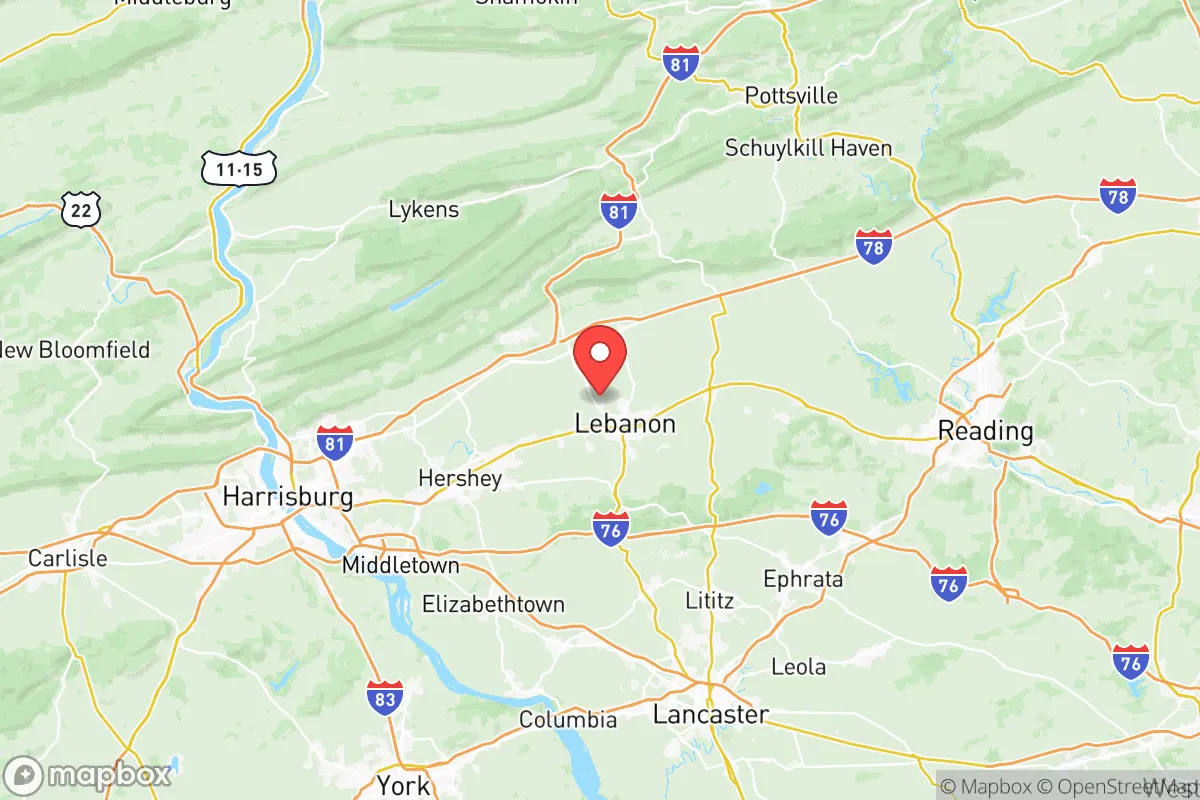
Lebanon County is one of the most reliably Republican areas in Pennsylvania, with a Cook PVI of R+19 that puts it far to the right of the state as a whole, which sits at EVEN. The county has been trending redder for years, driven by a mix of rural cultural conservatism and a growing population of retirees and commuters from the Harrisburg area who are fleeing blue policies. In the 2024 presidential race, Donald Trump carried the county by roughly 30 points, a margin that has widened from about 24 points in 2020. The shift is most visible in the townships surrounding the city of Lebanon, where new housing developments are filling with families who cite taxes and school policies as their primary reasons for moving here.
How it compares
Pennsylvania as a whole is a classic swing state, but Lebanon County is a deep red outlier. The county's R+19 rating means it votes about 19 points more Republican than the national average, while the state's EVEN rating reflects its perfect balance. To put that in perspective, Lebanon County is roughly as Republican as the most conservative parts of the state, like Fulton or Bedford counties, but with a much larger population. Within the county, the political geography is stark: the city of Lebanon itself is a blue island, with precincts like 7th Ward and 8th Ward consistently voting Democratic by 10-15 points, driven by a sizable Latino population and union households. In contrast, the northern townships—Union Township, Swatara Township, and Bethel Township—routinely deliver 70-80% of their votes to Republican candidates. The swing precincts are in the southern part of the county, around Palmyra and Annville, where moderate Republicans and independents sometimes split tickets, especially in local races. These areas are the ones to watch if the county ever shifts, but for now, the overall trajectory is solidly red.
What this means for residents
For conservative residents, Lebanon County offers a comfortable environment where their values are reflected in local policy. The county commissioners are all Republicans, and the school boards in districts like Northern Lebanon and Eastern Lebanon County have been proactive in banning critical race theory and restricting library books. Taxes are kept low, and the county has resisted state mandates on everything from gun control to environmental regulations. For liberal residents, the reality is more isolating. They are a clear minority, and while the city of Lebanon provides a small blue bubble, they often feel outnumbered in countywide elections. There is no organized progressive infrastructure to speak of, and Democratic candidates rarely bother to campaign here outside of the city limits. That said, the county is not hostile to diversity in a personal sense—most people are polite and neighborly—but the political climate can feel stifling for those who don't share the majority view.
One cultural distinction that sets Lebanon County apart is its strong Pennsylvania Dutch heritage, which influences both the pace of life and the political ethos. The Amish and Mennonite communities, concentrated around the towns of Myerstown and Newmanstown, tend to vote Republican but are often more libertarian than the national party, opposing government overreach in both social and economic matters. This creates a unique blend of fiscal conservatism and live-and-let-live attitudes that softens some of the harder edges of the county's politics. Looking ahead, the county is likely to stay red for the foreseeable future, but the growing Hispanic population in Lebanon city could slowly shift the urban precincts bluer, while the rural areas remain deeply conservative. For now, it's a place where the political temperature is warm but not boiling, and most residents are content with that.

State Political ClimatePolitical Climate in Pennsylvania
State Political AnalysisPolitical Environment in the State
Pennsylvania is the ultimate swing state, carrying a Cook PVI of EVEN, meaning it votes almost exactly in line with the national average. Over the past 20 years, it has shifted from a reliably blue-leaning state in presidential races (voting for Kerry in 2004, Obama twice) to a true battleground that flipped for Trump in 2016, then Biden in 2020, and remains a coin-flip in 2024. The dominant coalitions are Philadelphia and its collar counties (Delaware, Montgomery, Chester, Bucks) pulling hard left, while the vast rural interior and the northern tier pull hard right, with the Pittsburgh metro and the old industrial towns of the Lehigh Valley and Scranton/Wilkes-Barre area acting as the decisive swing zones.
Urban vs. rural divide
The political map of Pennsylvania is a textbook study in geographic polarization. Philadelphia County delivers roughly 80% of its vote to Democrats, a margin that alone can offset Republican landslides in the rest of the state. The Philly suburbs—Montgomery, Chester, Delaware, and Bucks counties—have been trending blue for a decade, driven by college-educated professionals moving from the city. In contrast, the vast rural expanse from the Poconos west through Centre County (home to Penn State, which is a blue island) and into the Allegheny Mountains is deeply Republican. The real battlegrounds are the old industrial towns: Erie, Scranton, Wilkes-Barre, and Bethlehem. These are the "blue wall" counties that flipped to Trump in 2016 and are now fiercely contested. Luzerne County (Wilkes-Barre) went from Obama +5 in 2012 to Trump +19 in 2016, a 24-point swing that decided the state. The Pittsburgh metro is a microcosm: Allegheny County is blue, but the surrounding counties (Westmoreland, Washington, Butler) are deep red, creating a donut effect.
Policy environment
Pennsylvania's policy environment is a mixed bag that reflects its divided government. The state has a flat income tax of 3.07%, one of the lowest in the nation, and a sales tax of 6% (8% in Philadelphia and Pittsburgh). Property taxes are high, averaging around 1.5% of home value, and are a perennial political flashpoint. There is no state-level right-to-work law, and union density remains significant, especially in public sector and construction. Education policy is locally controlled, with 500 school districts, but the state Supreme Court recently ruled the current funding system unconstitutional, setting up a major fight over school choice and funding equity. Election laws are moderate: no-excuse mail-in voting was passed in 2019 (Act 77) but remains controversial, with Republican legislators pushing for voter ID requirements. Gun laws are relatively permissive: no permit needed for open carry, a shall-issue concealed carry system, and no universal background checks or "red flag" law at the state level, though Philadelphia and Pittsburgh have attempted local ordinances that were struck down.
Recent policy direction
Recent legislation shows a state pulling in two directions at once. On gun and self-defense law, the legislature passed a preemption law in 2014 that blocks local governments from enacting their own firearms regulations, a win for gun rights advocates. On parental and education rights, the state expanded the Educational Improvement Tax Credit (EITC) program for private school scholarships, but a universal school choice bill failed in 2023. On medical and bodily autonomy, abortion remains legal up to 24 weeks under a 2019 state court ruling, and Governor Shapiro has pledged to veto any further restrictions. On property rights, the state has no statewide zoning reform, but Philadelphia and Pittsburgh have passed upzoning measures to increase housing supply. On taxation, the corporate net income tax was cut from 9.99% to 8.49% in 2023, with a path to 4.99% by 2031, making the state more competitive for business. On voting and ballot access, Act 77 (2019) expanded mail-in voting, but the legislature has not passed voter ID, leaving the state in a middle ground that frustrates both sides. On privacy and surveillance, there is no comprehensive state data privacy law, though a bill is pending. The overall direction is a slow, grudging moderation on economic policy (tax cuts, business incentives) while social policy remains deadlocked.
Civil unrest & political movements
Pennsylvania has seen its share of political flashpoints. The 2020 election aftermath was intense: Trump's campaign filed numerous lawsuits in the state, and the "Stop the Steal" movement held rallies at the state capitol in Harrisburg. Election integrity remains a live issue, with Republican-led audits in counties like York and Lancaster drawing national attention. On the left, the Black Lives Matter protests in Philadelphia in 2020 were large and occasionally violent, leading to a lasting debate over policing and public safety. Immigration politics are less heated than in border states, but Philadelphia is a sanctuary city, and the state has seen a small influx of migrants via bus from Texas, creating localized tensions in the city. The rural-urban cultural divide is visible in the "Second Amendment sanctuary" movement, with over 50 counties passing resolutions declaring themselves sanctuaries from state or federal gun laws. The Amish and Mennonite communities in Lancaster County are a unique political force, often voting Republican but with a strong libertarian streak on issues like education and government overreach. A new resident would notice the prevalence of "Trump 2024" flags in rural areas and "We Believe" signs in suburban blue enclaves, but the state is generally civil—people don't talk politics at the diner.
Projection
Over the next 5-10 years, Pennsylvania is likely to remain a toss-up, but the demographic trends favor a slow shift toward the Democrats. The Philly suburbs are getting bluer as college-educated professionals move in, while the rural population is aging and shrinking. However, the growth of the Lehigh Valley (Allentown, Bethlehem, Easton) and the Harrisburg metro area, both of which are becoming more diverse and moderate, could offset rural losses. The wild card is the Pittsburgh region: if the city's tech and healthcare sectors continue to grow, it could pull the surrounding red counties toward the center. In-migration is modest compared to Sun Belt states, but the state is attracting retirees from the Northeast and some remote workers from New York and New Jersey, who tend to be moderate to liberal. The state's divided government—Democratic governor, Republican-controlled state House (narrowly) and Senate—will likely persist, meaning policy will remain incremental. A new resident moving in now should expect a state that is politically competitive, with no dominant party, and where the outcome of every election is uncertain.
For a new resident, the bottom line is that Pennsylvania offers a balanced political environment where your vote genuinely matters. If you're conservative, you'll find a state where gun rights are strong, taxes are moderate, and rural communities are deeply Republican, but you'll need to accept that the major cities and suburbs will always vote blue. If you're liberal, you'll find strong labor unions, a functional state government under a Democratic governor, and a path to statewide victory through the Philly suburbs and the industrial towns. The practical takeaway: Pennsylvania is not a state where you can ignore politics—every election is a fight, and your neighbors will be split. But it's also a state where people generally get along, and the political battles are fought at the ballot box, not in the streets. If you want to live in a place that reflects the national divide, this is it.
* Values derived from national, state, county, city and local statistics and may differ in a specific area. Last updated: 2026-07-23T11:52:47.000Z
Narrative content on this page is AI-generated and may contain mistakes. Verify any details that matter before acting on them.
ReloMaps may earn a commission from affiliate links at no extra cost to you.

