
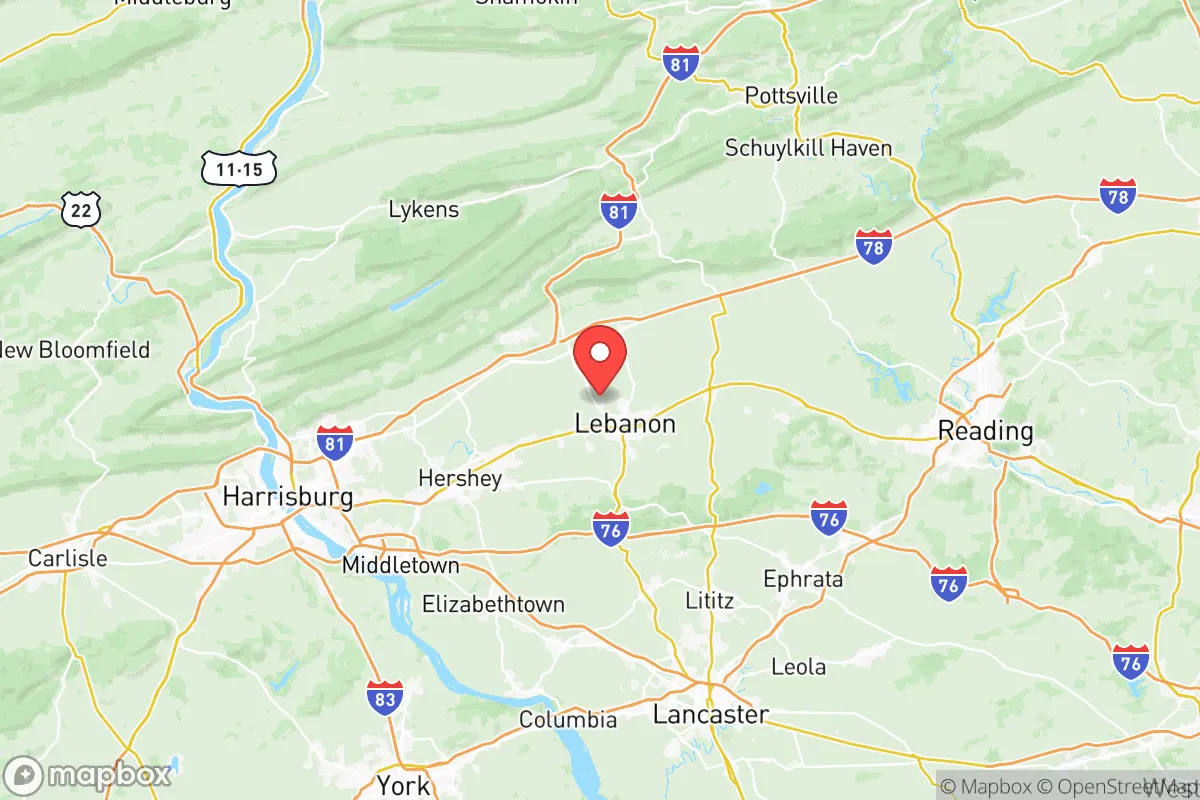
Photo: Wikipedia
Personal Sovereignty in Lebanon County
Strong independent fundamentals that actively favor personal liberty and low regulation.
What does Personal Sovereignty tell us?
Personal Sovereignty measures your capacity for self-reliance and independence with minimal government friction. Higher scores mean fewer barriers between you and the way you want to live... but it assumes you have the space you need and good neighbors.
What does this tell us?
Personal Sovereignty measures your capacity for self-reliance and independence with minimal government friction. Higher scores mean fewer barriers between you and the way you want to live... but it assumes you have the space you need and good neighbors.
State Policy
Energy independence: Net exporter (150% of energy produced in-state)
Personal Liberty
Homesteading

Personal Liberty Analysis
Lebanon County, Pennsylvania, offers a notably high degree of personal sovereignty compared to the Philadelphia or Pittsburgh metros, with a regulatory environment that generally favors individual autonomy over collective mandates. The county’s mix of small cities, rural townships, and historic boroughs creates a patchwork where a resident’s ability to live independently—from tax burden to gun rights to off-grid living—varies significantly by municipality. For a conservative-leaning individual or family seeking maximum freedom, understanding these local differences is as important as the state-level context.
Tax burden and regulatory posture: how Lebanon County compares to Pennsylvania’s norm
Lebanon County’s overall tax burden is moderate by Pennsylvania standards, but the real story is in the local regulatory posture. The county’s combined state and local tax burden is roughly 10.2% of income, slightly below the national average, with no county-level sales tax and a median property tax rate of about 1.5% of home value. However, the regulatory environment is far from uniform. In the city of Lebanon itself, zoning and business licensing are more structured, with a traditional urban code that can slow home-based enterprises. By contrast, townships like North Londonderry and South Londonderry maintain lighter-touch zoning, allowing for home occupations, small-scale agriculture, and accessory dwelling units with fewer hurdles. The county’s lack of a local income tax (most municipalities rely on property taxes and the state’s 3.07% flat income tax) is a clear advantage for wage earners. Business regulations are generally business-friendly, with no county-level occupational privilege tax, though some boroughs like Palmyra impose a modest per-capita tax. For a family or individual, the key takeaway is that unincorporated areas and rural townships offer the most regulatory breathing room, while the city of Lebanon and larger boroughs have more oversight.
Self-defense and gun law specifics: what Pennsylvania’s framework means for Lebanon County
Pennsylvania is a shall-issue state for concealed carry, and Lebanon County’s sheriff’s office processes permits efficiently—typically within 45 days. The county is overwhelmingly pro-Second Amendment, with no local ordinances restricting firearms beyond state law. Open carry is legal without a permit, and concealed carry requires a License to Carry Firearms (LTCF), which is issued to any applicant who passes a background check. The county’s rural townships, such as Bethel Township and Swatara Township, have a strong hunting culture, and firearm ownership is common. There are no county-level magazine capacity bans or assault weapon restrictions, as Pennsylvania preempts local gun laws. For self-defense, the state’s Castle Doctrine applies, with no duty to retreat in one’s home or vehicle. Stand-your-ground protections extend to any place where a person has a legal right to be. Lebanon County’s sheriff is known for a pro-license issuance posture, and the county’s gun culture is visible in local shooting ranges and gun shops. The only practical limitation is that firearms are prohibited in courthouses and K-12 schools, per state law. For a family prioritizing self-defense, Lebanon County offers a straightforward, low-restriction environment.
Self-reliance and homesteading viability: lot sizes, zoning, and off-grid feasibility
Homesteading and off-grid living are feasible in Lebanon County, but viability depends heavily on location. Rural townships like Union Township and East Hanover Township allow for larger lot sizes—typically 1 to 5 acres minimum—and have minimal restrictions on livestock, gardens, and outbuildings. In these areas, off-grid solar is permitted without special permits, and rainwater collection is legal (though not for potable use without treatment). The county’s agricultural zoning in areas like Jackson Township explicitly supports farming, including beekeeping, poultry, and small-scale livestock. However, the city of Lebanon and boroughs like Cleona and Jonestown have stricter codes: lot sizes are smaller (often under 0.25 acres), and raising chickens or goats may require a permit or be outright banned. Composting toilets and graywater systems are legal in rural townships but require a permit from the Pennsylvania Department of Environmental Protection, which can be a bureaucratic hurdle. The county’s water table is generally good for well drilling, and many rural properties have existing wells. For a family seeking true self-reliance, the northern and eastern townships offer the most freedom, while the more densely populated southern corridor near the Lebanon Valley Mall is less homestead-friendly.
Personal liberties: parental rights, medical autonomy, speech, and property
Lebanon County’s personal liberties environment is shaped by its conservative majority and local governance. Parental rights are strongly protected under Pennsylvania law, with no county-level mandates that override a parent’s authority in education or medical decisions. The county’s school districts—including Lebanon, Palmyra, and Northern Lebanon—have generally resisted controversial curriculum mandates, and school board meetings often reflect a community that values parental input. Medical autonomy is similarly robust: there are no county-level vaccine mandates or mask requirements, and the state’s COVID-era restrictions were largely lifted by 2023. The county’s health department is minimal, leaving most public health decisions to individual choice. Free speech is protected under the First Amendment, and the county has no local ordinances restricting political expression or assembly. Property rights are strong, with no county-level rent control or inclusionary zoning, and the eminent domain process is rarely used outside of infrastructure projects. The county’s right-to-farm law protects agricultural operations from nuisance lawsuits, which is a boon for homesteaders. The only notable limitation is that the county does not have a stand-alone home rule charter, meaning it operates under the Pennsylvania Borough Code and Township Code, which can vary in their interpretation of property rights. Overall, Lebanon County’s personal liberties environment is among the most permissive in the state, especially outside the city limits.
Compared to other Pennsylvania counties, Lebanon County offers a balanced sovereignty profile: lighter than the heavily regulated Philadelphia suburbs, but with more municipal variation than the deep-rural counties like Potter or Sullivan. For a family or individual prioritizing personal freedom, the county’s combination of low taxes, strong gun rights, and homestead-friendly rural townships makes it a strong contender. The key is to choose a municipality that aligns with your specific autonomy goals—whether that’s the open spaces of Union Township or the small-town feel of Palmyra. In a state where local control is the norm, Lebanon County stands out as a place where personal sovereignty is not just tolerated but actively supported by the community and its governance.

* Values derived from national, state, county, city and local statistics and may differ in a specific area. Last updated: 2026-07-23T11:52:47.000Z
Narrative content on this page is AI-generated and may contain mistakes. Verify any details that matter before acting on them.
ReloMaps may earn a commission from affiliate links at no extra cost to you.

