
Photo: Wikipedia
Personal Sovereignty in Indiana County
Strong independent fundamentals that actively favor personal liberty and low regulation.
What does Personal Sovereignty tell us?
Personal Sovereignty measures your capacity for self-reliance and independence with minimal government friction. Higher scores mean fewer barriers between you and the way you want to live... but it assumes you have the space you need and good neighbors.
What does this tell us?
Personal Sovereignty measures your capacity for self-reliance and independence with minimal government friction. Higher scores mean fewer barriers between you and the way you want to live... but it assumes you have the space you need and good neighbors.
State Policy
Energy independence: Net exporter (150% of energy produced in-state)
Personal Liberty
Homesteading

Personal Liberty Analysis
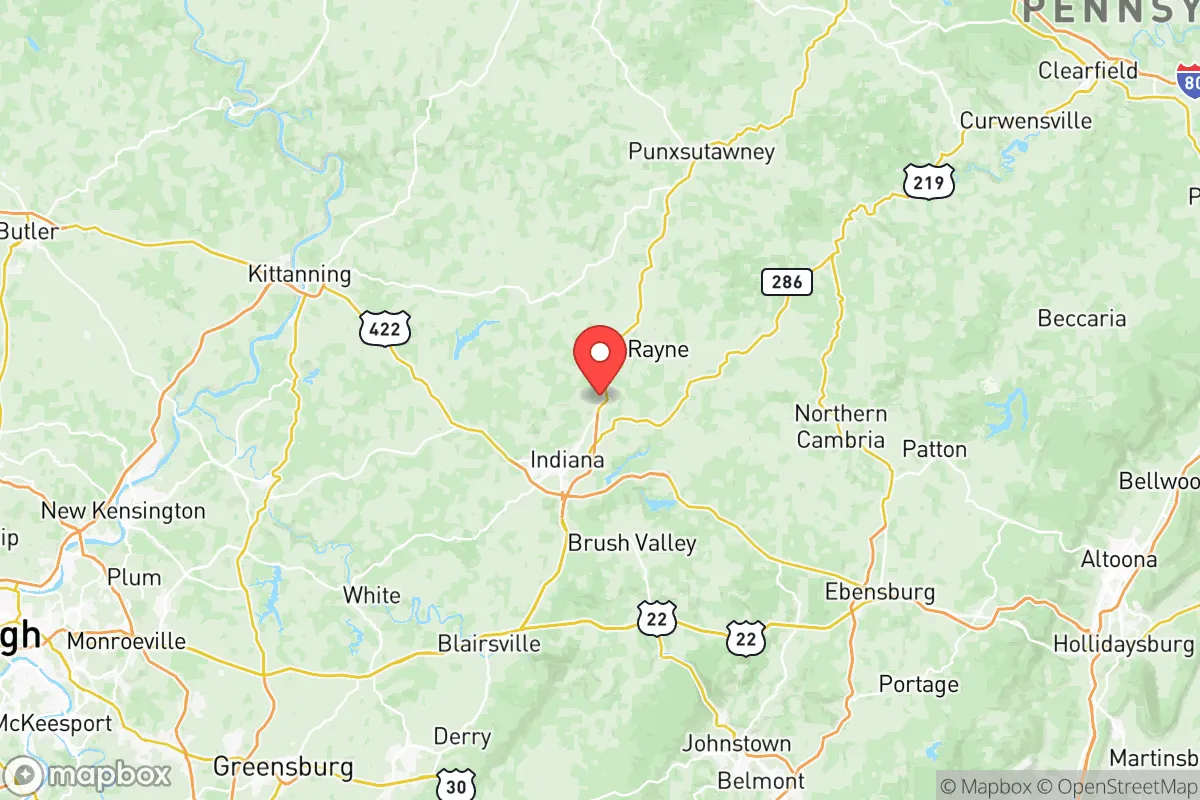
Indiana County, Pennsylvania offers a notably high degree of personal sovereignty compared to many suburban and urban areas in the Northeast, driven by a combination of low tax burdens, permissive gun laws, and a regulatory environment that largely leaves individuals and families to their own devices. The county’s rural character—anchored by the borough of Indiana, the county seat, and smaller communities like Blairsville, Homer City, and Clymer—means that state-level preemptions on local firearm ordinances and a generally light-touch approach to land use create an atmosphere where self-reliance is the norm rather than the exception. For a relocation audience prioritizing autonomy, this area stands out as a place where government interference in daily life is minimal, though the trade-off is fewer public services and a need for personal initiative.
Tax burden and regulatory posture in Indiana County
Pennsylvania’s tax structure is one of the most favorable in the country for those seeking to keep more of their earnings. The state levies a flat personal income tax of 3.07%—among the lowest in the nation—and Indiana County adds no additional county-level income tax. Property taxes are moderate: the county’s millage rate hovers around 5.0 mills, with school district taxes (such as those in the Indiana Area School District or Marion Center Area School District) adding roughly 15–20 mills, bringing total effective rates to about 1.5–2.0% of assessed home value. Sales tax is a flat 6% statewide, with no county add-ons. Regulatory posture is equally restrained: Indiana County has no countywide zoning ordinance, leaving land-use decisions to individual townships and boroughs. This means that in townships like White Township or Rayne Township, a resident can often operate a home-based business, keep livestock, or build a workshop without the layers of permitting common in more regulated counties. The result is a low-friction environment for entrepreneurs, homesteaders, and anyone who values the ability to use their property as they see fit.
Self-defense and gun law specifics in Indiana County
Pennsylvania is a shall-issue state for concealed carry permits, meaning that Indiana County’s sheriff must issue a license to carry a firearm to any qualified applicant who passes a background check—no discretionary denial or “good cause” requirement. The county’s sheriff, as of 2026, processes applications efficiently, with turnaround times typically under 30 days. Open carry is legal without a permit for anyone who can legally possess a firearm, and the county has no local ordinances restricting that right. Stand-your-ground protections apply statewide under Pennsylvania’s Castle Doctrine, which extends to vehicles and places of work, with no duty to retreat in any place where the individual is lawfully present. In practice, this means that in communities like Blairsville or Homer City, gun ownership is common and socially accepted, and there are no local restrictions on magazine capacity or firearm types beyond state law. The county’s rural character also means that shooting on private property is generally permissible, provided it is done safely and not within 150 yards of an occupied dwelling. For a reader prioritizing self-defense rights, Indiana County offers one of the most permissive legal environments in the Northeast.
Self-reliance and homesteading viability in Indiana County
Indiana County’s land-use policies make it a strong candidate for those seeking a self-reliant lifestyle. Lot sizes vary widely: in unincorporated townships like Armstrong Township or Green Township, parcels of 1 to 10 acres are common and affordable, with prices often under $5,000 per acre for raw land. Zoning is minimal—most townships have no zoning at all, and those that do, like White Township, typically allow agricultural uses, livestock, and accessory structures by right. Off-grid feasibility is high: well water is standard in rural areas, septic systems are permitted with a simple on-lot sewage permit (typically $200–$500), and solar panels are unrestricted by county or township ordinances. The county’s building code follows the state’s Uniform Construction Code, but enforcement is often lax in rural townships, and owner-built structures are permitted with proper inspections. For a family looking to raise chickens, keep goats, or grow a substantial garden, communities like Clymer and Penn Run offer the space and regulatory freedom to do so without neighbor complaints or HOA restrictions. The main limitation is access to high-speed internet in the most remote areas, though fixed wireless and satellite options are expanding.
Personal liberties in Indiana County
Beyond taxes and guns, Indiana County scores well on a range of personal liberty metrics. Parental rights are strong: Pennsylvania law allows for homeschooling with minimal oversight—a notarized affidavit and annual evaluation are the only requirements—and the county’s school districts, including Indiana Area and Homer-Center, are generally accommodating to homeschool families. Medical autonomy is respected: there are no county-level vaccine mandates, and the state’s medical marijuana program is operational, with dispensaries in nearby Westmoreland County. Free speech is protected under state and federal law, and the county has no local ordinances restricting political expression or assembly. Property rights are robust: eminent domain is rarely used, and the county’s assessment process is transparent, with appeals handled by the Indiana County Board of Assessment Appeals. For a reader concerned about government overreach, the combination of low taxes, minimal regulation, and strong legal protections for individual choice makes Indiana County a standout in Pennsylvania and the broader Mid-Atlantic region.
Overall, Indiana County offers a level of personal sovereignty that is rare in the Northeast and competitive with many parts of the Midwest and South. The county’s light regulatory touch, permissive gun laws, and affordable land create an environment where self-reliance is not just possible but encouraged. Compared to more regulated areas like Allegheny County (Pittsburgh) or Philadelphia, Indiana County provides a significantly higher degree of autonomy, with the trade-off being fewer public services and a need for personal initiative. For a single individual or family prioritizing freedom over convenience, this area ranks among the top choices in Pennsylvania.

* Values derived from national, state, county, city and local statistics and may differ in a specific area. Last updated: 2026-07-06T10:59:51.000Z
Narrative content on this page is AI-generated and may contain mistakes. Verify any details that matter before acting on them.
ReloMaps may earn a commission from affiliate links at no extra cost to you.

