
Photo: Wikipedia
Personal Sovereignty in Cambria County
Strong independent fundamentals that actively favor personal liberty and low regulation.
What does Personal Sovereignty tell us?
Personal Sovereignty measures your capacity for self-reliance and independence with minimal government friction. Higher scores mean fewer barriers between you and the way you want to live... but it assumes you have the space you need and good neighbors.
What does this tell us?
Personal Sovereignty measures your capacity for self-reliance and independence with minimal government friction. Higher scores mean fewer barriers between you and the way you want to live... but it assumes you have the space you need and good neighbors.
State Policy
Energy independence: Net exporter (150% of energy produced in-state)
Personal Liberty
Homesteading

Personal Liberty Analysis
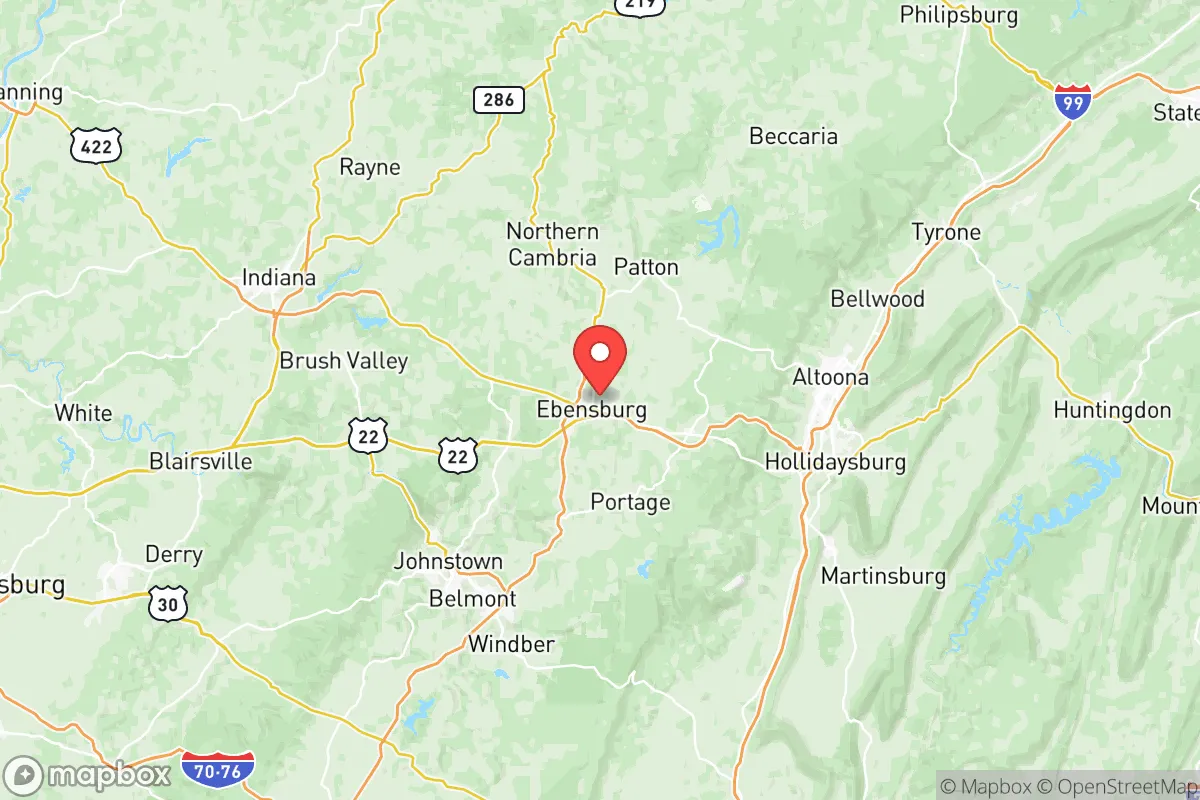
Cambria County, Pennsylvania, offers a notably high degree of personal sovereignty compared to many mid-Atlantic and Northeastern locales, largely due to its rural character, relatively low population density, and Pennsylvania’s state-level legal framework. The county’s regulatory environment is light-touch, its tax burden is moderate, and its gun laws are among the most permissive in the region, creating a strong foundation for self-reliant living. However, the degree of autonomy varies significantly between the county’s small cities—like Johnstown and Ebensburg—and its more remote townships, such as those around Northern Cambria or Portage, where zoning is minimal and property rights are more absolute.
Tax burden and regulatory posture in Cambria County
Pennsylvania’s flat state income tax rate of 3.07% is a key advantage for residents seeking fiscal predictability, and Cambria County adds a relatively modest county-level tax. The county’s total effective property tax rate hovers around 1.5% of assessed value, which is competitive for the region. Municipal taxes vary: Johnstown imposes a higher earned income tax (around 1.5%) to fund city services, while townships like Summerhill or Dean Township levy minimal or no local earned income tax. The regulatory posture is generally permissive. There is no county-wide zoning in unincorporated areas, meaning that in townships like Barr Township or Blacklick Township, residents can often build structures, keep livestock, or operate home-based businesses without extensive permitting. The Pennsylvania Department of Environmental Protection (DEP) does enforce state-level environmental regulations, particularly concerning water rights and septic systems, but these are typically less onerous than in states with more aggressive environmental agencies. For a reader prioritizing low regulatory overhead, the townships outside of Johnstown and Ebensburg offer the lightest touch.
Self-defense and gun law specifics in Cambria County
Pennsylvania is a shall-issue state for concealed carry permits, and Cambria County’s Sheriff’s Office processes applications efficiently, typically within a few weeks. The county is home to a strong gun culture, with multiple shooting ranges and gun shops in areas like Richland Township and Nanty Glo. Open carry is legal without a permit for anyone legally allowed to possess a firearm, and the county’s rural character means that open carry is a common sight in towns like Carrolltown and Hastings. Stand-your-ground laws apply in Pennsylvania, and there is no duty to retreat in any place where a person is legally permitted to be. Castle doctrine protections are also in place for homes and vehicles. The county’s courts are generally conservative on self-defense issues; a 2023 case in Cambria County saw a homeowner acquitted under the Castle Doctrine after a defensive shooting in a rural township. For a reader concerned with self-defense autonomy, Cambria County presents a favorable legal environment, with the caveat that Johnstown’s city ordinances restrict firearm discharge within city limits, a rule not present in the surrounding townships.
Self-reliance and homesteading viability in Cambria County
Homesteading and off-grid living are highly viable in Cambria County’s rural townships, where lot sizes are generous and zoning is minimal. In townships like West Carroll Township and East Taylor Township, minimum lot sizes for residential use are often one acre or less, but many parcels of 5 to 20 acres are available at prices well below the national median—often under $5,000 per acre. Off-grid feasibility is strong: Pennsylvania does not require a grid connection for a primary residence, though a septic system must meet DEP standards. Rainwater collection is legal without restriction, and solar panel installation is not subject to county-level permitting in most townships. However, in Johnstown and Ebensburg, city codes require grid-tied electrical systems and impose stricter building codes. For a reader seeking true self-reliance, the townships around Portage and Northern Cambria offer the best combination of low land costs, minimal regulation, and access to natural resources like timber and water. The county’s agricultural history means that many properties already have wells and septic systems, reducing the upfront cost of homesteading.
Personal liberties in Cambria County
Parental rights are strongly protected under Pennsylvania law, and Cambria County’s school districts—such as Cambria Heights and Penn Cambria—generally defer to parental authority on educational and medical decisions. Medical autonomy is supported by the state’s lack of a vaccine mandate for adults and its relatively permissive stance on alternative medical treatments, though the county’s healthcare infrastructure is limited, with the main hospital in Johnstown (Conemaugh Memorial Medical Center) offering standard care. Free speech is robustly protected; the county has seen few controversies over public expression, and local government meetings are generally open and accessible. Property rights are a cornerstone of the county’s identity. Eminent domain is rarely used outside of infrastructure projects, and the county’s tax assessment system is transparent, with appeals readily available. In townships like Stonycreek Township, property owners have near-total control over land use, subject only to state environmental regulations. The county’s courts have a reputation for upholding property rights in disputes, particularly in cases involving boundary lines or easements.
Overall, Cambria County ranks among the more sovereignty-friendly areas in Pennsylvania, particularly for those who choose to live outside its small cities. The combination of a low tax burden, permissive gun laws, minimal zoning in townships, and strong property rights creates an environment where personal autonomy is the default. For a reader comparing it to other regions, Cambria County offers a level of self-reliance that is rare in the Northeast but comparable to rural areas in the Midwest or Appalachia. The key trade-off is access to services: Johnstown and Ebensburg provide more amenities but impose more regulations, while the townships offer maximum freedom with fewer conveniences. For a family or individual prioritizing personal sovereignty, the townships of Cambria County represent a compelling option.

* Values derived from national, state, county, city and local statistics and may differ in a specific area. Last updated: 2026-07-09T07:46:54.000Z
Narrative content on this page is AI-generated and may contain mistakes. Verify any details that matter before acting on them.
ReloMaps may earn a commission from affiliate links at no extra cost to you.

