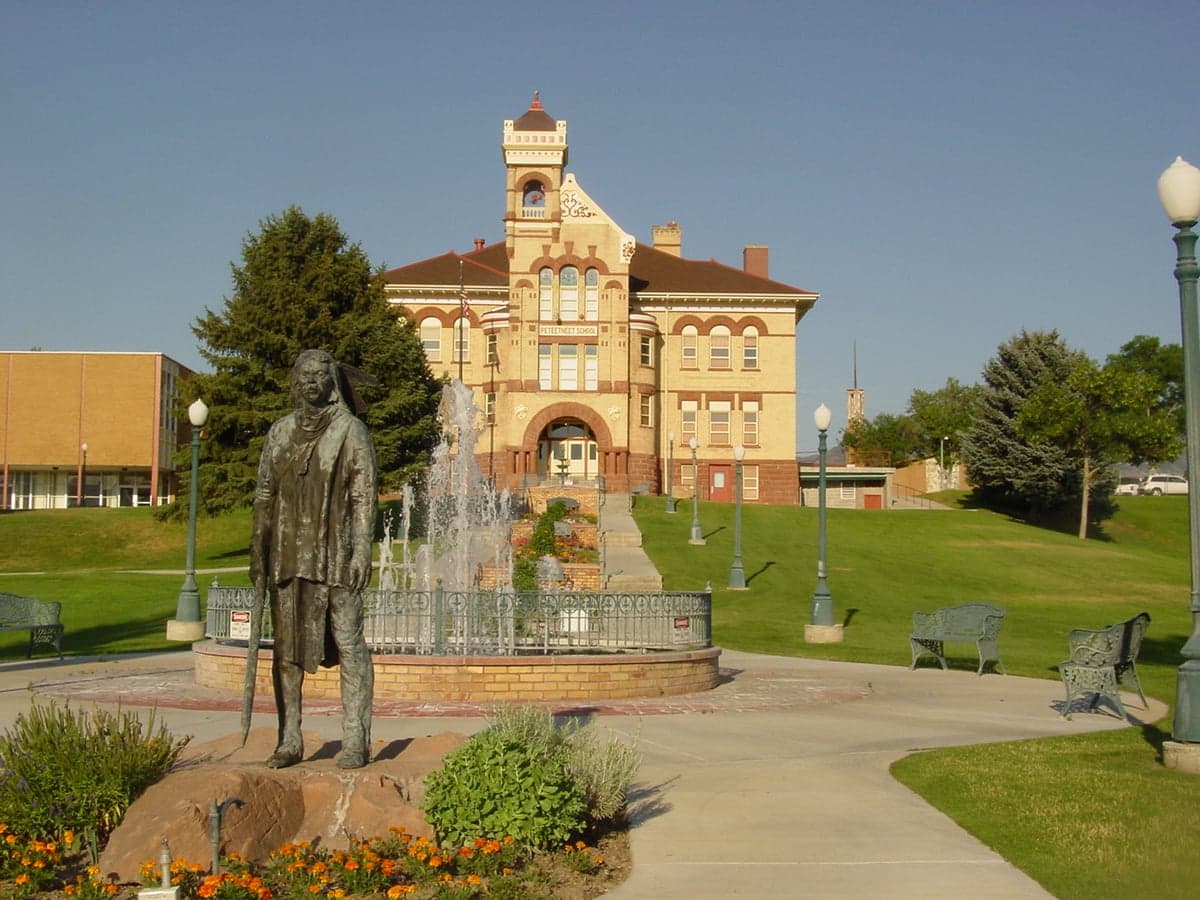
Photo: Wikipedia
Demographics of Payson, UT
Affluence Level in Payson, UT
A middle-class area roughly in line with national averages across income, home values, education, and employment.
People of Payson, UT
The people of Payson, Utah, today number 22,205 and form a predominantly white (77.2%) and Hispanic (17.9%) community with a strong Latter-day Saint cultural foundation and a growing blue-collar and suburban identity. The city retains a small-town feel with a population density of roughly 3,200 people per square mile, and its residents are notably less college-educated (26.6%) than the state average, reflecting a workforce rooted in trades, manufacturing, and local services. Distinctive markers include a high rate of homeownership, a deep connection to pioneer heritage, and a family-oriented character that draws in-migrants seeking affordable housing relative to Utah County’s pricier cities.
How the city was settled and grew
Payson’s human history begins with Mormon pioneers sent by Brigham Young in 1850 to settle the southern Utah Valley. The first wave, primarily families from the British Isles and Scandinavia who had converted to the LDS Church, arrived to farm the fertile benchlands and establish a fort for protection against Ute tribes. The original settlement clustered around what is now Historic Downtown Payson, centered on Utah Avenue and 100 East, where the first log homes and the Payson Tabernacle were built. By the 1870s, the arrival of the Utah Southern Railroad spurred a second wave of settlers, including miners and merchants drawn to the nearby Tintic Mining District. These newcomers built homes in the Payson Lakes area and along the West Mountain foothills, establishing a pattern of dispersed rural homesteads. The city’s population grew steadily through the early 1900s, reaching about 1,800 by 1910, supported by agriculture, the Geneva Steel plant in nearby Vineyard, and small-scale manufacturing. The Peteetneet Creek corridor became a hub for Italian and Greek immigrant laborers who worked on the railroad and in the orchards, though their numbers remained small.
Modern era (post-1965)
After the 1965 Immigration and Nationality Act, Payson saw minimal direct foreign immigration, with the foreign-born population today at just 5.0%. Instead, the city’s modern growth has been driven by domestic in-migration from other parts of Utah and the Intermountain West. The 1970s through 1990s brought a wave of families from the Salt Lake Valley seeking cheaper land and a quieter lifestyle, settling in subdivisions like Salem Hills (technically in Payson’s northern annexation area) and Payson Canyon developments. The Hispanic population began growing in the 1990s, driven by agricultural labor in the surrounding fruit orchards and construction jobs during Utah County’s building boom. Today, Hispanic residents (17.9%) are concentrated in the East Payson neighborhoods near 800 East and the Payson City Center area, where older, more affordable housing stock and rental properties are located. The Asian population (0.3%) and Indian subcontinent population (0.2%) remain negligible, with most families in those groups being professionals employed at Brigham Young University or in Provo’s tech sector, living in newer subdivisions like Payson Meadows. The Black population (0.1%) is similarly tiny, reflecting the broader Wasatch Front’s low African American presence. The city’s white population, while still dominant, has declined from over 90% in 1990 as Hispanic families have moved in, though the overall racial character remains overwhelmingly non-Hispanic white and LDS.
The future
Payson’s population is projected to continue growing steadily, driven by its reputation as an affordable alternative to Provo and Orem. The city’s master plan anticipates adding roughly 5,000–8,000 residents by 2040, with most new housing concentrated in the Payson North area near Interstate 15 and along the Payson Parkway corridor. The Hispanic share is likely to increase modestly, potentially reaching 22–25% by 2040, as younger families move into entry-level homes and rental units in East Payson and the Payson City Center redevelopment zone. The white population will remain the majority but continue its gradual decline in percentage terms. The Asian and Indian populations are expected to grow slowly, likely remaining under 2% combined, as tech and healthcare jobs in Utah County attract a small number of professionals. The city’s cultural identity is evolving from a purely pioneer-LDS enclave to a more economically diverse community, though the LDS Church’s influence remains strong—over 80% of residents are estimated to be members. For someone moving in now, Payson offers a stable, family-oriented environment with a growing Hispanic presence and a conservative political tilt, but it is not becoming a multicultural hub. The future points to a slightly more diverse, still predominantly white, and increasingly suburban city that retains its small-town roots while absorbing growth from the expanding Wasatch Front.
Payson is becoming a more affordable, family-focused satellite of Utah County’s economic engine, with a demographic trajectory that favors slow diversification rather than rapid change. For a relocating family or individual, this means a community with strong social cohesion, low crime, and a clear cultural identity, but limited racial or ethnic variety outside the growing Hispanic population. The city’s character is best suited for those who value traditional values, outdoor recreation, and a slower pace of life, with the understanding that its demographic future will look much like its present—predominantly white, LDS-influenced, and gradually more Hispanic.

* Values derived from national, state, county, city and local statistics and may differ in a specific area. Last updated: 2026-11-06T03:24:06.000Z
Narrative content on this page is AI-generated and may contain mistakes. Verify any details that matter before acting on them.
ReloMaps may earn a commission from affiliate links at no extra cost to you.

