
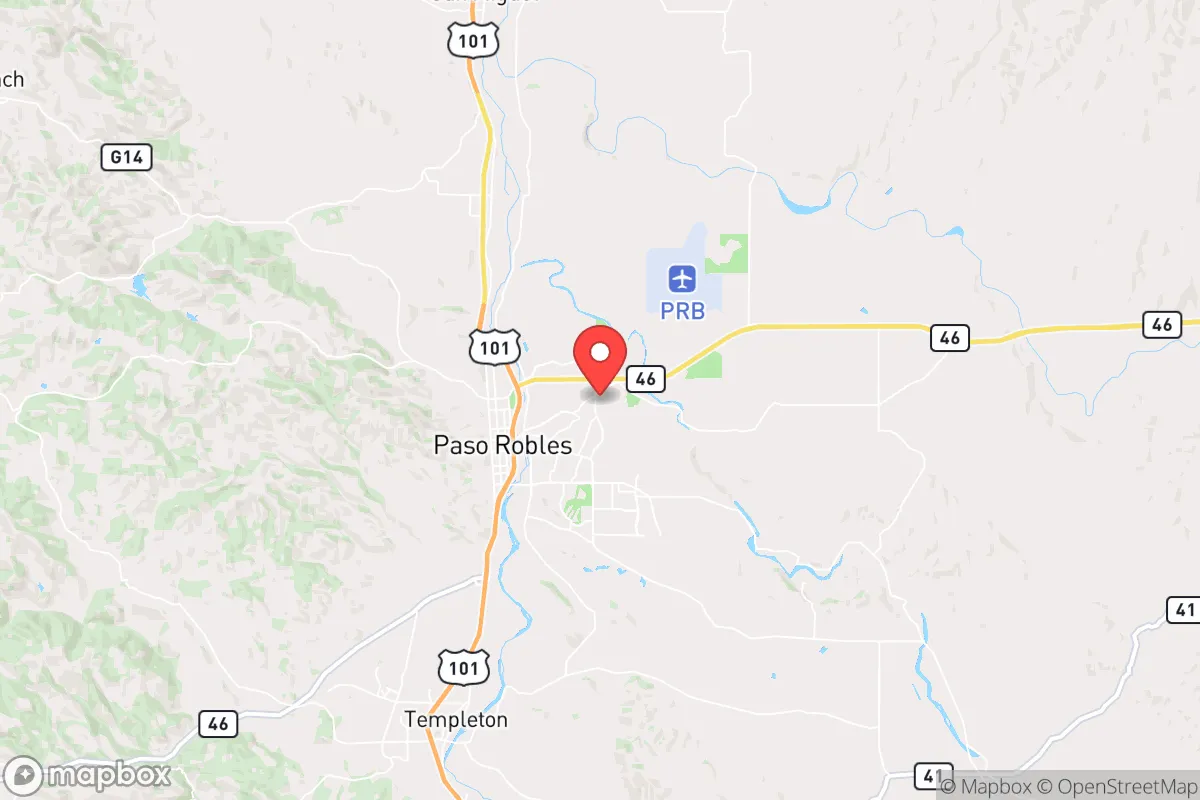
Photo: Wikipedia
Personal Sovereignty in Paso Robles, CA
Moderate friction. Expect trade-offs in some aspect of personal liberty and independence.
What does Personal Sovereignty tell us?
Personal Sovereignty measures your capacity for self-reliance and independence with minimal government friction. Higher scores mean fewer barriers between you and the way you want to live... but it assumes you have the space you need and good neighbors.
What does this tell us?
Personal Sovereignty measures your capacity for self-reliance and independence with minimal government friction. Higher scores mean fewer barriers between you and the way you want to live... but it assumes you have the space you need and good neighbors.
State Policy
Energy independence: Importer (33% of energy produced in-state)
Personal Liberty
Homesteading

Personal Liberty Analysis
Paso Robles offers a notably high degree of personal sovereignty relative to most coastal California cities, driven by its inland agricultural character and a local culture that prizes self-reliance. While residents operate under California’s statewide regulatory framework—which is among the most comprehensive in the nation—the practical enforcement and local political climate in northern San Luis Obispo County lean significantly more libertarian than what one finds in Los Angeles or the Bay Area. For a single individual or family prioritizing autonomy, Paso Robles represents a meaningful trade-off: you accept California’s baseline tax and regulatory structure, but gain a community where local officials are generally skeptical of overreach, property rights are respected, and a do-it-yourself ethos is the norm.
Tax burden and regulatory posture in Paso Robles
California’s state-level tax burden is high—top marginal income tax rate of 13.3% and a state sales tax that reaches 8.75% in Paso Robles—but the city itself does not add a local income tax. Property taxes are effectively capped at roughly 1% of assessed value under Proposition 13, with annual increases limited to 2%, which provides long-term predictability for homeowners. The regulatory posture in Paso Robles is lighter than in most of coastal California: the city’s planning department is known for relatively streamlined permitting for single-family homes and agricultural uses, and the county’s zoning code explicitly supports farming and winery operations as primary land uses. However, new construction still faces California Environmental Quality Act (CEQA) review, and building permits can take several months. For a reader accustomed to Texas or Florida, the permitting process will feel slow; for someone coming from the Bay Area, it will feel refreshingly straightforward. The city’s general plan emphasizes preserving rural character, which means fewer density mandates and less pressure for high-density housing than in larger metros.
Self-defense and gun law specifics in San Luis Obispo County
California is a “may-issue” state for concealed carry permits, but San Luis Obispo County has historically been one of the more permissive counties in the state. The sheriff’s office issues CCW permits to applicants who demonstrate “good cause,” and in practice, the standard has been interpreted broadly—self-defense for personal protection is generally accepted as sufficient cause, unlike in coastal urban counties where permits are rarely issued. As of 2025, the county processes applications within 90–120 days, and the required training course is 16 hours. Open carry of handguns is prohibited, and all firearm purchases require a 10-day waiting period and a Firearm Safety Certificate. Magazine capacity is limited to 10 rounds, and the state maintains a roster of approved handguns. Paso Robles has no local ordinances restricting firearms beyond state law, and the city’s rural culture means gun ownership is common and socially accepted. For a reader prioritizing self-defense rights, this is the most favorable environment available within California, though it remains restrictive compared to states like Arizona or Nevada.
Self-reliance and homesteading viability: lot sizes, zoning, and off-grid feasibility
Paso Robles is one of the few places in coastal California where genuine homesteading is still feasible. The city’s zoning allows for residential lots as small as 6,000 square feet in suburban subdivisions, but agricultural zoning (AG) permits parcels of 20 acres or more where livestock, orchards, and vineyards are standard uses. Outside city limits, San Luis Obispo County allows accessory dwelling units (ADUs) on agricultural parcels without additional parking requirements, and the county’s code explicitly permits “farmworker housing” as a by-right use. Off-grid living is legally complicated: California requires connection to the electrical grid for new construction in most areas, but solar panels with net metering are widely used, and many rural properties rely on private wells and septic systems. Rainwater catchment is legal without a permit for non-potable uses. The county’s building code requires permits for structures over 120 square feet, so a small shed or greenhouse is fine, but a full off-grid cabin requires formal approval. For a family wanting to raise chickens, keep goats, and grow a substantial garden, Paso Robles is highly viable; for someone seeking complete off-grid independence, the regulatory hurdles are significant but not insurmountable, especially on larger agricultural parcels.
Personal liberties: parental rights, medical autonomy, speech, and property
California’s state laws on parental rights are mixed. Parents have broad authority over their children’s education—homeschooling is legal and straightforward, with a simple private school affidavit required—but the state mandates vaccination for school attendance, and medical autonomy for minors is limited by parental consent requirements. In Paso Robles, the local school district (Paso Robles Joint Unified) has a conservative board majority as of 2025, and parental notification policies for sensitive topics are in place. Medical freedom is constrained by California’s strict licensing laws: alternative treatments like ivermectin or hydroxychloroquine are not prohibited, but doctors face professional risk in prescribing them off-label. Speech is fully protected under the First Amendment, and Paso Robles has no local ordinances restricting public expression. Property rights are relatively strong: the city does not impose rent control, and short-term rental regulations are moderate (a permit is required for whole-home STRs, but owner-occupied units are exempt). Eminent domain is rarely used, and the county’s zoning code protects agricultural uses from nuisance complaints—a “right to farm” ordinance shields standard farming practices from lawsuits by new residents.
Overall, Paso Robles offers the highest degree of personal sovereignty available in a California coastal climate, but it is not a low-regulation environment by national standards. Compared to rural counties in Idaho, Texas, or Montana, the tax burden is higher, gun laws are more restrictive, and off-grid living requires more permits. However, for someone who values California’s geography, wine country lifestyle, and moderate climate, Paso Robles represents a pragmatic middle ground: a community where self-reliance is respected, local government is generally hands-off, and the state’s regulatory weight is felt less heavily than in urban areas. A single individual or family moving here should expect to navigate California’s baseline rules but will find a local culture that supports independence, property rights, and a live-and-let-live ethos uncommon in the state’s coastal corridor.

* Values derived from national, state, county, city and local statistics and may differ in a specific area. Last updated: 2026-09-02T21:56:32.000Z
Narrative content on this page is AI-generated and may contain mistakes. Verify any details that matter before acting on them.
ReloMaps may earn a commission from affiliate links at no extra cost to you.

