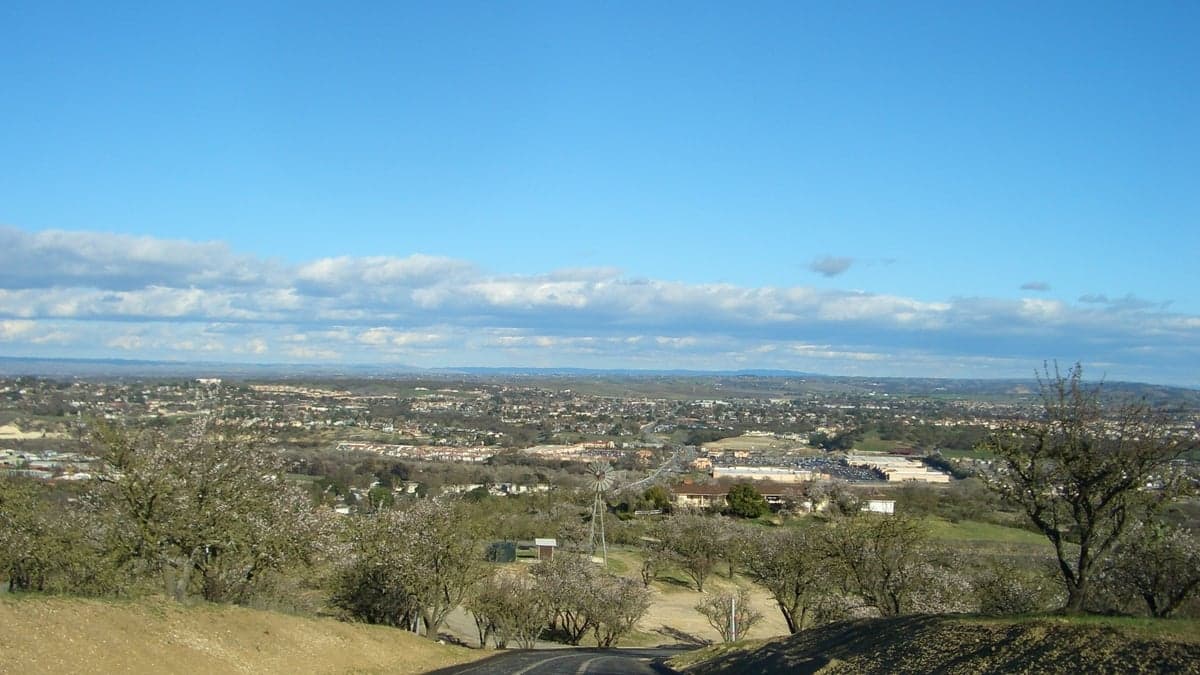
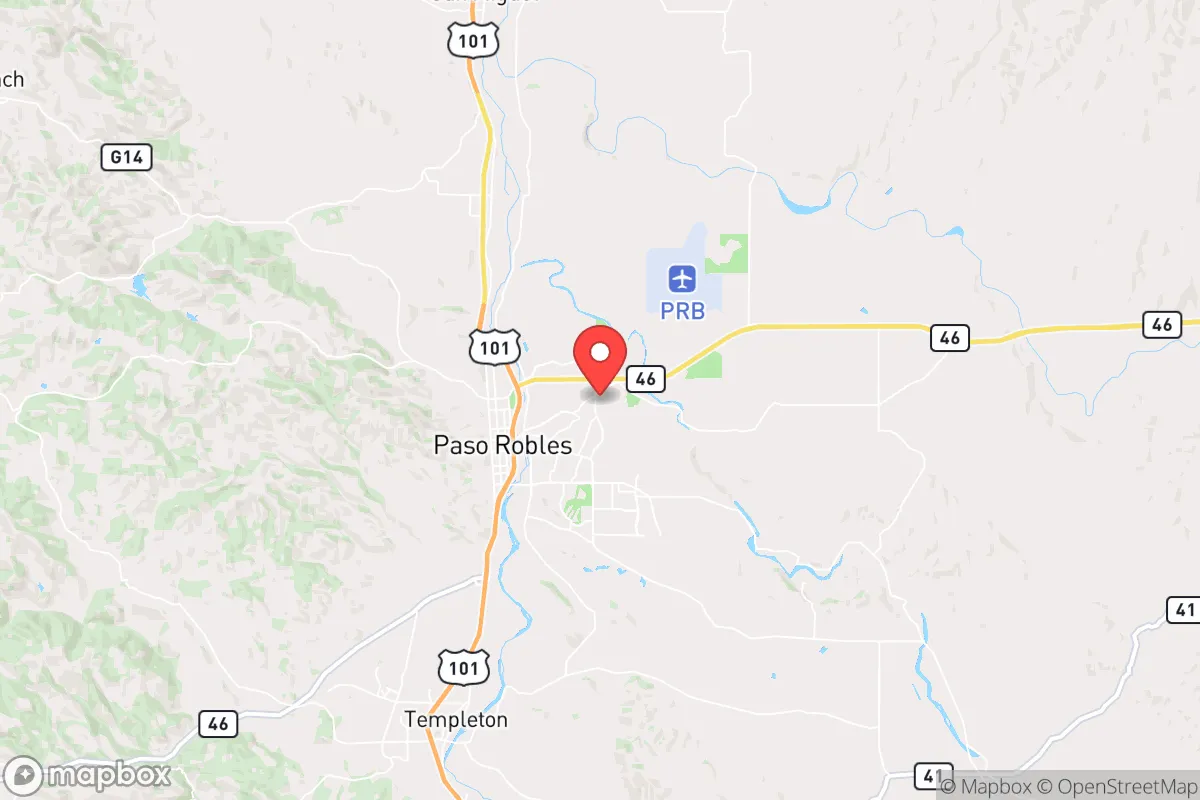
Photo: Wikipedia
Demographics of Paso Robles, CA
Affluence Level in Paso Robles, CA
An upper-middle-class area. Household wealth, education levels, and homeownership run ahead of national benchmarks.
People of Paso Robles, CA
The people of Paso Robles today number roughly 31,400, forming a community that is distinctly bicultural — just over half the population identifies as White (53.3%) while more than a third identifies as Hispanic or Latino (36.6%). The city is less diverse in other dimensions: East and Southeast Asian residents make up 2.2% of the population, Indian-subcontinent residents 0.9%, and Black residents 0.3%, with a foreign-born share of 9.7% that is well below the California average. Despite its inland location, Paso Robles has a notably young, family-oriented character, with a median age around 34 and a college attainment rate of 29.1% that reflects the professional pull of the wine and hospitality industries.
How the city was settled and grew
Paso Robles was originally inhabited by the Salinan people, but the city's modern population history begins with the 1844 Mexican land grant of Rancho Paso de Robles, awarded to José Pedro Narváez. After California statehood, the area attracted Anglo-American settlers drawn to the hot springs and stagecoach routes, and the town was formally platted in 1886 with the arrival of the Southern Pacific Railroad. The earliest residential core developed around the downtown Downtown Core and Spring Street neighborhoods, where merchants, railroad workers, and hotel staff built modest wood-frame houses. A second wave arrived in the early 20th century, driven by almond and alfalfa farming, and later by the discovery of oil in the 1920s. This period saw the growth of Sherwood Forest, a neighborhood of bungalows and cottages built for oil-field workers and their families, and Paso Robles Highlands, where more prosperous ranchers and business owners settled on larger lots. The population remained overwhelmingly White and native-born through the mid-20th century, with a small Mexican-origin community concentrated near the railroad tracks in what is now the Southside district.
Modern era (post-1965)
The 1965 Hart-Cellar Act and the subsequent expansion of agricultural labor opportunities reshaped Paso Robles's demographics significantly. Mexican and Central American immigrants arrived in growing numbers to work in the vineyards and orchards, settling primarily in the Southside and Beeson Tract neighborhoods, where older, more affordable housing stock and proximity to agricultural jobs created a stable Hispanic enclave. By the 1990s, the wine industry boom — Paso Robles earned AVA status in 1983 — began attracting a different wave of domestic in-migrants: professionals, retirees, and entrepreneurs from coastal California and out of state. These newcomers gravitated toward newer subdivisions on the city's north and east edges, including Lake Nacimiento Estates and the master-planned Chimney Rock area, where larger homes and vineyard views appealed to higher-income buyers. The result is a city where the Hispanic population is concentrated in older, central and southern neighborhoods, while the White population is more dispersed across newer, more affluent subdivisions. The East/Southeast Asian and Indian-subcontinent communities remain small but are growing slowly, drawn by professional opportunities in healthcare and winemaking, and tend to settle in the newer northern tracts rather than the historic core.
The future
Paso Robles is becoming slightly more diverse, but the pace is gradual. The Hispanic share has risen from roughly 25% in 2000 to 36.6% today, and this trend is expected to continue as younger Hispanic families have higher birth rates and as agricultural and service-sector jobs continue to attract immigrants. The White share, while still a majority, is slowly declining. The East/Southeast Asian and Indian-subcontinent populations are likely to grow modestly as the city's healthcare sector expands — Twin Cities Community Hospital is a major employer — but Paso Robles lacks the large tech or university anchor that drives rapid diversification in other California cities. New housing developments on the city's periphery, such as the planned Airport Area and Union Road corridors, are attracting a mix of first-time homebuyers and retirees, but these areas remain predominantly White and higher-income. The cultural identity of Paso Robles is evolving from a rural farm town with a Hispanic labor force into a more economically stratified community where the wine-country lifestyle and the agricultural heritage coexist uneasily.
For someone moving in now, Paso Robles offers a community that is stable, family-oriented, and politically moderate — but one where the demographic divide between older, wealthier, White neighborhoods and younger, more Hispanic, working-class areas is visible and likely to persist. The city is not becoming a melting pot in the manner of coastal California; rather, it is a place where two distinct populations share the same geography but often different social and economic worlds. New arrivals should expect a community that values its agricultural roots and small-town feel, but where the future will be shaped by how these two groups integrate — or remain separate.

* Values derived from national, state, county, city and local statistics and may differ in a specific area. Last updated: 2026-09-02T21:56:32.000Z
Narrative content on this page is AI-generated and may contain mistakes. Verify any details that matter before acting on them.
ReloMaps may earn a commission from affiliate links at no extra cost to you.

