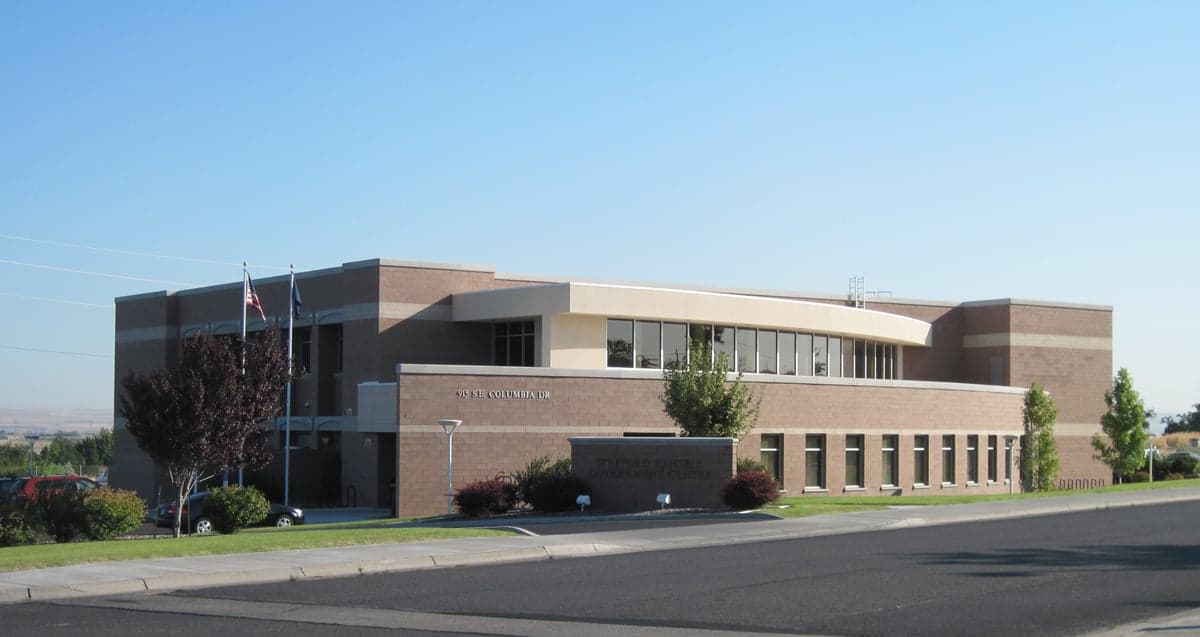
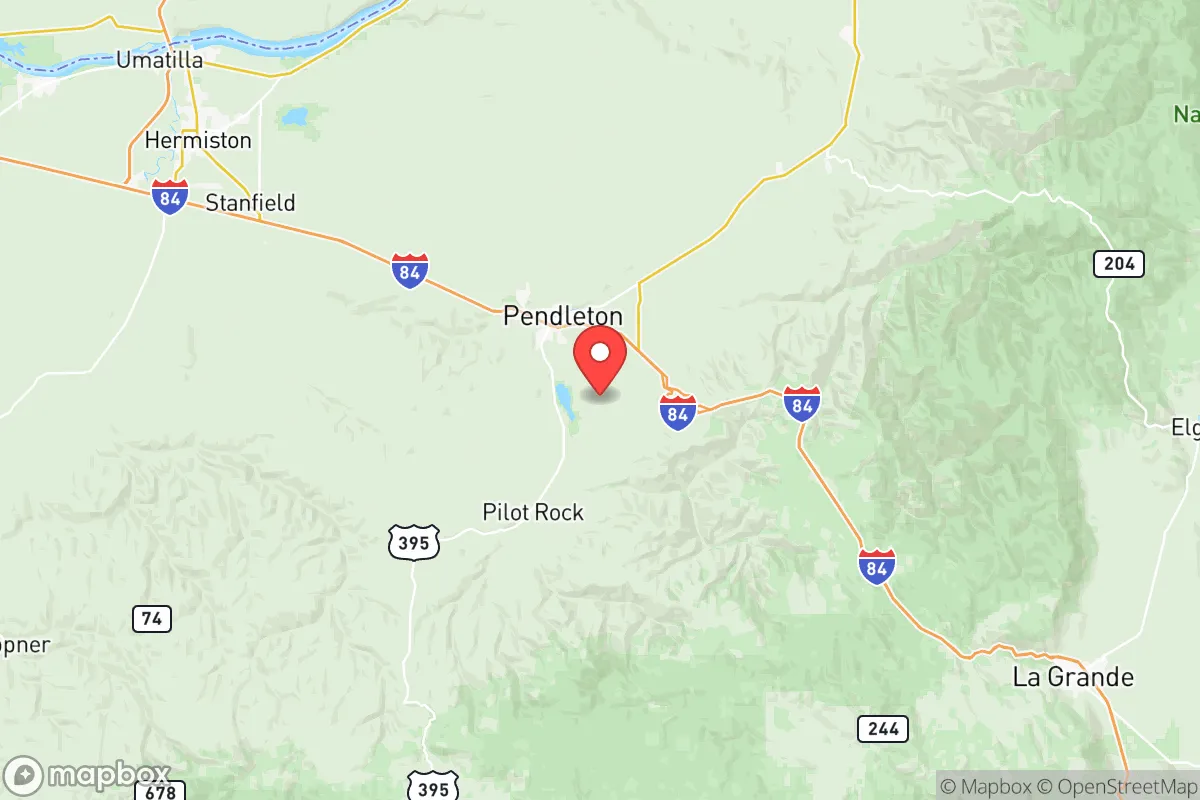
Photo: Wikipedia
Political ClimatePolitical Climate in Umatilla County
Showing district-level results — no local-only data available.
Local Political AnalysisPolitical Analysis of Umatilla County
Umatilla County is one of the most reliably Republican areas in Oregon, carrying a Cook Partisan Voting Index (PVI) of R+14. That means the county votes about 14 points more Republican than the national average, a stark contrast to the state of Oregon as a whole, which sits at D+8. The county has not voted for a Democratic presidential candidate since Lyndon B. Johnson in 1964, and in 2024, Donald Trump won the county by a margin of roughly 30 points. The political center of gravity here is not just red — it's a deep, durable shade of crimson that has only deepened over the last two decades.
How it compares to Oregon
The gap between Umatilla County and the rest of Oregon is enormous. While the state leans Democratic by 8 points, Umatilla leans Republican by 14 — a 22-point chasm in partisan orientation. This makes Umatilla one of the most conservative counties in a state dominated by the liberal Portland metro area and the Willamette Valley. The county's politics are closer to Idaho's than to Oregon's coastal cities. In the 2022 gubernatorial race, Republican Christine Drazan won Umatilla County with 58% of the vote, while Democrat Tina Kotek took the state by a narrow margin. That disconnect is a daily reality: residents here often feel their votes are canceled out by the population centers west of the Cascades.
What this means for residents
For conservative residents, Umatilla County is a comfortable place to live politically. Local offices — from the county commission to the sheriff — are held by Republicans, and policy debates tend to center on agriculture, water rights, and property taxes rather than urban issues like transit or rent control. For liberal residents, it can feel isolating. There are no reliably blue precincts in the county, though Pendleton and Hermiston show the most variation. Pendleton, the county seat, has a handful of precincts that occasionally vote within 5 points of a Democrat, especially in local races. Athena and Weston are deeply conservative, while Milton-Freewater leans red but with a notable Hispanic electorate that sometimes shifts the needle on immigration-related ballot measures. Echo and Umatilla are reliably Republican, with little swing. The practical effect for liberals is that they often have to drive to Portland or Bend to find a political community, though local Democratic groups do exist in Pendleton and Hermiston.
Culturally, the county's politics show up in everyday life. Gun rights are broadly supported, and you'll see "Don't Tread on Me" flags alongside American flags in rural areas. The county has a strong agricultural identity — wheat, cattle, and potatoes dominate — and that shapes policy priorities like water storage and land use. There is also a growing tension between long-time residents and newer arrivals from California and Washington, who sometimes bring different political expectations. That dynamic is most visible in Hermiston, the fastest-growing city in the county, where new housing developments are drawing a mix of retirees and remote workers. For now, the county's political trajectory remains firmly rightward, but if Hermiston continues to grow, it could become a bellwether for whether Umatilla County stays R+14 or drifts closer to the state average over the next decade.

State Political ClimatePolitical Climate in Oregon
State Political AnalysisPolitical Environment in the State
Oregon is a reliably Democratic state at the presidential level, with a Cook PVI of D+8, but that blue veneer hides one of the most politically fractured landscapes in the country. The state has shifted leftward over the past 20 years, driven by explosive growth in the Portland metro area, but that shift has been met with fierce resistance from rural and exurban counties, creating a political climate that feels like two different states under one roof. For a conservative-leaning relocator, the reality is nuanced: you can find deep-red communities with strong property rights and low crime, but you will be living under a state government that consistently passes progressive legislation on taxes, guns, education, and land use.
Urban vs. rural divide
The political map of Oregon is a study in extremes. Multnomah County (Portland) alone accounts for roughly 20% of the state's vote and delivers margins of 75-80% for Democrats, making it the engine of the state's blue lean. Washington County (suburban Portland, including Hillsboro and Beaverton) has shifted from purple to solidly blue over the past decade, driven by the tech and semiconductor workforce. Lane County (Eugene) and Benton County (Corvallis) add another layer of progressive votes from the university towns. Meanwhile, the rest of the state is overwhelmingly Republican. Eastern Oregon counties like Malheur, Harney, and Lake routinely vote 70-80% Republican. The I-5 corridor south of Eugene, including Douglas and Jackson counties, has trended redder as conservative-leaning Californians have moved in. A notable recent shift: Deschutes County (Bend) flipped from reliably red to a competitive purple in the 2010s and 2020s, as remote workers and retirees from California and Portland reshaped the electorate. If you are looking for a politically like-minded community as a conservative, your best bets are the rural Willamette Valley towns like Molalla and Stayton, the Rogue Valley around Grants Pass, or the high desert around Redmond and Prineville.
Policy environment
Oregon's state-level policy environment is decidedly progressive, and it has real teeth. The state has no sales tax, which sounds appealing, but it is paired with a progressive income tax that tops out at 9.9% on high earners and a property tax system that, while capped by Measure 50 (1997), still runs high in urban counties. Land use is governed by the statewide Urban Growth Boundary system, which restricts development and drives up housing costs, particularly in the Willamette Valley. On education, Oregon has moved toward centralization: the 2019 Student Success Act poured $1 billion into K-12 through a corporate activities tax, but test scores remain below national averages and school choice options are limited compared to states like Arizona or Florida. Healthcare policy is dominated by the Oregon Health Plan, the state's Medicaid expansion, which covers about one in four residents. Election law is among the most accessible in the nation: Oregon was the first state to vote entirely by mail (1998), and automatic voter registration at the DMV has driven turnout consistently above 70%. For a conservative, the policy environment means paying high income taxes and living under restrictive land-use laws, even if your local county government is friendly.
Recent policy direction
The last five years have seen Oregon's legislature push aggressively on several fronts that matter to relocators weighing personal liberty. On guns, Measure 114 (passed 2022, tied up in court) would require a permit to purchase, a background check, and a ban on magazines over ten rounds; its fate remains uncertain, but the direction is clear. On parental rights and education, the 2023 legislative session saw bills expanding LGBTQ+ curriculum requirements and restricting conversion therapy, while a parental notification bill for gender-related discussions in schools failed. On speech and privacy, Oregon passed one of the nation's strongest data privacy laws (the Oregon Consumer Privacy Act, effective 2024), but has not moved on social media content moderation reform. On medical and bodily autonomy, Oregon has some of the most permissive laws in the country: assisted suicide has been legal since 1997 (Death with Dignity Act), and in 2023 the legislature passed a shield law protecting gender-affirming care providers from out-of-state legal action. Property rights remain constrained by the land-use system, and a 2023 bill to preempt local rent control failed, but Portland and several other cities have their own rent control ordinances. On voting, Oregon expanded same-day voter registration in 2021 and continues to mail ballots to all active voters. For a conservative, the recent direction is a net loss on guns, parental rights, and property freedom, with some wins on privacy and tax restraint (no new income tax hikes since 2020).
Civil unrest & political movements
Oregon has a long history of political activism, and the past decade has been particularly intense. The 2020 Portland protests, which ran for months and involved federal intervention, were a national flashpoint and left a lasting impression on the city's reputation. The state is also home to organized right-wing movements: the People's Rights network (founded by Ammon Bundy) has a presence in eastern Oregon, and the Josephine County (Grants Pass) area has seen armed standoffs over land-use issues. Immigration politics are a live wire: Portland is a sanctuary city, and the 2021 legislature passed a law limiting local law enforcement cooperation with ICE. The Greater Idaho movement, which proposes seceding from Oregon to join Idaho, has gained traction in 13 eastern Oregon counties that have voted to explore the idea; while legally unlikely, it reflects the depth of rural alienation. Election integrity controversies have been less pronounced than in swing states, but the 2020 election saw some rural counties pass symbolic resolutions questioning results. A new resident will notice the political tension most in the contrast between Portland's visible homelessness and protest culture and the quiet, self-reliant ethos of rural towns like John Day or Lakeview.
Projection
Over the next 5-10 years, Oregon's political trajectory points toward continued polarization, with the Portland metro and college towns growing bluer and the rest of the state growing redder. The key demographic wildcard is the influx of remote workers: Bend, Hood River, and Ashland are seeing significant in-migration from California and the East Coast, which tends to shift purple areas leftward. However, the same trend is also bringing conservative-leaning retirees to the Rogue Valley and the coast. The legislature is likely to remain under Democratic control, given the concentration of population in the Willamette Valley, but the margin may narrow as rural counties continue to lose population and the Portland suburbs mature. Expect continued fights over land use (housing density mandates from the state), gun rights (further restrictions if Measure 114 is upheld), and education (school choice and parental rights battles). The Greater Idaho movement will remain a symbolic pressure valve but is unlikely to succeed. For a conservative moving in now, the realistic expectation is that state-level policy will continue to trend left, but local control in red counties will remain strong, and the quality of life in those areas—lower crime, more affordable land, less regulation—will remain intact.
For a conservative relocator, Oregon offers a trade-off: you can find a community that shares your values in places like Redmond, Grants Pass, or Molalla, and you will enjoy stunning natural beauty, no sales tax, and a relatively low population density outside the I-5 corridor. But you will be living under a state government that is actively moving in the opposite direction on guns, education, taxes, and land use. The bottom line: Oregon is a great fit if you value local community and are willing to fight for your rights at the state level, but it is not a state where you can expect the political culture to shift your way anytime soon.
* Values derived from national, state, county, city and local statistics and may differ in a specific area. Last updated: 2026-06-27T02:10:23.000Z
Narrative content on this page is AI-generated and may contain mistakes. Verify any details that matter before acting on them.
ReloMaps may earn a commission from affiliate links at no extra cost to you.

