
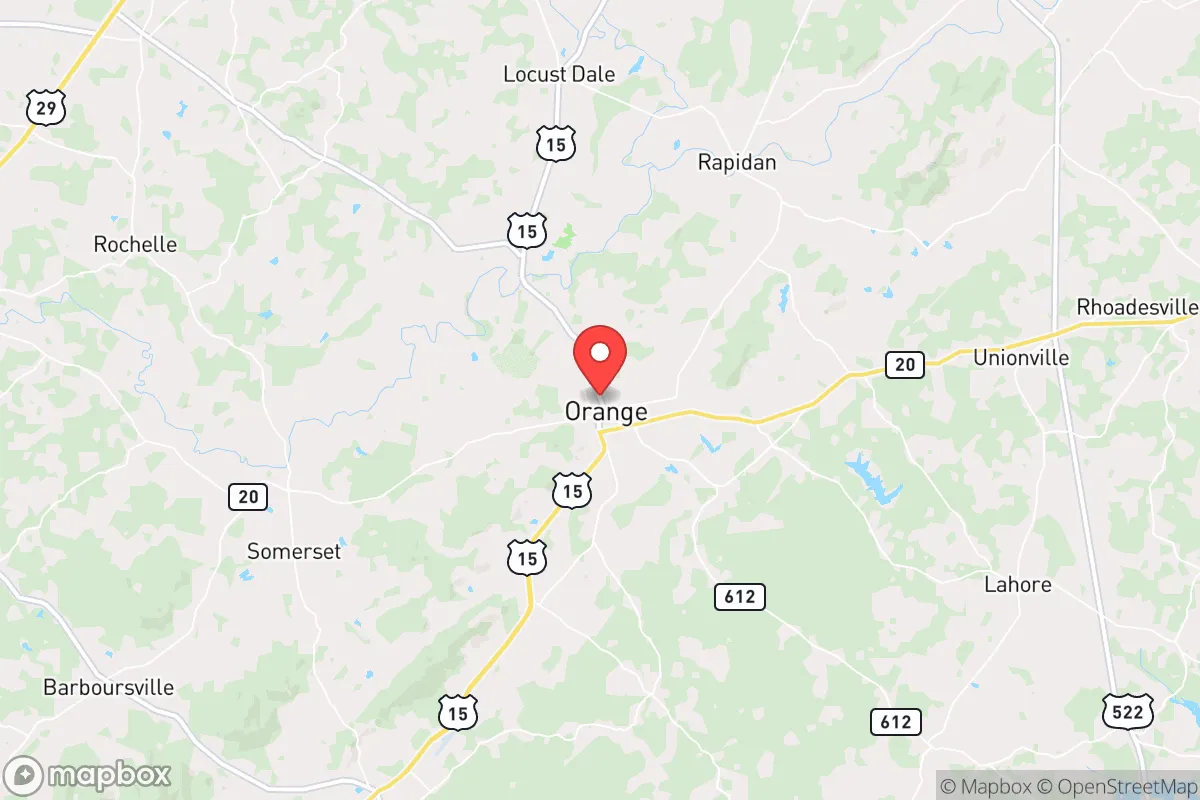
Photo: Wikipedia
Personal Sovereignty in Orange, VA
Viable for self-reliance. Generally workable, though some barriers may limit total independence.
What does Personal Sovereignty tell us?
Personal Sovereignty measures your capacity for self-reliance and independence with minimal government friction. Higher scores mean fewer barriers between you and the way you want to live... but it assumes you have the space you need and good neighbors.
What does this tell us?
Personal Sovereignty measures your capacity for self-reliance and independence with minimal government friction. Higher scores mean fewer barriers between you and the way you want to live... but it assumes you have the space you need and good neighbors.
State Policy
Energy independence: Importer (20% of energy produced in-state)
Personal Liberty
Homesteading

Personal Liberty Analysis
Orange, Virginia offers a notably high degree of personal sovereignty, anchored by Virginia’s status as a shall-issue concealed carry state and a right-to-work state, combined with a rural county government that generally maintains a light regulatory touch. For individuals and families who prioritize autonomy—whether in self-defense, property use, or medical decision-making—the town and surrounding county provide a legal and cultural environment that leans heavily toward personal responsibility rather than government oversight. The key trade-off is that residents must navigate Virginia’s state-level tax structure, which is moderate compared to the Deep South but lighter than the Northeast, and accept that local zoning and health codes impose some limits on off-grid living.
Tax burden and regulatory posture in Orange County
Orange County’s overall tax burden is moderate for Virginia, which itself ranks near the middle of U.S. states for combined state and local tax burden. The county’s real property tax rate is approximately $0.62 per $100 of assessed value, which is competitive with surrounding rural counties like Madison ($0.58) and Louisa ($0.65), and significantly lower than urban centers like Fairfax County ($1.11). Personal property tax on vehicles and boats is assessed at 100% of value with a rate of $4.00 per $100, a standard practice across Virginia that adds a recurring cost for vehicle owners. There is no county-level income tax; Virginia’s state income tax ranges from 2% to 5.75%, with a flat rate of 5.75% on taxable income above $17,000. The regulatory posture of Orange County government is best described as permissive but not absent. Building permits are required for new construction and major renovations, but the county does not impose the kind of stringent environmental or land-use overlay districts found in Northern Virginia. The county’s comprehensive plan encourages agricultural and rural uses, and the zoning ordinance allows for home-based businesses and accessory dwelling units by-right in many districts. For a resident seeking to minimize interactions with government, Orange offers a relatively friction-free environment compared to Virginia’s urban crescent.
Self-defense and gun law specifics in Orange, VA
Virginia is a shall-issue state for concealed handgun permits, meaning that if a resident passes a background check and completes a state-approved firearms safety course, the sheriff’s office must issue the permit. Orange County Sheriff’s Office processes applications with typical turnaround times of 30–45 days. Open carry of handguns and long guns is legal without a permit for anyone 18 or older who can legally possess a firearm. There is no state-level magazine capacity ban, no assault weapons ban, and no requirement to register firearms. Virginia does have a one-handgun-per-month purchase limit, which applies to handguns only and does not affect rifles or shotguns. The state also maintains a “red flag” law (Emergency Substantial Risk Order), which allows law enforcement to petition a court to temporarily seize firearms from an individual deemed a danger to themselves or others. This law is enforced statewide, including in Orange County, and has been a point of contention among Second Amendment advocates. However, local sheriffs in rural counties like Orange have publicly stated they will not proactively enforce laws they consider unconstitutional, though they comply with court orders. For practical self-defense, Orange residents face no local restrictions on carrying in most public spaces, though carrying is prohibited in schools, courthouses, and airports under state law. The overall environment is one where law-abiding gun owners can exercise their rights with minimal bureaucratic friction.
Self-reliance and homesteading viability: lot sizes, zoning, and off-grid feasibility
Orange County’s rural character makes it a viable location for homesteading and self-reliance, though with some constraints. Minimum lot sizes in the Agricultural (A-1) district are 3 acres, and in the Rural Residential (RR) district, 1 acre. Most of the county outside the town limits is zoned A-1, meaning a 3-acre minimum is the norm for new subdivisions, but existing smaller parcels are grandfathered. Raising livestock—including chickens, goats, sheep, and cattle—is permitted by-right on parcels of 3 acres or more in the A-1 district. Beekeeping is allowed without special permits. Gardening and food preservation are unrestricted. Off-grid living is legally feasible but requires compliance with the Virginia Uniform Statewide Building Code. The county does not require connection to municipal water or sewer; private wells and septic systems are standard and permitted through the Virginia Department of Health. Solar panels are allowed by-right, and net metering is available through Dominion Energy, the primary electric utility. However, completely disconnecting from the grid is not straightforward: Dominion requires a signed interconnection agreement for grid-tied solar, and going fully off-grid with battery storage is legal but may complicate property resale and financing. Rainwater collection is legal and encouraged for non-potable uses, but potable rainwater systems must meet health department standards. Wood stoves and outdoor boilers are permitted but must comply with air quality regulations. For a family seeking to produce its own food, water, and energy, Orange offers a permissive environment relative to most of Virginia, but not the complete regulatory vacuum found in some Western states.
Personal liberties: parental rights, medical autonomy, speech, and property
Orange County’s cultural and legal environment supports a broad interpretation of personal liberties, particularly in areas of parental rights and property use. Virginia law grants parents the right to direct the upbringing, education, and care of their children, including the right to opt out of specific public school instruction (e.g., sex education) and to homeschool under the state’s homeschool statute. Orange County Public Schools has a history of accommodating parental requests for curriculum review and alternative assignments. Medical autonomy is more constrained: Virginia requires childhood vaccinations for school attendance, with only medical and religious exemptions available (philosophical exemptions were eliminated in 2021). The state does not have a right-to-try law for terminally ill patients, though it does allow access to investigational drugs under federal law. Telehealth and direct-primary-care arrangements are legal and available locally. Free speech is protected under the First Amendment, and Orange County has not enacted any local ordinances restricting speech or assembly beyond standard time-place-manner regulations. Property rights are strong: the county does not have a rental registration or inspection program, and there are no rent control ordinances. Short-term rentals (Airbnb/VRBO) are permitted by-right in most zoning districts, though a business license is required. The county’s comprehensive plan explicitly supports “the protection of private property rights” as a guiding principle. For a resident who values minimal government intrusion into family and personal decisions, Orange provides a legal framework that is generally deferential to individual choice, with the notable exception of vaccination mandates and some health regulations.
Compared to other areas in Virginia and the Mid-Atlantic, Orange offers a sovereignty profile that is strong on property rights, self-defense, and homesteading, moderate on tax burden, and more restrictive on medical autonomy and off-grid energy independence. It is not a libertarian enclave like Grafton, New Hampshire, or a low-tax haven like much of Texas, but it provides a balanced environment where a self-reliant family can live with a high degree of personal control over daily life. For a conservative-leaning individual or family relocating from a high-regulation state like California or New York, Orange represents a significant step toward greater autonomy without the isolation of more remote rural counties.

* Values derived from national, state, county, city and local statistics and may differ in a specific area. Last updated: 2026-09-11T00:59:06.000Z
Narrative content on this page is AI-generated and may contain mistakes. Verify any details that matter before acting on them.
ReloMaps may earn a commission from affiliate links at no extra cost to you.

