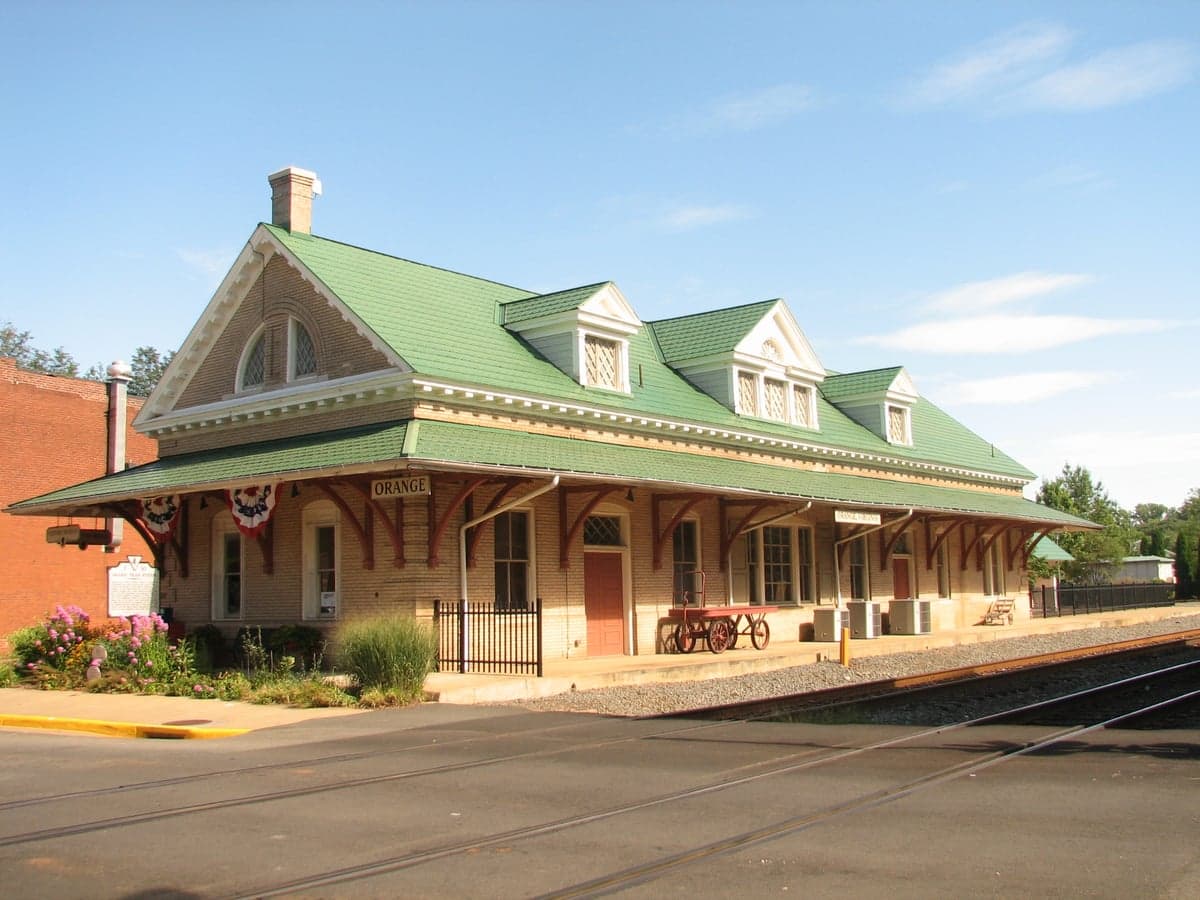
Photo: Wikipedia
Demographics of Orange, VA
Affluence Level in Orange, VA
A middle-class area roughly in line with national averages across income, home values, education, and employment.
People of Orange, VA
Orange, Virginia, is a small town of roughly 5,000 residents where a deeply rooted Black community and a long-standing white population coexist in a place that feels both historic and quietly changing. The town’s character is defined by its role as the county seat of Orange County, a position that has anchored its economy and social life for centuries, giving it a stable, traditional feel. With a population that is 65.0% white and 27.1% Black, and a very small foreign-born share of just 0.2%, Orange remains one of the least diverse towns in the Piedmont region, though its Hispanic population has grown to 3.3% in recent years. For those moving in now, Orange offers a close-knit, slow-paced environment where family history and local institutions—like the courthouse and the Orange Volunteer Fire Company—still carry significant weight.
How the city was settled and grew
Orange was officially established in 1834, but its roots stretch back to the early 18th century when the Virginia General Assembly designated the area as the seat of the newly formed Orange County. The original population was drawn by land grants and the promise of tobacco farming, with wealthy planters establishing large estates on the rolling hills surrounding the town. Enslaved African Americans made up a substantial portion of the early workforce, and after emancipation, many of their descendants remained in Orange, forming the foundation of the town’s Black community. These families settled primarily in the West End neighborhood, a historically Black area along West Main Street and surrounding blocks, where churches like Mount Zion Baptist became community anchors. The town grew slowly through the 19th and early 20th centuries, with the arrival of the railroad in the 1850s bringing a modest wave of white merchants and tradespeople who built homes in the East End district, near the train depot. By 1900, Orange’s population was roughly evenly split between white and Black residents, a pattern that held until the mid-20th century.
Modern era (post-1965)
The post-1965 period brought significant demographic shifts to Orange, though not through international immigration—the foreign-born share remains negligible at 0.2%. Instead, the changes came from domestic migration and suburbanization. The expansion of U.S. Route 15 and the construction of Interstate 64 in the 1970s made Orange more accessible to commuters working in Charlottesville (30 miles south) and Fredericksburg (40 miles east). This drew a wave of white professionals and retirees seeking lower housing costs and a quieter lifestyle. Many of these newcomers settled in newer subdivisions on the town’s periphery, such as Lakeview Estates and Hickory Ridge, which are predominantly white and home to many of the town’s college-educated residents (20.0% of the population holds a bachelor’s degree or higher). Meanwhile, the historic Black population in the West End has aged and declined, with younger Black families often moving to larger cities for employment. The Hispanic population, now 3.3%, is a recent arrival, concentrated in a few rental properties near the South Main Street corridor, where seasonal agricultural work and service jobs in local restaurants and hotels provide entry points. The town’s overall racial composition has shifted only modestly since 2000, with the white share dropping from about 70% to 65% and the Black share holding steady near 27%.
The future
Orange’s population is projected to remain stable or grow slowly over the next decade, with the town’s limited housing stock and lack of major employers constraining rapid expansion. The Hispanic share is likely to continue its gradual increase, possibly reaching 5-6% by 2035, as families settle in the South Main Street area and near the Orange County Airport industrial zone, where distribution centers and light manufacturing offer entry-level jobs. The Black population is expected to hold steady or decline slightly, as younger Black residents continue to leave for urban job markets, while older Black homeowners age in place in the West End. The white population will likely remain the majority, but its composition is shifting: retirees and remote workers from Northern Virginia are buying homes in Hickory Ridge and Lakeview Estates, bringing more political and cultural diversity than the town’s traditional white families. The town’s cultural identity is evolving slowly—newcomers are less tied to the county’s agricultural past and more focused on outdoor recreation (the Rapidan River and Shenandoah National Park are nearby) and small-town amenities. For a mover, this means Orange is becoming a place where old and new Virginia meet, but the pace of change is deliberate, and the town’s historic character remains intact.
For someone moving in now, Orange offers a stable, affordable community with a clear sense of its past and a modest, manageable future. The town is not becoming a diverse hub—its foreign-born and Asian populations are effectively zero—but it is slowly absorbing a small Hispanic community and a steady stream of white retirees and remote workers. The bottom line: Orange is a place for those who value tradition, quiet streets, and a pace of life that resists the rapid changes seen in Virginia’s larger cities.

* Values derived from national, state, county, city and local statistics and may differ in a specific area. Last updated: 2026-09-11T00:59:06.000Z
Narrative content on this page is AI-generated and may contain mistakes. Verify any details that matter before acting on them.
ReloMaps may earn a commission from affiliate links at no extra cost to you.

