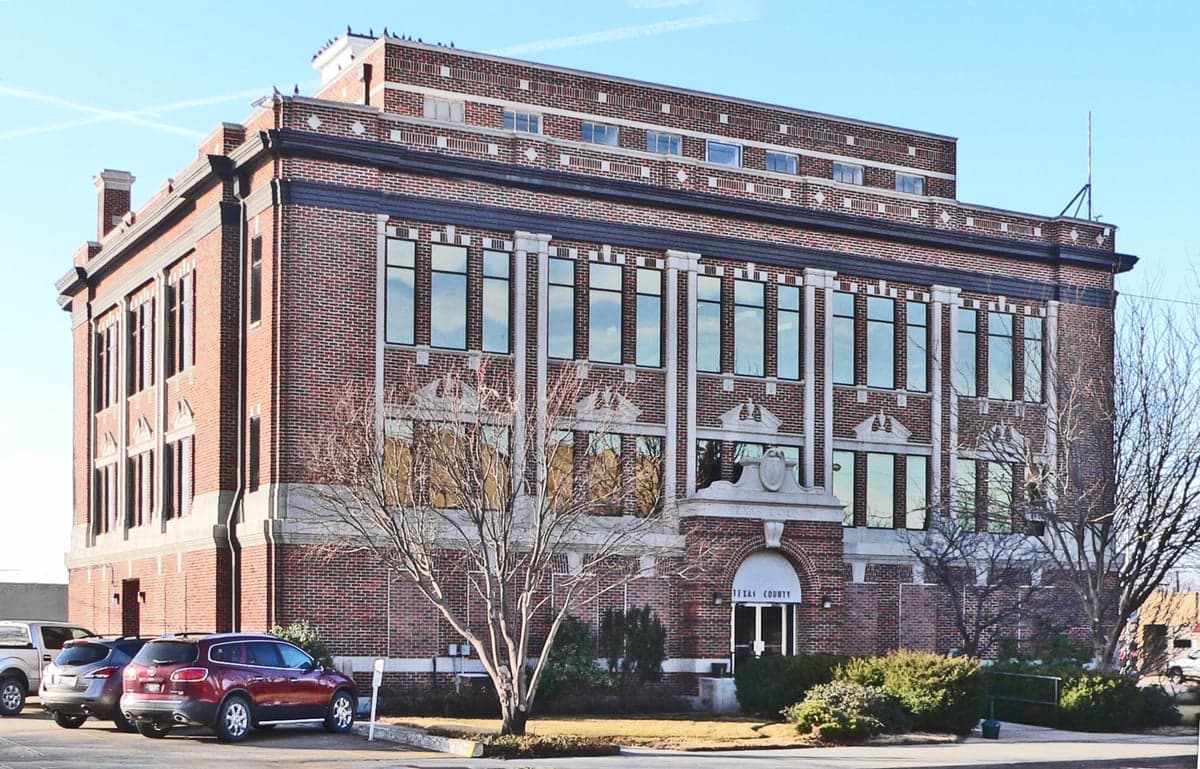
Photo: Wikipedia
Political ClimatePolitical Climate in Texas County
Showing district-level results — no local-only data available.
Local Political AnalysisPolitical Analysis of Texas County
Texas County, Oklahoma, is about as deep red as it gets in the Sooner State, with a Cook PVI of R+23 that puts it among the most reliably Republican counties in the nation. That number isn't just a statistic—it reflects a political reality where Democrats rarely crack 30% in a presidential race, and local offices from county commissioner to state representative are almost always decided in the GOP primary. The trajectory here has been steady: the county has gotten redder over the past two decades, driven by a growing population of conservative-leaning transplants from other parts of the Panhandle and a strong agricultural base that prizes limited government and gun rights. But don't let the uniform shade fool you—there's real variation on the ground, especially between the county's two main towns.
How it compares
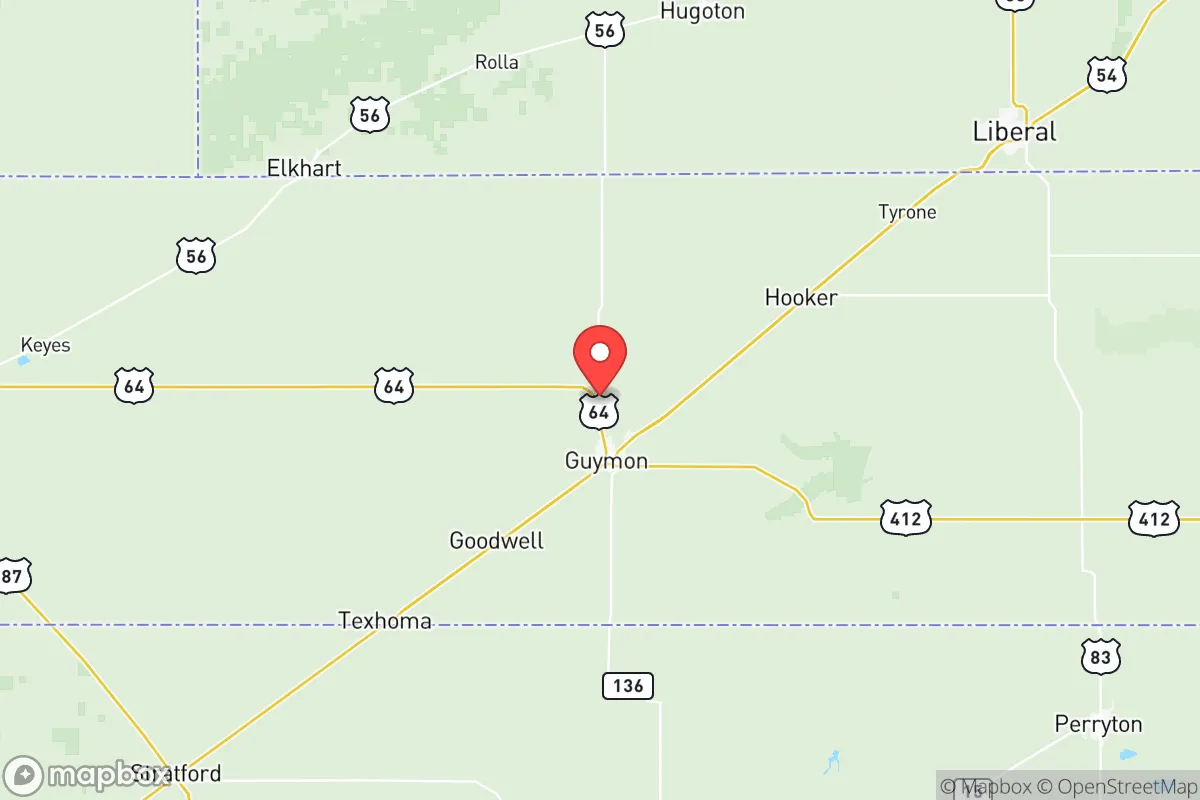
Compared to Oklahoma as a whole, which sits at R+18, Texas County is a solid five points more conservative. That gap matters in practice: while the state has a few blue-leaning pockets like Oklahoma City and Tulsa, Texas County has no such urban counterweight. The largest town, Guymon, is the county's economic hub and leans heavily Republican, but it's not a monolith. The precincts around the Guymon High School and the western edge of town have shown slightly more competitive margins in recent cycles, often breaking 60-40 for the GOP instead of the 75-25 you see in rural precincts. Meanwhile, the smaller towns—Hooker, Tyrone, and Goodwell—are reliably deep red, with Goodwell's precinct near Oklahoma Panhandle State University occasionally showing a modest blue tint from faculty and student voters. The swing precincts are few and far between, but they exist: the area around the Guymon Walmart and the newer subdivisions off Highway 54 have seen a slight uptick in Democratic votes in the last two cycles, likely driven by younger families moving in for jobs at the Seaboard Foods plant or the local hospital.
What this means for residents
For conservative residents, the political climate is a comfortable fit. Local government is small and responsive, property taxes are low, and the county commission rarely faces contested races. The Republican primary is where the real action happens, and it's common for candidates to campaign on school board issues, water rights, and road maintenance—not national culture wars. For liberal residents, life is more about finding your niche. There's no active Democratic party infrastructure in the county, so progressive voters often engage through nonpartisan channels like the library board or the local food bank. The biggest practical difference is in policy: the county has no zoning ordinances to speak of, which means development is fast and loose, and the local school board has resisted state-level mandates on curriculum changes. Gun laws are as permissive as state law allows, and there's no local push to change that.
Culturally, Texas County feels more like the Texas Panhandle than the rest of Oklahoma—Guymon is closer to Amarillo than to Oklahoma City, and the local economy is tied to cattle, hogs, and wheat. The county's Hispanic population, which makes up about 40% of Guymon, has grown steadily, but political representation hasn't kept pace; no Hispanic candidate has won a countywide office in recent memory. That's a quiet tension that locals acknowledge but rarely discuss in public. Looking ahead, the county's R+23 lean is likely to hold, but the growing diversity in Guymon could slowly shift the margins in a decade or two—though don't expect any sudden flips. For now, Texas County remains a place where the politics are as straightforward as the landscape: flat, wide-open, and deeply conservative.

State Political ClimatePolitical Climate in Oklahoma
State Political AnalysisPolitical Environment in the State
Oklahoma is one of the most reliably Republican states in the country, with a Cook PVI of R+18 that puts it in the same deep-red tier as Idaho and Wyoming. The state hasn’t voted for a Democratic presidential candidate since 1964, and over the last 20 years, the GOP has only tightened its grip — every statewide office, both U.S. Senate seats, and five of the six U.S. House seats are now held by Republicans. The shift accelerated after 2010, when the Tea Party wave swept out moderate Democrats in rural areas and turned the state legislature into a supermajority GOP body. Today, the dominant coalition is a mix of evangelical conservatives, oil-and-gas interests, and rural voters who see the state as a bulwark against coastal progressivism.
Urban vs. rural divide
The political map is a classic red-state checkerboard. Oklahoma City and Tulsa are the only real blue dots, and even they are purple at best. Oklahoma County (OKC) went for Trump by just 2 points in 2024, while Tulsa County was about 10 points redder. The real Democratic base is concentrated in the state’s two urban cores — the historically Black northeast side of Tulsa, the Hispanic and working-class south side of OKC, and the university precincts around Norman (home to the University of Oklahoma). Norman itself is the most reliably Democratic city of any size, consistently voting 15-20 points bluer than the state average. Drive 20 minutes in any direction from either metro, and you’re in deep-red territory. Edmond, a wealthy suburb north of OKC, votes Republican by about 25 points. Broken Arrow, east of Tulsa, is even redder. The rural panhandle counties — Texas County and Cimarron County — regularly hit 85-90% Republican. The divide isn’t just cultural; it’s economic. The urban areas are diversifying with tech, healthcare, and aerospace jobs, while the rural counties depend on agriculture and energy, making them more sensitive to federal regulation and commodity prices.
Policy environment
Oklahoma’s policy environment is aggressively conservative. The state has a flat income tax of 4.75% (down from 5% in 2022, with a path to 3.99% by 2027), no estate tax, and a sales tax that averages 8.9% when local add-ons are included. Property taxes are among the lowest in the nation — typically 0.5-0.9% of assessed value — thanks to a constitutional cap. The regulatory posture is light-touch: no state-level minimum wage above the federal $7.25, no rent control, and a right-to-work law that bans union security agreements. Education policy is a flashpoint. The state has a robust school voucher program (the Oklahoma Parental Choice Tax Credit Act, 2023) that gives up to $7,500 per child for private school tuition, and it was one of the first states to mandate the Ten Commandments be displayed in public school classrooms (2024). Healthcare is a mixed bag: Oklahoma expanded Medicaid in 2021 via ballot initiative, but the state legislature has since restricted abortion to near-total prohibition (no exceptions for rape or incest, only to save the mother’s life). Election laws are strict: voter ID is required, absentee ballot drop boxes are banned, and the state purged over 300,000 inactive voters from the rolls between 2020 and 2024.
Recent policy direction
The last five years have seen Oklahoma move decisively toward a maximalist version of conservative governance. On gun and self-defense law, the state enacted permitless carry in 2019 and a “stand your ground” law in 2021. Parental and education rights are a top priority: the 2022 “Parental Bill of Rights” (HB 1775) bans teaching that “any individual is inherently racist or sexist,” and the 2023 “Save Women’s Sports Act” bars transgender girls from female school sports. Speech and privacy are less protected than in many states — Oklahoma has no comprehensive data privacy law, and the state’s “critical race theory” ban has been used to restrict classroom discussion. Medical and bodily autonomy is sharply limited: abortion is banned at conception, and the state has a strict “abortion trafficking” law that makes it a felony to help a minor cross state lines for the procedure. Property rights are strong — the state has a “right to farm” constitutional amendment (2016) that protects agricultural operations from nuisance lawsuits. Taxation is trending downward: the 2024 tax cut package accelerates the income tax reduction and eliminates the corporate franchise tax. Voting and ballot access have tightened: the 2023 “Voter Integrity Act” requires proof of citizenship for voter registration and bans private funding of election administration.
Civil unrest & political movements
Oklahoma has a history of political flashpoints that feel more like a simmer than a boil. The most visible recent unrest was the 2018 teacher walkout, when 30,000 educators marched on the state capitol demanding higher pay and more school funding — it was the largest labor action in state history and forced a $6,000 raise, but the underlying funding issues remain. On the right, the “Oklahoma Freedom Caucus” has been a powerful force since 2021, pushing for further tax cuts, school choice expansion, and anti-ESG legislation that bars state pension funds from considering environmental factors in investments. Immigration politics are heated but not chaotic: the 2024 “Border Security Act” makes it a state crime to enter Oklahoma from Mexico without authorization, though enforcement is largely symbolic given the state’s distance from the border. There’s no serious secession or nullification movement — Oklahoma’s conservative leaders prefer to work within the federal system, suing the Biden administration over environmental rules and vaccine mandates. Election integrity controversies flared after 2020, with the state GOP launching a “forensic audit” of the 2020 election in 2022 that found no evidence of widespread fraud but still led to the voter purge laws. A new resident would notice the political energy most at the state capitol in OKC, where rallies are frequent, and in the “Tulsa Race Massacre” centennial in 2021, which reignited debates about how the state teaches its own history.
Projection
Over the next 5-10 years, Oklahoma is likely to stay deep red but with a slowly shifting texture. The urban cores — OKC, Tulsa, and Norman — are growing faster than the rural counties, driven by in-migration from Texas and California. That’s adding a small but steady stream of moderate and even liberal voters, especially in the tech and aerospace sectors. The state’s Hispanic population, now about 12% and concentrated in OKC and the panhandle, is growing and leans Democratic, though turnout is lower than average. The wild card is the energy transition: if oil and gas employment declines faster than expected, rural counties could lose population and political clout, while the urban areas that are diversifying into renewables and data centers gain influence. The state GOP will likely continue to push tax cuts and school choice, but internal fights between the business-friendly chamber wing and the populist Freedom Caucus could produce more gridlock. For a new resident, the practical takeaway is that Oklahoma will remain a place where conservative values are the default in law and culture, but the edges are softening — especially in the metro areas, where you’ll find a growing number of people who voted for Biden but still own guns and go to church.
Bottom line for a new resident: If you’re conservative, you’ll find a state government that actively shares your priorities — low taxes, school choice, gun rights, and a culture that respects traditional values. If you’re liberal, you’ll be in a clear minority, but you won’t be isolated; the urban cores and college towns offer like-minded communities, and the low cost of living means you can afford a lifestyle that might be out of reach in bluer states. The political climate is stable, predictable, and unlikely to flip anytime soon — but it’s not static. The growing metros are slowly pulling the state toward a more suburban, less rural version of conservatism, and that’s the direction you should expect over the next decade.
* Values derived from national, state, county, city and local statistics and may differ in a specific area. Last updated: 2026-07-10T06:30:27.000Z
Narrative content on this page is AI-generated and may contain mistakes. Verify any details that matter before acting on them.
ReloMaps may earn a commission from affiliate links at no extra cost to you.

