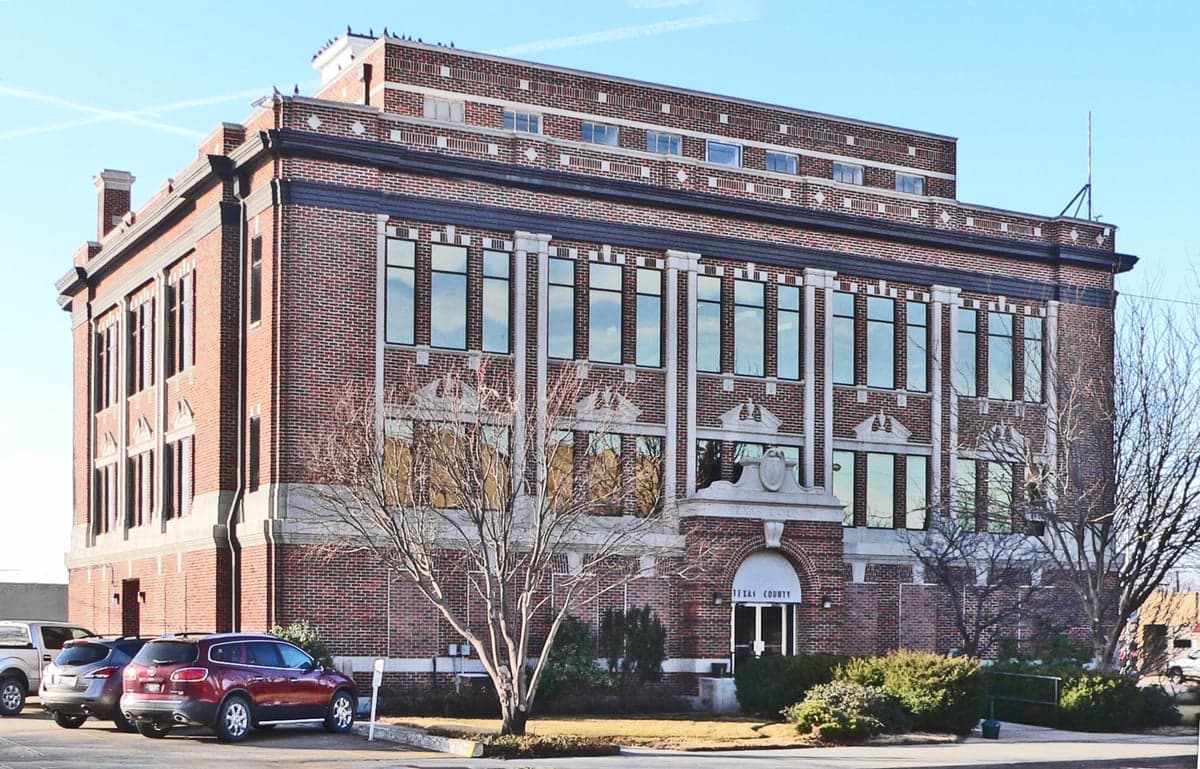
Photo: Wikipedia
Demographics of Texas County
Affluence Level in Texas County
A middle-class area roughly in line with national averages across income, home values, education, and employment.
People of Texas County
The people of Texas County, Oklahoma today form a predominantly Hispanic and white rural population of 20,880, characterized by a strong agricultural identity and a growing cultural diversity that sets it apart from many neighboring counties in the Oklahoma Panhandle. With a foreign-born population of 20.4%, the county is a notable hub for immigrant labor, primarily in the cattle and wheat industries, while its white population of 38.4% reflects deep-rooted ranching and farming traditions. The county's distinctive identity is shaped by a blend of conservative values, a tight-knit community ethos, and a demographic shift that has made it one of the most Hispanic counties in Oklahoma, with 51.1% of residents identifying as Hispanic or Latino.
Settlement & growth (pre-1960)
Before American settlement, the area now known as Texas County was part of the vast domain of the Comanche and Kiowa nations, who followed bison herds across the high plains. The region saw little European presence until the 1820s, when Spanish and later Mexican claims gave way to American expansion after the 1845 annexation of Texas. The land was formally opened to non-Native settlement through the 1890 Organic Act, which created Oklahoma Territory, but the Panhandle's arid climate delayed significant homesteading until the early 1900s.
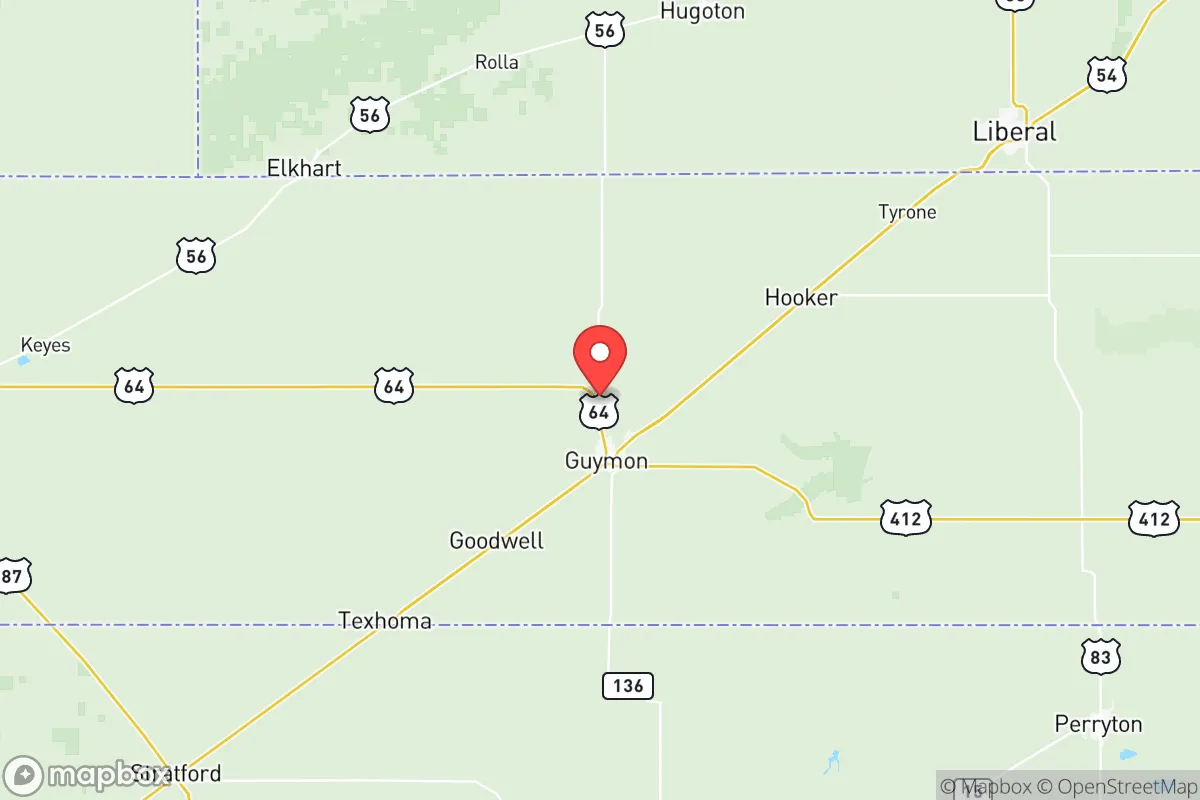
The first major wave of settlers arrived between 1900 and 1910, drawn by the Enlarged Homestead Act of 1909, which offered 320 acres for dryland farming. These were predominantly white farmers from the Midwest and the South—many of Scots-Irish and German descent—who established the county's foundational towns. Guymon, founded in 1901 as a railroad stop on the Chicago, Rock Island and Pacific line, became the county seat and a commercial hub for wheat and cattle. Nearby Hooker, settled in 1905, grew around the same railroad, while Goodwell, established in 1903, became a center for agricultural education with the founding of Panhandle State University (then Panhandle Agricultural and Mechanical College) in 1909. These early settlers practiced dryland wheat farming and cattle ranching, industries that remain central today.
A second wave came during the Dust Bowl of the 1930s, when many families from the southern Plains—including those from the Texas Panhandle and Oklahoma—moved into the county seeking more stable land. However, the Dust Bowl also drove out a significant number of original homesteaders, leading to a population decline from a peak of 14,000 in 1930 to 9,000 by 1940. The post-World War II period saw a modest recovery, fueled by the expansion of irrigation from the Ogallala Aquifer, which transformed the county into a major producer of corn, sorghum, and cattle. Texhoma, straddling the Texas-Oklahoma border, grew as a livestock shipping point, while Hardesty and Tyrone remained small farming communities. By 1960, the population had rebounded to 14,000, still overwhelmingly white and native-born.
Modern era (post-1965)
The 1965 Hart-Cellar Act fundamentally changed Texas County's demographics, though the shift was gradual and driven more by economic pull than direct immigration policy. Starting in the 1970s, the county's booming agricultural sector—particularly the feedlot and meatpacking industries—began attracting Mexican and Central American laborers. Guymon became the epicenter of this change, with the opening of a large Seaboard Farms (now Seaboard Foods) pork processing plant in the 1990s, which drew hundreds of immigrant workers. By 2000, the Hispanic share of the population had risen to 30%, and by 2020 it had reached 51.1%, making Texas County one of the most Hispanic counties in Oklahoma.
Domestic migration also reshaped the county, though on a smaller scale. The 1980s farm crisis pushed some white families out, while retirees and workers from the Rust Belt moved in, attracted by low housing costs and a conservative political climate. The county's black population, at 4.1%, is small but stable, concentrated in Guymon and Hooker, and includes both descendants of early 20th-century settlers and newer arrivals. East and Southeast Asian communities, at 2.5%, are primarily Vietnamese and Filipino families who came in the 1990s and 2000s, often working in the meatpacking industry; they are concentrated in Guymon and Goodwell. The Indian subcontinent population is negligible at 0.0%.
Suburbanization has been limited, as Texas County remains rural. However, Guymon has seen modest suburban-style development on its outskirts, with new housing subdivisions and retail centers catering to a growing population. The county's foreign-born share of 20.4% is nearly double the Oklahoma state average, reflecting the ongoing reliance on immigrant labor. The college-educated share of 24.4% is below the national average, as many residents work in agriculture or manufacturing rather than professional services.
The future
Texas County is projected to become more diverse over the next 10-20 years, with the Hispanic share likely to exceed 60% by 2040, driven by continued immigration and higher birth rates among Hispanic families. The white population, while still a significant minority, is aging and declining in absolute numbers, as younger white residents often leave for urban areas like Oklahoma City or Amarillo, Texas. The black and East/Southeast Asian populations are expected to remain stable or grow slightly, as the meatpacking industry continues to attract workers from diverse backgrounds.
New communities are likely to concentrate in Guymon, which already houses over 60% of the county's population, and in Hooker, which is seeing modest growth from spillover housing demand. The county's cultural identity is evolving from a purely Anglo ranching culture to a bilingual, bicultural community where Spanish is increasingly common in schools and businesses. This shift has created some tension, but also a vibrant fusion of traditions, evident in local festivals like Guymon's annual Pioneer Days and the growing popularity of Mexican rodeo (charreada). For a newcomer, Texas County offers a low-cost, family-oriented lifestyle with a strong work ethic, but requires comfort with a rapidly changing demographic landscape and limited urban amenities.
For someone moving in now, Texas County is becoming a place where agricultural roots meet a new multicultural reality—a community where the economy depends on immigrant labor, and where conservative values coexist with a growing Hispanic majority. It is not a typical Oklahoma county, but a unique borderland where the Panhandle's past and its immigrant-driven future are being written together.

* Values derived from national, state, county, city and local statistics and may differ in a specific area. Last updated: 2026-07-10T06:30:27.000Z
Narrative content on this page is AI-generated and may contain mistakes. Verify any details that matter before acting on them.
ReloMaps may earn a commission from affiliate links at no extra cost to you.

