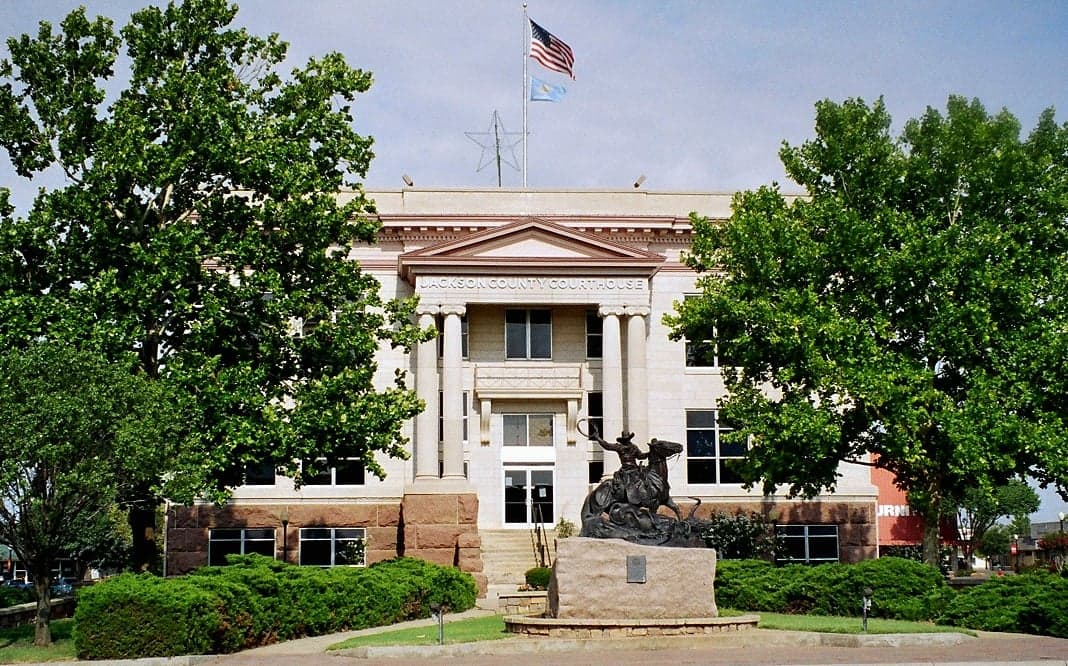
Photo: Wikipedia
Political ClimatePolitical Climate in Jackson County
Showing district-level results — no local-only data available.
Local Political AnalysisPolitical Analysis of Jackson County
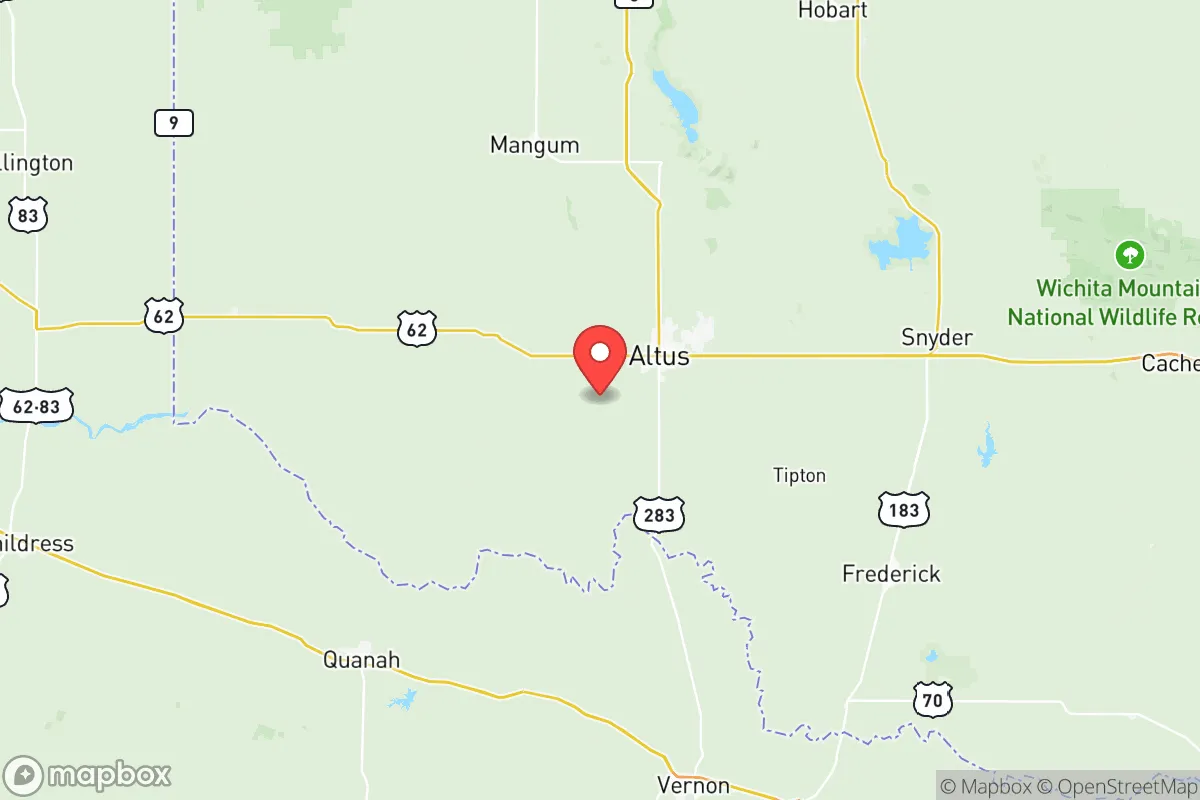
Jackson County in southwestern Oklahoma is one of the most reliably Republican areas in the state, anchored by a Cook Partisan Voting Index (PVI) of R+23. That’s a solid five points redder than Oklahoma’s statewide PVI of R+18, a gap that’s been widening for the last decade. The shift is most visible in the county seat, Altus, which used to be a swing town but now votes consistently for GOP candidates by double-digit margins. The smaller communities—Headrick, Eldorado, Olustee—have always been deep red, while the tiny precinct around Victory appears to be where any residual Democratic strength is concentrated, though it’s fading. The long-time resident take is that the county hasn’t gone blue in a presidential race since 1996, and it’s only getting redder.
How it compares to Oklahoma, OK
The comparison with the statewide figure—R+18—is instructive because it shows just how much rural southwestern Oklahoma differs from the more competitive areas of the state. Oklahoma City and Tulsa have some blue-leaning precincts, especially around downtown and near the universities, but Jackson County lacks those pockets of liberalism. The closest thing to a “purple” area in the county is the vicinity of Altus Air Force Base, where the transient military population sometimes votes more moderately—occasionally producing a narrow Democratic edge in local school board races. But that’s an exception, not the norm. Where statewide Oklahoma might see a 60-40 Republican split in a typical election, Jackson County is often closer to 70-30 or even 75-25. The county’s Hispanic population, concentrated in Altus’s barrio, has been growing but hasn’t yet translated into a meaningful political counterweight; turnout there remains lower than the Anglo precincts.
What this means for residents
For conservative residents, Jackson County is a comfortable place to live if you’re tired of the culture wars in the city. Local candidates almost never face a serious primary challenge from the left, so the real action tends to be in the GOP primary for county commissioner or sheriff. The bigger headache is not losing elections but making sure the county gets its share of state money—Altus needs it for infrastructure, especially after the 2023 drought strained local water supplies. For liberal residents, the reality is more isolating. You can find like-minded people at the county Democratic Party meetings (they have a modest but active group), but you’re not going to see many yard signs for state legislative races. A few precincts in central Altus vote blue consistently in local elections—the 5th and 6th wards—but that’s about it. The practical effect is that if you’re a Democrat in Jackson County, you’re probably more engaged in city-level issues—like pushing for a new library or park—than in national politics, because those are the races where your vote can actually swing something.
The cultural and policy distinctions from the rest of Oklahoma are subtle but real. Jackson County is more pro-agriculture policy than even the state GOP, meaning local representatives are hawkish on water rights and crop insurance subsidies, sometimes irritating the oil-and-gas dominated state party. You’ll also notice a stronger resistance to statewide mask or vaccination mandates—in 2020, the county commission voted unanimously to become a “Second Amendment sanctuary” area, which was less about guns and more about symbolically rejecting federal health orders. Overall, the political climate here favors stability and tradition, with a deep distrust of government overreach but a pragmatism that usually comes through in local decisions. Don’t expect any sudden shifts: the partisan trend line has been consistent for two decades, and barring a major economic shift—like a wind farm boom that brings in new residents—Jackson County will likely stay R+23 or deeper for the foreseeable future.

State Political ClimatePolitical Climate in Oklahoma
State Political AnalysisPolitical Environment in the State
Oklahoma is one of the most reliably Republican states in the country, carrying a Cook PVI of R+18. The state has moved sharply rightward over the past two decades, driven by the consolidation of rural conservatives and the realignment of once-Democratic working-class voters, particularly in the eastern part of the state. While Oklahoma City and Tulsa still hold sizable liberal pockets, the statewide trajectory has been a steady march toward deeper red, with the GOP holding supermajorities in both legislative chambers and every statewide office since 2011.
Urban vs. rural divide
The political map of Oklahoma breaks into three distinct zones. Greater Oklahoma City and Tulsa are the blue islands. Oklahoma County (Oklahoma City) has trended Democratic in presidential races, flipping blue in 2020 and 2024, driven by a growing suburban professional class and a significant African American and Hispanic population in the urban core. Tulsa County has similarly narrowed the GOP margin, though it still leans Republican. The suburbs around both metros — places like Edmond, Norman, and Broken Arrow — are reliably red, with Norman being the most liberal of the bunch due to the University of Oklahoma. Outside these corridors, the state is deeply conservative. Rural counties like Dewey, Roger Mills, and Cimarron regularly post 80-90% Republican margins. A notable shift has occurred in southeastern Oklahoma, a region that was historically "Yellow Dog Democrat" territory (sequoyah and Le Flore counties). These areas now vote solidly Republican, driven by cultural conservatism and opposition to federal environmental and energy regulations that affect the region's oil, gas, and timber industries. The only consistent Democratic stronghold outside the metro cores is the rural, majority-Native American counties in the east, like Adair and Choctaw, where tribal identity and federal trust relationships create a different political calculus.
Policy environment
Oklahoma's policy environment is firmly conservative. The state has a flat income tax rate of 4.75%, with ongoing legislative efforts to reduce it further. There is no inheritance or estate tax. Sales taxes are high, averaging nearly 9% statewide, with municipalities adding their own. The state is a "right-to-work" state, meaning union membership is voluntary, and it has some of the weakest worker protections in the country. Education policy is a flashpoint: the state has seen a wave of school choice legislation, including the Oklahoma Education Freedom Act (2024), which provides state-funded vouchers for private school tuition. Public teacher pay has increased significantly since the 2018 strike, but remains below the regional average. Healthcare access is limited, with Oklahoma consistently ranking near the bottom for uninsured rates and having not expanded Medicaid until 2021. Election laws have tightened: the state requires a government-issued photo ID to vote, and in 2023, it passed a law banning foreign nationals from contributing to state ballot measure campaigns. Absentee voting requires a notarized affidavit or a copy of a valid ID.
Recent policy direction
The last five years have seen a dramatic acceleration of conservative policy making. On gun and self-defense law, Oklahoma adopted permitless carry in 2019, and in 2023, it passed a law blocking state and local police from enforcing certain federal gun restrictions — a direct challenge to federal authority. Parental and education rights have been a central focus: the "Save Women's Sports Act" (2022) bans transgender athletes from participating in K-12 girles sports, and the "Parents' Bill of Rights" (2021) gives parents the ability to review curriculum and opt their children out of specific instruction. On speech and privacy, the state passed the "Oklahoma Social Media Protection Act" (2023), requiring social media platforms to disclose moderation practices and allowing users to sue over perceived censorship. Medical and bodily autonomy is sharply restricted: abortion is banned from conception under the Oklahoma Heartbeat Act (2021), with no exceptions for rape or incest. The enforcement mechanism relies on private civil lawsuits. On property rights, Oklahoma remains a strong mineral rights state, with the "Split Estate" laws favoring surface owners in oil and gas disputes. Taxation is trending downward: the legislature passed a $1 billion tax cut in 2023, accelerating the rate cut from 4.75% to 4.5% by 2026. Voting and ballot access has tightened: a 2022 law requires absentee ballot applications to be renewed annually, and the state bar used drop boxes for the 2024 general election, with in-person early voting only available on specific dates. The overall direction is toward lower taxes, greater parental control over education, fewer gun restrictions, and heightened cultural regulation on issues like gender identity and abortion.
Civil unrest & political movements
Oklahoma has not seen the large-scale civil unrest common in coastal states, but there have been flashpoints. The most significant recent protest movement was the 2018 teacher walkout, which shut down hundreds of schools across the state for two weeks. It was the largest labor action in Oklahoma history, with an estimated 40,000 educators marching on the state capitol. While it led to a $6,000 average teacher raise, the movement's cohesion fractured over funding mechanisms, and subsequent school funding battles have been more subdued. On the right, the "Oklahoma Freedom Caucus" has become a powerful force in the state legislature, frequently pushing bills on election integrity, education, and gun rights. Local "Moms for Liberty" chapters have been active in school board races, particularly in suburban districts like Edmond and Owasso. Immigration politics are less visible than in border states, but Oklahoma passed a strict "anti-sanctuary" law in 2020, requiring local law enforcement to cooperate with ICE. A more unique movement is the ongoing tension between the state and Native American tribal nations. The 2020 Supreme Court ruling in McGirt v. Oklahoma affirmed that much of eastern Oklahoma remains tribal land for criminal jurisdiction purposes. This has created a complex legal patchwork, with some residents upset about jurisdictional changes and others supportive of tribal sovereignty. The state has not seen significant election integrity protests, though Oklahoma was one of the first states to create an "election integrity unit" within its Secretary of State's office in 2022.
Projection
Over the next 5-10 years, Oklahoma is likely to remain deeply conservative, but with a few demographic shifts that could soften the edges. In-migration is modest but growing, driven largely by Texans moving to the Oklahoma City suburbs for lower home prices — places like Mustang and Piedmont are booming. These newcomers are generally conservative but may bring slightly different priorities, like a preference for stronger public schools and better infrastructure. The urban cores of OKC and Tulsa will continue to become more Democratic, but the rural-urban polarization will likely widen. The state's fiscal position is strong thanks to energy revenue, but over-reliance on oil and gas makes the budget volatile; a major downturn could revive tax debates. The biggest wildcard is the McGirt ruling's long-term impact on state-tribal relations. If Congress intervenes or the state negotiates compacts, it could reshape law enforcement and resource allocation in eastern Oklahoma for decades. Someone moving in now should expect the state to maintain its conservative policy posture, with gradual modernization of infrastructure and limited cultural liberalization in the metros, but no fundamental political realignment.
For a new resident, the bottom line is straightforward: Oklahoma is a state where conservative policies are embedded at every level of government. A conservative family will find its taxes low, its schools increasingly choice-oriented, its gun laws permissive, and its cultural regulations aligned with traditional values. A liberal resident will find reliable political allies in Norman, the Paseo Arts District in OKC, and the Pearl District in Tulsa, but will face an uphill battle on almost every statewide policy front. Both sides will navigate a state where politics is present and concrete, not abstract — from the moment you pay sales tax on groceries to the signs at the city limits telling you what's allowed. What you won't find is much ambiguity. Oklahoma's politics are lived daily, and they are remarkably consistent from the statehouse to the school board.
* Values derived from national, state, county, city and local statistics and may differ in a specific area. Last updated: 2026-06-29T00:43:22.000Z
Narrative content on this page is AI-generated and may contain mistakes. Verify any details that matter before acting on them.
ReloMaps may earn a commission from affiliate links at no extra cost to you.

