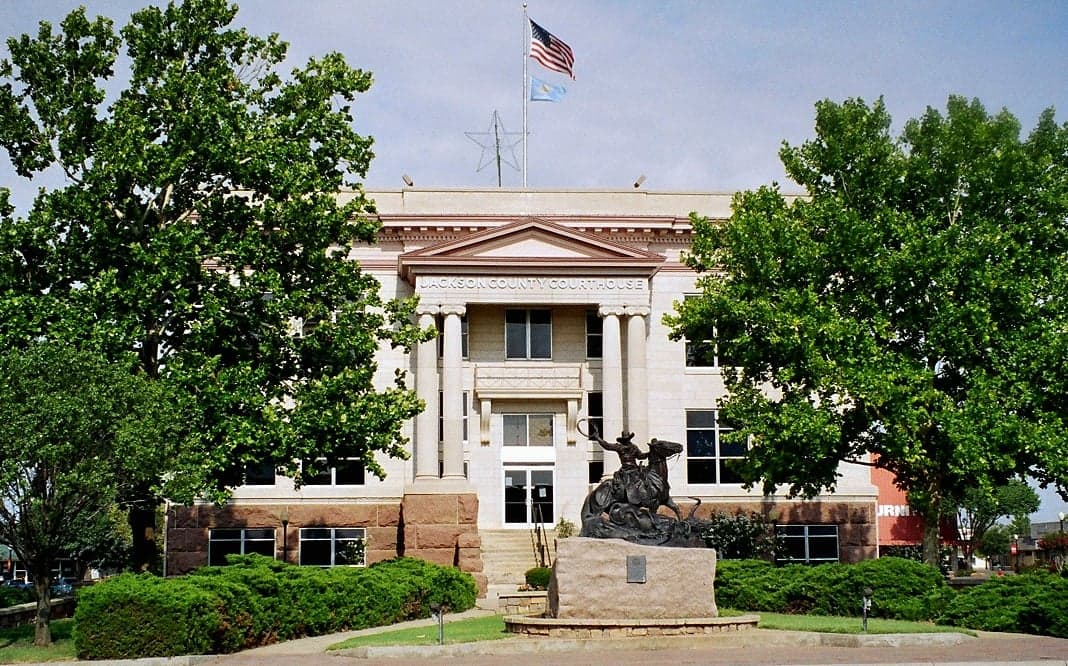
Photo: Wikipedia
Strategic Assessment of Jackson County
Workable tactical position. Some exposure to population density or targets, but generally defensible in a crisis.
What does the Strategic Assessment tell us?
Our Strategic Assessment grades tactical survivability of an area. Major population centers, military targets, fallout zones, natural disasters, and border exposure all drive risk — lower exposure means a more defensible position in a crisis.
This is heavily inspired by Joel Skousen's Strategic Relocation book. Highly recommended you checkout the book ($)What does this tell us?
Our Strategic Assessment grades tactical survivability of an area. Major population centers, military targets, fallout zones, natural disasters, and border exposure all drive risk — lower exposure means a more defensible position in a crisis.
This is heavily inspired by Joel Skousen's Strategic Relocation book. Highly recommended you checkout the book ($)Strategic Pillars

Key Distances
Strategic Assessment Analysis
Jackson County, Oklahoma occupies a strategic crossroads where the Southern Plains meet the Red River, offering a relocation candidate a blend of agricultural self-sufficiency and geographic separation from major metropolitan fallout zones. The county's position roughly 120 miles southwest of Oklahoma City and 140 miles northwest of the Dallas-Fort Worth metroplex places it outside the immediate blast and fallout shadows of those population centers while still providing access to their supply chains when needed. For a family or individual prioritizing resilience and disaster readiness, this buffer—combined with the area's low population density, working agricultural landscape, and distance from high-value strategic targets—creates a defensible niche worth serious consideration.
Geographic position and natural advantages for self-sufficiency
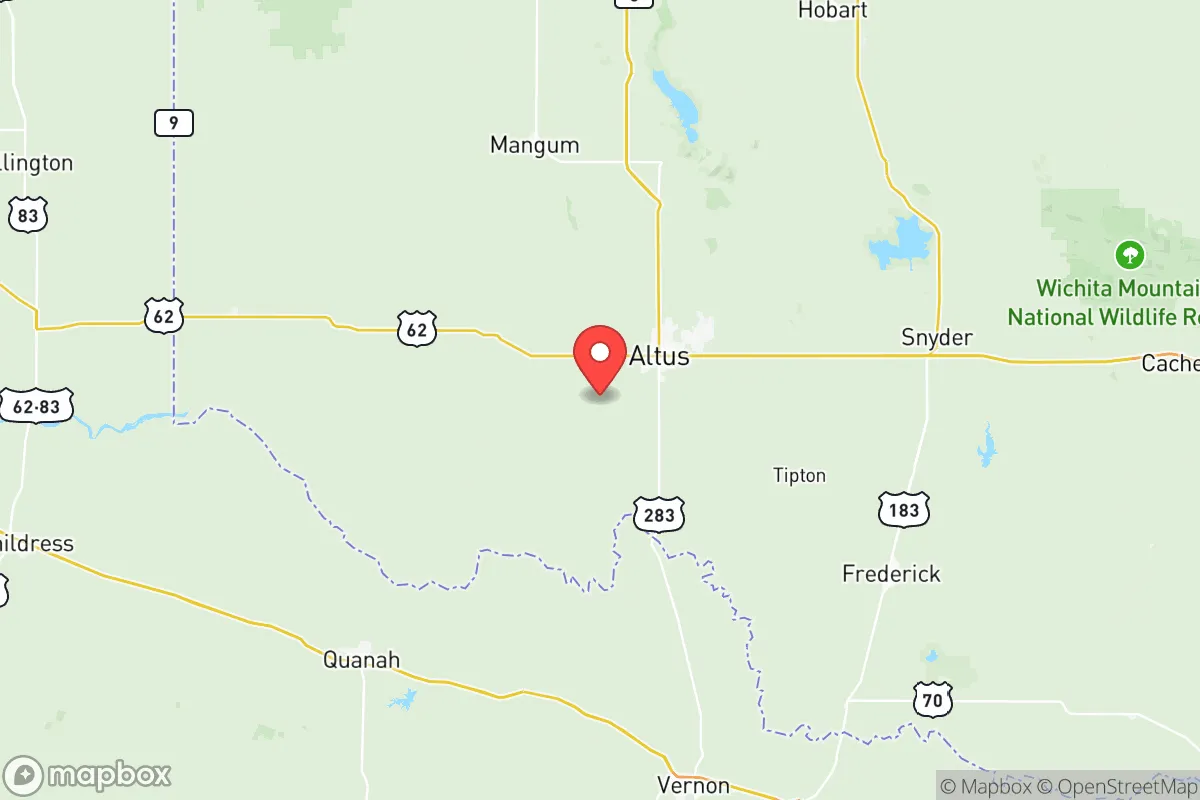
Jackson County sits in the southwestern corner of Oklahoma, bordered to the south by the Red River and Texas, with the communities of Altus (the county seat) and Mangum serving as the primary population anchors. The region is part of the Rolling Red Plains, a landscape of gentle slopes, mesquite-dotted prairies, and fertile alluvial soils along the Red River and its tributaries like the North Fork of the Red River. This is not mountain terrain—elevations rarely exceed 1,600 feet—but the open country provides long sightlines and multiple ingress/egress routes via U.S. Highway 62, U.S. Highway 283, and state highways. The area's agricultural base is a genuine advantage: cotton, wheat, hay, and cattle dominate the local economy, meaning a relocator with even modest land can tap into established farming infrastructure—co-ops, equipment dealers, and a workforce familiar with food production. The local climate features hot summers and mild winters, with average annual precipitation around 25 inches, sufficient for dryland farming but low enough to limit humidity-related mold and pest issues. The Ogallala Aquifer's southern reaches provide groundwater irrigation, though potential relocators should note that groundwater levels have declined in recent decades, making rainwater catchment and well testing essential due diligence.
Exposure to natural and man-made risks
The same geography that offers isolation also exposes Jackson County to specific hazards. Severe weather is the primary natural risk: the county sits in the heart of Tornado Alley, with spring and early summer bringing supercell thunderstorms capable of producing EF2-EF5 tornadoes. Altus experienced a deadly outbreak on May 9, 2016, when an EF1 tornado tracked through the city, and the broader region has a documented history of violent twisters. Flash flooding along the Red River and its tributaries is a secondary concern, particularly during El Niño years. On the man-made risk side, Jackson County's key vulnerability is its proximity to Altus Air Force Base, located just north of Altus. Home to the 97th Air Mobility Wing and training operations for C-17 and KC-135 crews, the base is a legitimate strategic asset—and thus a potential target in a major conflict. A conventional strike or sabotage event at the base could generate localized fallout and disruption. Additionally, the county lies roughly 150 miles northeast of the Wichita Falls-area petroleum infrastructure and 180 miles from the more concentrated refining corridor around the Dallas-Fort Worth metroplex. While not immediately adjacent to these targets, prevailing winds from the south-southeast during spring and summer could carry airborne contaminants from a strike on those assets. The county's rural character means emergency response times to remote homes can be 20-30 minutes or longer, so pre-positioned medical supplies and a robust first-aid capability are non-negotiable.
Practical resilience for a relocator: food, water, energy, and defensibility
For a family or individual serious about self-sufficiency, Jackson County offers several structural advantages. Food resilience is strong due to the local agricultural economy; farmers' markets operate in Altus and Mangum during growing season, and bulk purchasing from grain elevators or feed stores is straightforward. Home gardening is viable with the region's 200+ day growing season, though irrigation will be necessary during July and August dry spells. Soil quality varies—the county's deep, loamy soils in the river bottoms are excellent for vegetables, while upland soils are sandier and benefit from raised beds or amendments. Water resilience requires planning: municipal water in Altus comes from the Tom Steed Reservoir (located about 20 miles north in Kiowa County), which has experienced drought-induced drawdowns. A relocator should plan for a private well (depth ranges from 100 to 300 feet in the county), rainwater catchment from roof surfaces, and at least a two-week supply of stored potable water per person. Energy resilience is moderate: the region has good solar insolation (5.5-6.0 peak sun hours per day), making photovoltaic systems effective. Wind is also a resource, though seasonal. The local electrical grid is served by Western Farmers Electric Cooperative, which relies on a mix of natural gas, wind, and coal; a backup generator with fuel storage is advisable given the risk of weather-related outages. Defensibility is inherently solid due to favorable sightlines and rural setting. A home with 20-40 acres, positioned away from major roads and with a clear view of approaches, offers genuine strategic depth. The local population is predominantly conservative, with a strong hunting and firearms culture, which tends to foster mutual aid networks rather than dependency on distant authorities—a practical factor for community-level disaster response.
The overall strategic picture for Jackson County, Oklahoma is one of balanced opportunity and measured risk. Its location provides a meaningful buffer from the blast zones of Oklahoma City and the Dallas-Fort Worth metroplex while remaining within a half-day's drive of their medical and logistical resources for routine needs. The risks—tornadoes, the presence of Altus Air Force Base, and gradual water depletion—are real and require specific mitigation strategies, not casual dismissal. For a relocation candidate with a serious, self-sufficient mindset, the county's agricultural infrastructure, low population density (roughly 26,000 residents across 790 square miles), and community-oriented culture create a defensible and functional base. It is not a prepper fantasyland but a working, quiet corner of the Southern Plains where a prepared family can carve out a resilient existence—as long as they respect the weather, drill their own well, and keep an eye on the wind direction.

* Values derived from national, state, county, city and local statistics and may differ in a specific area. Last updated: 2026-06-29T00:43:22.000Z
Narrative content on this page is AI-generated and may contain mistakes. Verify any details that matter before acting on them.
ReloMaps may earn a commission from affiliate links at no extra cost to you.

