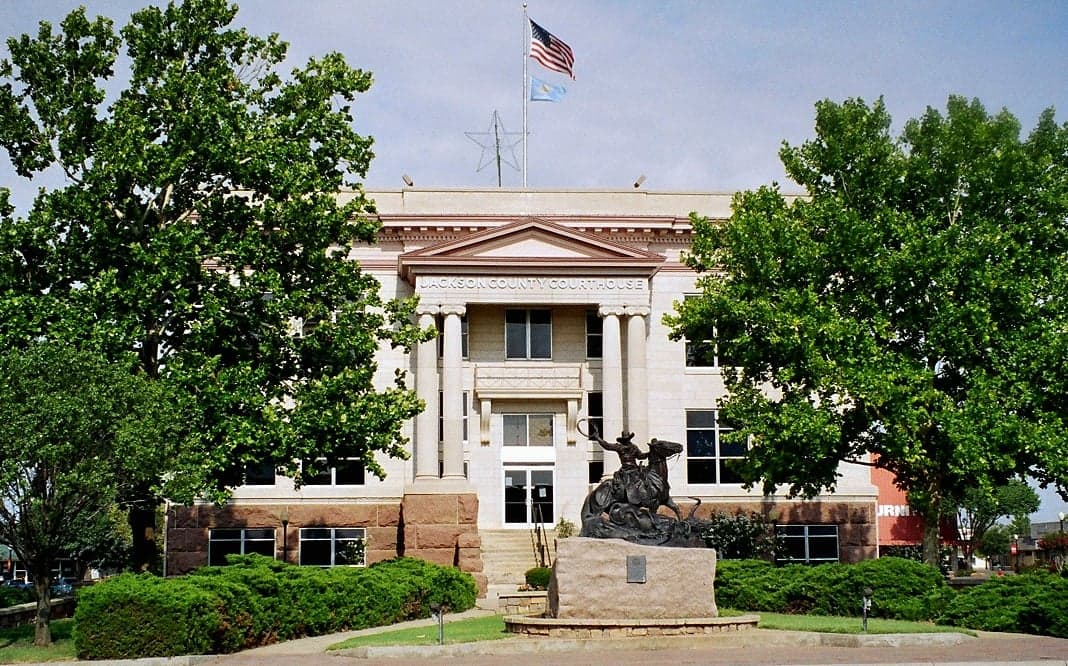
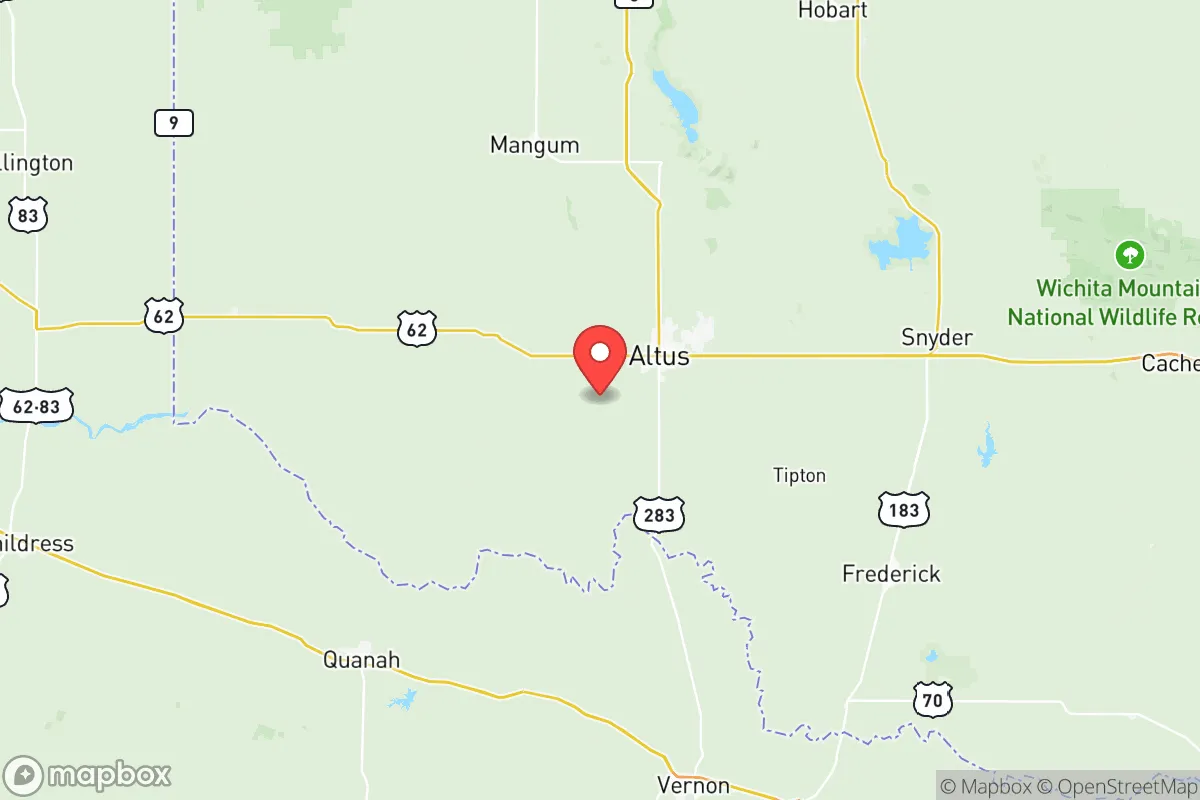
Photo: Wikipedia
Demographics of Jackson County
Affluence Level in Jackson County
A below-average socioeconomic profile. Incomes, home values, and educational attainment trail the U.S., with higher poverty and unemployment.
People of Jackson County
The people of Jackson County, Oklahoma, today form a predominantly White but rapidly diversifying population of 24,730, anchored by the county seat of Altus and shaped by a history of agricultural settlement, military presence, and recent Hispanic growth. With a 61.5% White, 24.6% Hispanic, and 5.9% Black demographic profile, the county's identity remains rooted in its rural, conservative, and faith-oriented character, though Altus and the area around Altus Air Force Base inject a transient, younger, and more ethnically varied element. The foreign-born share is just 3.3%, reflecting a region that, despite recent diversification, remains far less cosmopolitan than national averages.
Settlement & growth (pre-1960)
Before American settlement, Jackson County lay within the traditional lands of the Kiowa, Comanche, and Apache peoples, who followed bison herds across the shortgrass prairie. The region passed through Spanish and then French claims before becoming part of the United States through the Louisiana Purchase. However, no permanent European settlements took root until after the Civil War, when the U.S. government forced the Kiowa, Comanche, and Apache onto reservations in present-day southwestern Oklahoma. The 1892 Jerome Agreement opened these lands to White homesteading through a series of land runs, the most consequential being the 1892 Cherokee Outlet opening, which brought the first significant wave of Anglo settlers to what would become Jackson County.
These early settlers were overwhelmingly White, native-born Americans from Texas, Arkansas, and Missouri—predominantly of Scots-Irish and English descent—drawn by the promise of 160-acre homesteads. They established the county's agricultural economy, building the towns of Altus (the county seat, founded in 1886), Olustee (1892), and Eldorado (1902). Cotton quickly became king, with Altus emerging as a regional cotton-ginning and shipping hub. The arrival of the Kansas City, Mexico and Orient Railway in 1902 cemented Altus as the commercial center, and the town's population surged from a few hundred in 1900 to over 4,000 by 1910.
The Dust Bowl of the 1930s hit Jackson County especially hard—its wheat and cotton fields turned to blowing topsoil—and caused a temporary exodus of farm families to California, akin to the more famous "Okie" migration. However, three post-war developments reversed this trend. First, the construction of the Altus Water Project and Lake Thomas in the 1940s brought irrigation, stabilizing cotton and wheat production. Second, the establishment of Altus Air Force Base in 1943 brought a steady influx of military personnel and their families, injecting a youthful, educated, and geographically diverse population into the county. Third, the mechanization of farming reduced labor needs but increased yields, allowing those who remained to consolidate land and prosper. By 1960, Jackson County's population had reached roughly 29,000—its historic peak—with Altus housing nearly half the county's residents.
Modern era (post-1965)
The 1965 Hart-Cellar Act had a relatively muted direct impact on Jackson County compared to coastal or urban areas. The foreign-born share of just 3.3% attests to this limited international immigration. However, the county's Hispanic population began to grow noticeably from the 1970s onward, driven not by new arrivals from abroad but by internal migration from Texas and Mexico's northern states. Hispanic workers, many of Mexican descent, were drawn to Jackson County's agricultural sector—specifically the cotton, wheat, and increasingly peanut and sorghum operations—as well as to construction and service jobs in Altus. Today, the 24.6% Hispanic share makes this the county's largest minority group, and this population is concentrated most heavily in Altus and the surrounding unincorporated areas, where they work in fields, processing plants, and the local school district.
The Black population, at 5.9%, is historically rooted in the post-Reconstruction settlement of the region by freedmen and their descendants, but this share has declined from a peak of roughly 8–9% in the early 20th century as younger generations moved to urban centers like Oklahoma City and Dallas. The East/Southeast Asian population (1.5%) is a newer addition, primarily associated with military families assigned to Altus Air Force Base, with a small but visible community in Altus proper. The Indian subcontinent population registers at 0.0%, reflecting the absence of the tech-related immigration that has transformed other Oklahoma cities.
Domestically, the most significant demographic shift since 1965 has been stagnation and then decline. From a peak of 28,686 in 1960, Jackson County's population fell to 24,730 by 2020—a decline of roughly 14%. This mirrors the broader pattern of rural depopulation across the Great Plains. Young adults, especially those with college degrees (24.2% of adults), leave for college and do not return, while the remaining population ages. Altus Air Force Base, however, provides a critical counterweight: the base's active-duty and civilian workforce keeps the county's population from shrinking faster and brings in a steady stream of outsiders, many of whom marry locally and stay.
The future
Jackson County is likely to become more Hispanic and more multiracial over the next 10–20 years, while its total population may stabilize or decline only modestly. The White non-Hispanic share, which has fallen from roughly 75% in 1990 to 61.5% today, will continue to edge downward as the older, predominantly White cohort ages out and the younger, more diverse population ages in. The Hispanic population is projected to approach 30% of county residents by 2040, as young Hispanic families have higher birth rates and as agricultural employers continue to rely on this labor pool. The East/Southeast Asian share may grow slightly through military assignments but is unlikely to exceed 2%. The Black population is expected to remain stable at roughly 5–6%.
Geographically, this growth will be almost entirely concentrated in Altus. The smaller towns of Olustee, Eldorado, and Headrick continue to lose population and will likely see their commercial districts further hollow out. Altus, by contrast, benefits from the base's economic anchor and from its role as a regional retail and healthcare hub. New housing developments on Altus's north and west sides are attracting some younger families, though the overall pace of growth remains slow.
Culturally, Jackson County is becoming more bilingual and more diverse in its religious and social practices, but it is not undergoing a rapid transformation. The county remains solidly Republican, with Burnet County voting +24 for Donald Trump in 2024. Churches—particularly Southern Baptist and United Methodist—remain central to community life, and Hispanic congregations are now a visible part of that fabric. For a newcomer, especially one with a conservative leaning, Jackson County offers a stable, affordable, and community-oriented environment, though those seeking a more cosmopolitan or diverse social scene may find it limited. The bottom line: this is a place that is slowly diversifying at its margins, but whose core identity—rural, family-centered, and politically conservative—remains firmly in place.

* Values derived from national, state, county, city and local statistics and may differ in a specific area. Last updated: 2026-06-29T00:43:22.000Z
Narrative content on this page is AI-generated and may contain mistakes. Verify any details that matter before acting on them.
ReloMaps may earn a commission from affiliate links at no extra cost to you.

