Photo: Wikipedia
Demographics of Comanche County
Affluence Level in Comanche County
A below-average socioeconomic profile. Incomes, home values, and educational attainment trail the U.S., with higher poverty and unemployment.
People of Comanche County
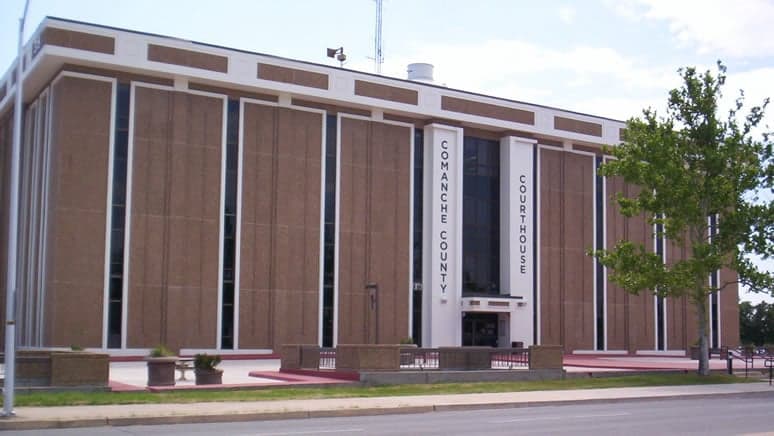
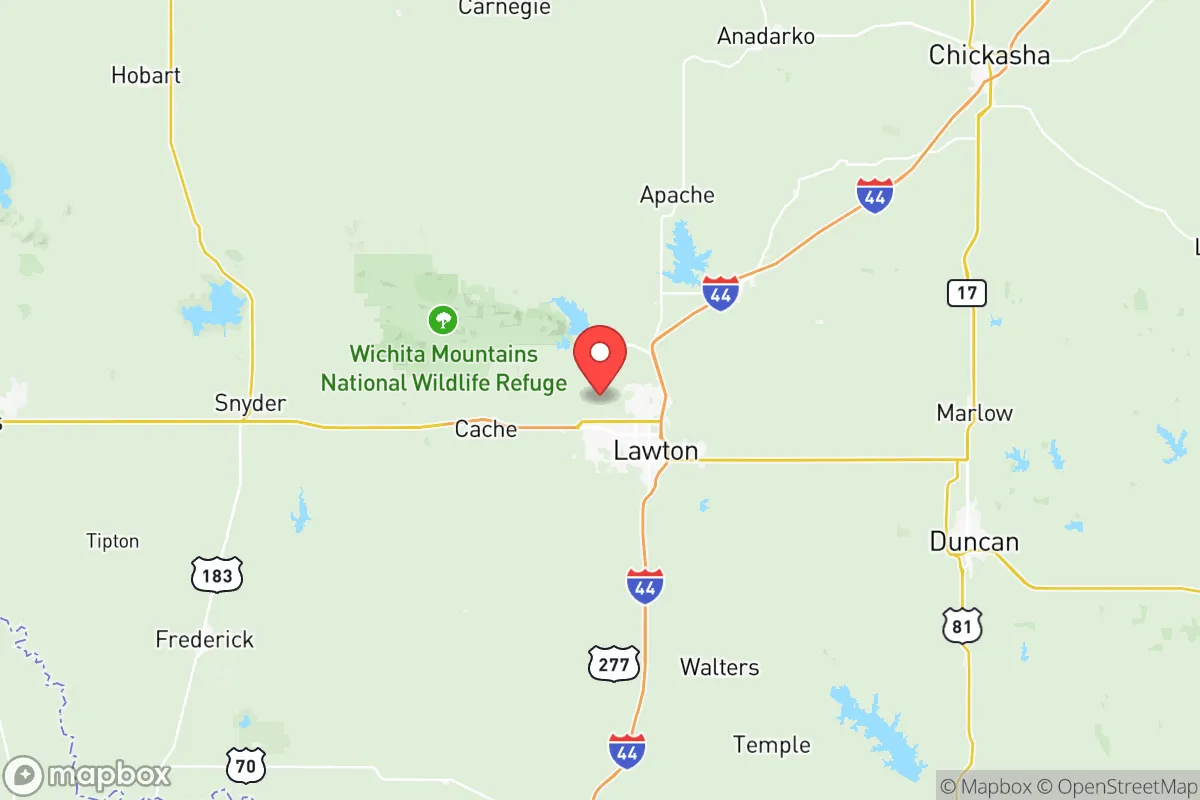
Comanche County, Oklahoma, is home to 121,699 residents, a population shaped by its deep military roots and a demographic profile that is notably more diverse than the state average. The county’s identity is anchored by Fort Sill, a major U.S. Army installation, and the city of Lawton, which together create a community with a transient military population, a significant Native American presence, and a growing Hispanic community. With a foreign-born population of just 2.4%, the county is less diverse in terms of international immigration than the national average, but its racial and ethnic composition—54.4% White, 14.4% Hispanic, 14.2% Black, and 2.1% East/Southeast Asian—reflects a unique blend of historical settlement patterns and modern military recruitment.
Settlement & growth (pre-1960)
Long before European settlement, the area now known as Comanche County was the heartland of the Comanche and Kiowa nations, who controlled the southern Plains for centuries. The U.S. government forcibly removed these tribes to reservations in the 1860s and 1870s, culminating in the establishment of the Kiowa-Comanche-Apache Reservation. The land was opened to non-Native settlement through the 1901 land lottery, which drew thousands of homesteaders—primarily of Anglo-American and Scots-Irish descent—from Texas, Arkansas, and the Midwest. These settlers founded the county’s first towns, including Lawton (named after a Union general), Cache, and Fletcher, with Lawton quickly emerging as the commercial hub.
The single most transformative event for Comanche County was the establishment of Fort Sill in 1869. Originally a cavalry post to control the Plains tribes, Fort Sill became a permanent Army installation and, by the 20th century, a major training center. The base drew a steady stream of military personnel and their families from across the United States, injecting a diverse, transient population into the county. The Dust Bowl of the 1930s brought additional waves of displaced farmers from Oklahoma’s western counties, many of whom settled in Lawton and the surrounding rural areas. World War II and the Cold War expanded Fort Sill’s role, bringing in African American soldiers after the military’s desegregation in 1948 and, later, soldiers from allied nations for training. By 1960, the county’s population had grown to roughly 90,000, with a majority-white, native-born population and a significant Black minority concentrated in Lawton’s north side.
Modern era (post-1965)
The 1965 Hart-Cellar Act had a limited direct impact on Comanche County, as the area never attracted large numbers of international immigrants. Instead, the county’s modern demographic shifts have been driven primarily by domestic migration tied to Fort Sill. The post-1965 era saw a steady increase in Hispanic residents, many of whom arrived as military families or as workers in construction and service industries supporting the base. Today, Lawton’s Hispanic population is concentrated in the central and southern parts of the city, with a growing presence in Elgin and Cache. The Asian population, primarily East and Southeast Asian (2.1%), is largely composed of military-affiliated families from the Philippines, Korea, and Vietnam, who tend to live near the base in Lawton’s southwest neighborhoods.
The county’s Black population (14.2%) has deep roots in the post-World War II era, when African American soldiers stationed at Fort Sill chose to remain after service. The community is centered in Lawton’s historic Lincoln neighborhood and the northwest Lawton area. The Indian subcontinent population (0.4%) is small and almost entirely military-affiliated, with families living near Fort Sill. Suburbanization in the 1990s and 2000s pushed growth outward from Lawton into Fletcher, Geronimo, and Sterling, where newer housing developments attracted both military retirees and civilians seeking lower costs. The county’s overall population has remained relatively stable since 2000, hovering around 120,000, as the military’s base realignment and closure (BRAC) processes have kept Fort Sill active but not dramatically expanded.
The future
Comanche County’s population is projected to remain stable or grow slowly, driven by Fort Sill’s continued role as a major training center for the Army and Marine Corps. The county is becoming slightly more diverse: the Hispanic share is expected to rise from 14.4% to perhaps 18-20% by 2040, driven by both military recruitment and civilian migration from Texas and the Southwest. The Asian and Indian populations will likely remain small and tied to the base. The white population share is declining gradually, as it is across Oklahoma, but the county remains majority-white. New residential development is concentrating in Lawton’s southwest corridor near Fort Sill’s main gate and in the Cache area, where new subdivisions are attracting younger military families. The county’s cultural identity is evolving from a historically Southern Plains, military-town character to a more multicultural one, though the pace of change is slow compared to urban Texas or the East Coast.
For someone moving to Comanche County today, the area offers a stable, military-anchored community with a moderate cost of living and a population that is more racially and ethnically diverse than most of rural Oklahoma. The county’s future is tied to Fort Sill’s mission, which appears secure, and to the gradual diversification of its population. New residents will find a place where the military ethos of service and community remains central, but where the faces of that community are increasingly varied.

* Values derived from national, state, county, city and local statistics and may differ in a specific area. Last updated: 2026-07-20T00:31:34.000Z
Narrative content on this page is AI-generated and may contain mistakes. Verify any details that matter before acting on them.
ReloMaps may earn a commission from affiliate links at no extra cost to you.

