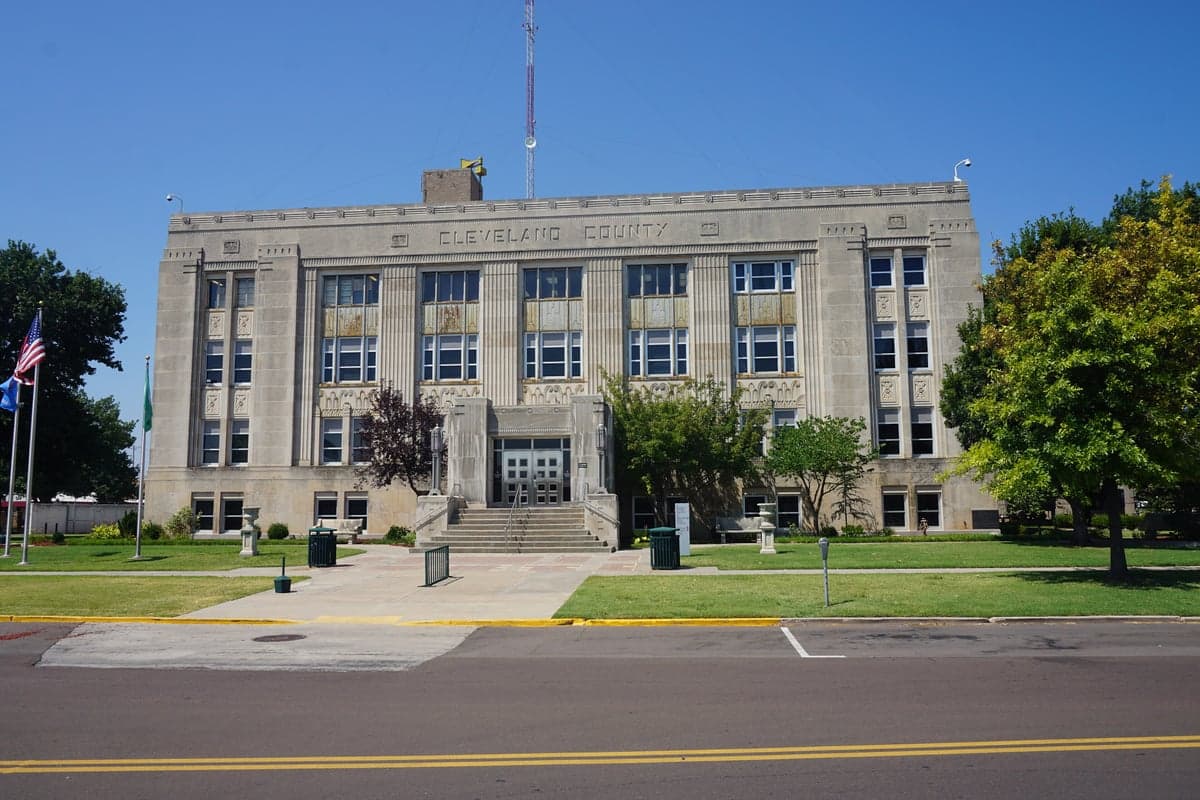
Photo: Wikipedia
Demographics of Cleveland County
Affluence Level in Cleveland County
A middle-class area roughly in line with national averages across income, home values, education, and employment.
People of Cleveland County
The people of Cleveland County, Oklahoma, today form a rapidly growing, predominantly white-collar population of nearly 300,000, anchored by the University of Oklahoma in Norman and spreading across a suburban landscape that blends college-town energy with family-oriented bedroom communities. With a population density of roughly 290 people per square mile, the county is the third-most populous in the state, yet retains a distinctly Oklahoman character — politically moderate-to-conservative, deeply tied to public education and energy-sector employment, and notably less diverse than the national average. The county's identity is shaped by a 67.9% white, non-Hispanic majority, a growing Hispanic community at 10.6%, and small but established Black (4.7%) and East/Southeast Asian (4.0%) populations, all living within a region where the foreign-born share is just 3.3% — well below the U.S. average of roughly 14%.
Settlement & growth (pre-1960)
Cleveland County's human history begins with the forced displacement of Native nations. The area that would become the county was originally part of the lands assigned to the Choctaw and Chickasaw nations after their removal from the Southeast along the Trail of Tears in the 1830s. For decades, the region was sparsely settled by Choctaw and Chickasaw families, with a few scattered trading posts and farms. No permanent non-Native settlement existed until after the Land Run of 1889, when the U.S. government opened the Unassigned Lands — including what is now Cleveland County — to white homesteaders. On April 22, 1889, tens of thousands of settlers surged into the area, staking claims on 160-acre plots. The town of Norman was founded that same day, named after a railroad surveyor, and quickly became the county seat. Nearby Moore and Noble also trace their origins to the Land Run, with Moore established as a station on the Santa Fe Railway and Noble growing as a farming and railroad town.
The early white settlers were overwhelmingly native-born Americans from the Midwest and Upper South — farmers from Kansas, Missouri, Arkansas, and Tennessee seeking cheap land. There was no significant wave of European immigrant settlement in Cleveland County, unlike in the Texas Hill Country or the Northern Plains. The foreign-born population remained minuscule throughout the county's early decades, a pattern that persisted well into the 20th century. The establishment of the University of Oklahoma in Norman in 1890 — just one year after the Land Run — was the single most transformative event in the county's history. The university drew faculty, administrators, and students from across the country, giving Norman a more educated and cosmopolitan character than its rural neighbors. By the 1910s and 1920s, Norman had become a small college town of about 5,000 people, while Moore and Noble remained agricultural hamlets of a few hundred each.
The oil boom of the 1920s and 1930s brought a new wave of domestic migrants to Cleveland County. The discovery of the Oklahoma City Oil Field, which extended into the northwestern corner of the county, drew roughnecks, drillers, and speculators from Texas, Kansas, and other oil-producing states. The town of Oklahoma City itself exploded in population, and its southern suburbs — including Moore — began to grow as bedroom communities for oil-field workers and refinery employees. This period also saw the first significant Black population in the county, as African American families moved from rural Oklahoma and the South seeking work in the oil fields and in Norman's service economy. By 1940, Cleveland County's population had reached roughly 40,000, with Norman accounting for about half.
World War II and the postwar era brought further change. The Naval Air Technical Training Center in Norman (established in 1942) brought thousands of military personnel and civilian employees to the county, many of whom stayed after the war. The GI Bill enabled a surge in enrollment at the University of Oklahoma, transforming Norman from a small college town into a mid-sized university city. Suburbanization began in earnest in the 1950s, with new housing developments spreading south from Oklahoma City into Moore and south Oklahoma City (the portion within Cleveland County). The county's population doubled between 1950 and 1960, reaching about 80,000, as families seeking affordable homes and good schools moved into the expanding suburban corridor along Interstate 35.
Modern era (post-1965)
The 1965 Hart-Cellar Act, which abolished national-origin quotas, had a relatively muted effect on Cleveland County compared to coastal regions. The foreign-born share remained low — just 3.3% as of the most recent data — but the composition of that small immigrant population shifted notably. The most significant change was the growth of the Hispanic community, which rose from a negligible share in 1970 to 10.6% today. This growth was driven primarily by domestic migration from Texas and the southwestern U.S., as well as direct immigration from Mexico and Central America. Hispanic families concentrated in Norman and Moore, where they found work in construction, hospitality, and the service industries tied to the university and the expanding suburban economy. A smaller but visible East/Southeast Asian community — now 4.0% of the population — grew primarily through university-related migration. Vietnamese, Chinese, and Korean families settled in Norman, often connected to graduate programs and faculty positions at OU, as well as to the engineering and energy sectors that draw skilled workers to the region.
The Indian-subcontinent community (0.6% of the population) is a more recent and smaller presence, concentrated almost entirely in Norman, where Indian professionals work in technology, medicine, and academia at the university and at nearby employers such as the Oklahoma City VA Medical Center. Unlike in Texas or California, no large ethnic enclave has formed; the Indian population remains dispersed within Norman's broader professional-class neighborhoods.
The most transformative demographic force in the modern era has been domestic migration from the Rust Belt and coastal states. Beginning in the 1980s and accelerating after 2000, families from California, Illinois, Ohio, and Michigan have moved to Cleveland County in search of lower housing costs, lower taxes, and a more conservative political environment. This wave has been particularly pronounced in Moore and the newer suburbs of south Oklahoma City and Newcastle (the latter partially in Cleveland County). These migrants are predominantly white, middle-class, and family-oriented, and they have reinforced the county's existing cultural and political character. The county's Black population, at 4.7%, has grown slowly but steadily, driven by African American families moving from Oklahoma City proper and from other parts of the South for jobs in education, healthcare, and the energy sector.
Suburbanization has reshaped the county's geography dramatically since 1990. Moore has grown from a town of 15,000 in 1980 to over 60,000 today, becoming a classic Sun Belt suburb with sprawling housing developments, big-box retail, and a strong public school system. Norman has grown to over 128,000, but its character remains distinct — denser, more walkable near the university, and more politically mixed, with a noticeable liberal minority among faculty and students. The unincorporated areas and smaller towns like Noble (about 7,000) and Slaughterville (about 4,000) have grown more slowly, retaining a semi-rural feel. The county's overall population has more than tripled since 1960, reaching 297,545, with the vast majority of growth concentrated in the I-35 corridor from Moore through Norman to the southern edge of the county.
The future
Cleveland County is projected to continue growing at a steady pace, likely surpassing 350,000 by 2040, driven by the same forces that have fueled its expansion for the past half-century: affordable housing, low taxes, a strong public university, and in-migration from higher-cost states. The county is becoming modestly more diverse, but the pace of change is slow. The Hispanic share is expected to rise gradually, possibly reaching 14-16% by 2040, as younger Hispanic families have higher birth rates and continued migration from Texas and the Southwest. The East/Southeast Asian and Indian populations will likely grow as the University of Oklahoma continues to recruit international graduate students and as the Oklahoma City metro's healthcare and technology sectors expand. However, the county is unlikely to see the rapid diversification of suburban counties in Texas or Virginia; the foreign-born share will probably remain below 5% for the foreseeable future.
The most significant demographic trend is the continued suburbanization of the county's southern and western fringes. New housing developments are pushing south of Norman toward the Canadian River and west toward the Grady County line, with towns like Newcastle and Blanchard (the latter partially in Cleveland County) absorbing much of the new growth. These areas are attracting families who want larger lots and lower taxes than Moore or Norman offer, and they are overwhelmingly white and politically conservative. The cultural divide between the university-centered, more liberal Norman and the surrounding conservative suburbs is likely to widen, creating a county that is politically bifurcated even as it grows more populous.
For someone moving to Cleveland County now, the bottom line is this: you are choosing a place that is growing steadily but not explosively, where the population is predominantly white and native-born, where the economy is anchored by a major university and the energy sector, and where the political and cultural character remains broadly conservative outside of Norman proper. The county offers affordable housing, good public schools, and a low cost of living, but it is not a diverse or globally connected community in the way that Sun Belt suburbs in Texas or Georgia are. It is a place where the people are largely the descendants of the Land Run settlers and the postwar suburban migrants, and where the next wave of growth will likely look much like the last one — only farther south and west.

* Values derived from national, state, county, city and local statistics and may differ in a specific area. Last updated: 2026-07-27T14:29:30.000Z
Narrative content on this page is AI-generated and may contain mistakes. Verify any details that matter before acting on them.
ReloMaps may earn a commission from affiliate links at no extra cost to you.

