
Photo: Wikipedia
Political ClimatePolitical Climate in Richland County
Showing district-level results — no local-only data available.
Local Political AnalysisPolitical Analysis of Richland County
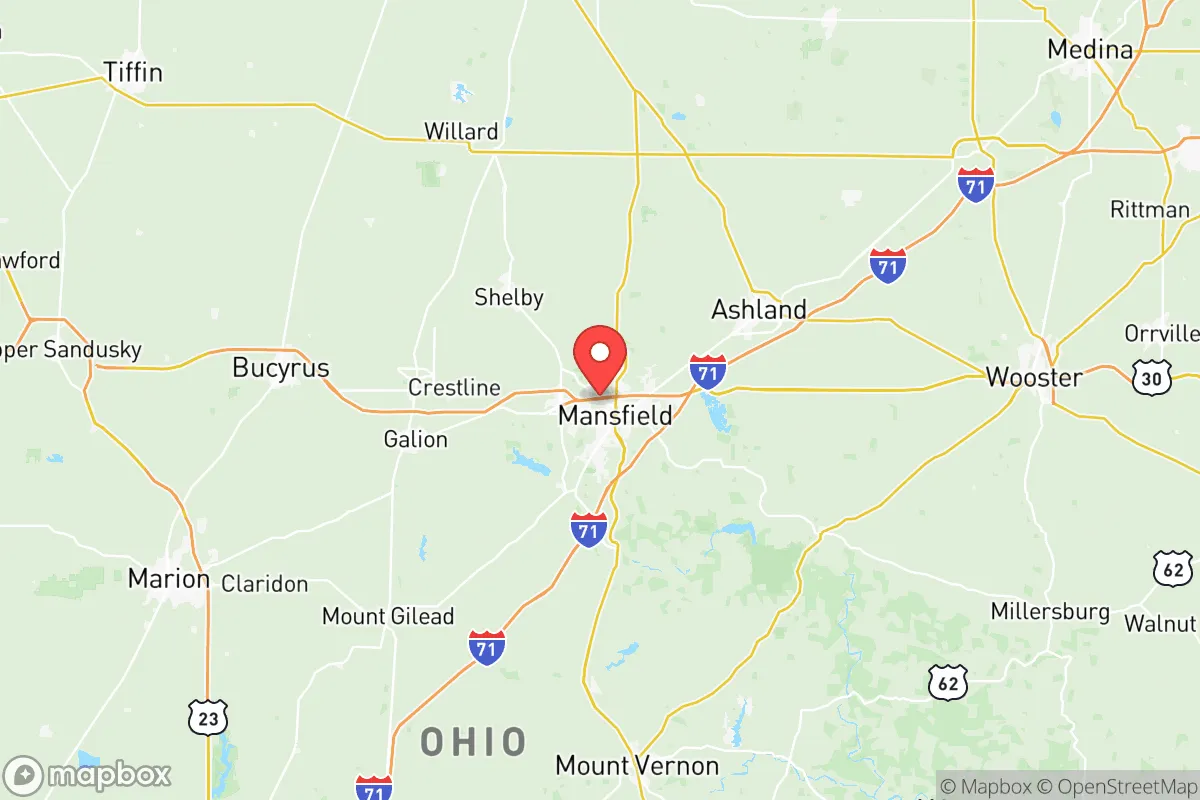
Richland County is a solidly Republican area in north-central Ohio, with a Cook Partisan Voting Index of R+18 that makes it significantly more conservative than the state as a whole, which sits at R+5. The county has been trending redder over the past decade, driven largely by the shift of working-class voters in the former industrial hub of Mansfield away from the Democratic Party. While the county still has pockets of Democratic strength, particularly in the city of Mansfield itself and the college town of Lexington, the surrounding rural townships and communities like Ontario, Shelby, and Bellville have moved decisively to the right, making the overall landscape deeply Republican.
How it compares
Richland County's R+18 rating is more than three times as Republican-leaning as Ohio's statewide R+5, placing it among the most conservative counties in the state's north-central region. To put that in perspective, while Ohio as a whole has become a reliable Republican state in presidential elections, Richland County votes about 13 points more Republican than the state average. The city of Mansfield, which once reliably voted Democratic, has seen its Democratic margins shrink considerably, though it still provides the bulk of the county's Democratic votes. In contrast, the fast-growing suburb of Ontario has become a Republican stronghold, while Lexington, home to many North Central State College faculty and professionals, remains a swing area that can go either way depending on the election cycle. The rural townships—like Madison, Jefferson, and Franklin—are overwhelmingly Republican, often delivering margins of 70% or more for GOP candidates.
What this means for residents
For conservative residents, the county's lean means that Republican candidates are virtually guaranteed to win most local offices, from county commissioner to sheriff, and that conservative policy priorities generally dominate at the county level. For liberal residents, the reality is that they are a clear minority in countywide elections, though they can still find representation in Mansfield city government and in some school board races. The practical effect is that the county's political discourse tends to be conservative, with strong support for gun rights, limited government, and traditional values, while progressive initiatives like renewable energy projects or diversity programs often face an uphill battle. The county's trajectory suggests that this gap will only widen, as younger voters in the rural areas continue to lean Republican while the Democratic base in Mansfield ages and shrinks.
Culturally, Richland County is more traditional and community-oriented than the state's major urban centers, with a strong emphasis on local churches, agricultural fairs, and high school sports. The county's politics are reflected in its policy choices: it is a Second Amendment sanctuary county, has resisted state-level marijuana legalization efforts, and tends to favor lower taxes and fewer regulations. For newcomers, the political climate is something to be aware of but not necessarily a barrier—many residents report that while politics are discussed, they don't dominate daily life in the way they might in more polarized urban areas. The county's political identity is deeply tied to its industrial and agricultural heritage, and that sense of place remains strong even as the economy shifts toward healthcare, logistics, and education.

State Political ClimatePolitical Climate in Ohio
State Political AnalysisPolitical Environment in the State
Ohio is a classic battleground that has shifted from a true swing state to a solidly Republican-leaning one, with a Cook PVI of R+5. Over the past 10-20 years, the state has moved rightward by about 5-7 points, driven by the realignment of working-class voters in small cities and rural areas, even as the suburbs of Columbus and Cincinnati have become more competitive. The dominant coalition is now a mix of Appalachian and Midwestern conservatives, with the GOP holding all statewide executive offices and a supermajority in the legislature, though the state still elects Democrats to the U.S. Senate (Sherrod Brown) and occasionally to the state Supreme Court.
Urban vs. rural divide
The political map of Ohio is a textbook study in geographic polarization. The three major metros — Cleveland, Columbus, and Cincinnati — are Democratic strongholds, with Cuyahoga County (Cleveland) delivering a 2-to-1 margin for Biden in 2020. Columbus, the fastest-growing major city in the Midwest, has become a blue island in a red sea, driven by Ohio State University and a booming tech and insurance sector. Cincinnati's Hamilton County flipped from red to blue in the Trump era, powered by suburban voters in places like Madeira and Wyoming. Meanwhile, the rest of the state is deeply Republican. The rural southeast (Appalachian Ohio) and the northwest (the old "Black Swamp" region) vote 65-75% GOP. The most telling shift is in the Mahoning Valley — Youngstown and Warren — which were once reliably Democratic union strongholds but have flipped hard to Trump, with Mahoning County going from +18 Obama in 2012 to +3 Trump in 2020. The Dayton area, anchored by Wright-Patterson Air Force Base, remains a bellwether: Montgomery County voted for Obama twice, then Trump, then Biden by a narrow margin.
Policy environment
Ohio's policy environment is broadly conservative but with some notable wrinkles. The state has a flat income tax rate of 3.5% (down from 4.8% in 2020), with a phaseout to 2.75% by 2026. Sales tax is 5.75% plus local add-ons, typically totaling 7-8%. Property taxes are moderate, with effective rates around 1.5% of home value. The state is a "right-to-work" state in practice but not by law — a 2011 law was repealed by referendum in 2011. Education policy is a flashpoint: Ohio has one of the largest school voucher programs in the country (EdChoice), expanded in 2023 to be nearly universal. The state also passed a "Parents' Bill of Rights" (HB 8) in 2024, requiring schools to notify parents of any changes to a student's health or well-being. On healthcare, Ohio expanded Medicaid under the ACA in 2014, and about 3 million residents are now on the program. Election laws have tightened: voter ID is now required (HB 458, 2023), early voting is limited to 28 days, and drop boxes are restricted to one per county. The state also purges inactive voters regularly, a practice upheld by the Supreme Court in 2018.
Recent policy direction
The last three years have seen a sharp conservative turn on multiple fronts. On gun rights, Ohio passed constitutional carry (HB 227) in 2022, allowing permitless concealed carry for adults 21 and over. A "stand your ground" bill (SB 175) was signed in 2024. On education and parental rights, the state banned transgender girls from female sports (HB 61, 2023) and restricted gender-affirming care for minors (HB 68, 2024), overriding a gubernatorial veto. On abortion, voters enshrined reproductive rights in the state constitution via Issue 1 in November 2023, with 57% support — a direct rebuke to the GOP legislature's six-week ban passed in 2019. This creates an unusual dynamic: a conservative legislature with a liberal abortion policy. On taxation, the trend is toward lower rates, with the income tax phaseout and a 2023 law exempting up to $100,000 in business income from the Commercial Activity Tax. On voting, the trend is restrictive: HB 458 shortened the absentee ballot application window and tightened ID requirements. On property rights, Ohio is a "Dillon's Rule" state, meaning local governments have only the powers explicitly granted by the state — the legislature has preempted local gun laws, local minimum wage hikes, and local plastic bag bans.
Civil unrest & political movements
Ohio has a long history of political activism, from the labor movement to the anti-abortion movement. In recent years, the most visible flashpoint was the 2020 protests in Columbus and Cincinnati following the killing of George Floyd, which included property damage and a heavy police response. The state also saw significant protests in 2023 over the East Palestine train derailment, with residents demanding accountability from Norfolk Southern. On the right, the "Moms for Liberty" movement is active in suburban school board races, particularly in Delaware County (north of Columbus) and Warren County (north of Cincinnati). Immigration politics are less heated than in border states, but there is a growing debate over the influx of Haitian migrants to Springfield, which has strained local services and become a national talking point. Election integrity remains a live issue: the 2020 election in Ohio was relatively uncontroversial (Trump won by 8 points), but the legislature has nonetheless tightened voting laws. There is no serious secession or nullification movement in Ohio, though some rural counties have passed symbolic "Second Amendment sanctuary" resolutions.
Projection
Over the next 5-10 years, Ohio is likely to become more Republican at the state level, but with a ceiling. The demographic trends are unfavorable for Democrats: the state is aging, with the 65+ population growing faster than the national average, and the population is stagnant or declining in most counties outside of Columbus and the Cincinnati suburbs. The in-migration is modest and mostly from other Midwestern states, not from high-tax coastal states, so the political culture is unlikely to shift dramatically. However, the 2023 abortion referendum showed that the GOP's supermajority has limits — voters will break with the party on specific issues. The wild card is the Columbus metro, which is growing and diversifying: Franklin County added 100,000 residents between 2010 and 2020, and if that trend continues, it could eventually turn the state purple again in presidential elections. For now, expect continued conservative governance on taxes, guns, and education, with occasional voter revolts on social issues like abortion and marijuana (which was legalized by ballot initiative in 2023).
For a new resident, the bottom line is this: Ohio is a reliably conservative state for day-to-day governance, but with a populist streak that keeps things unpredictable. You'll find low taxes, constitutional carry, and a legislature that moves quickly on conservative priorities. But you'll also find a state where abortion is constitutionally protected, marijuana is legal, and the cities are reliably Democratic. If you're moving from a blue state, you'll notice the difference in the statehouse and the school board; if you're moving from a deep red state, you'll notice the union presence and the purple suburbs. It's a state where your vote matters less in the general election (Ohio is no longer a swing state) but more in primaries and local races, where the real action is.
* Values derived from national, state, county, city and local statistics and may differ in a specific area. Last updated: 2026-06-26T15:50:28.000Z
Narrative content on this page is AI-generated and may contain mistakes. Verify any details that matter before acting on them.
ReloMaps may earn a commission from affiliate links at no extra cost to you.

