
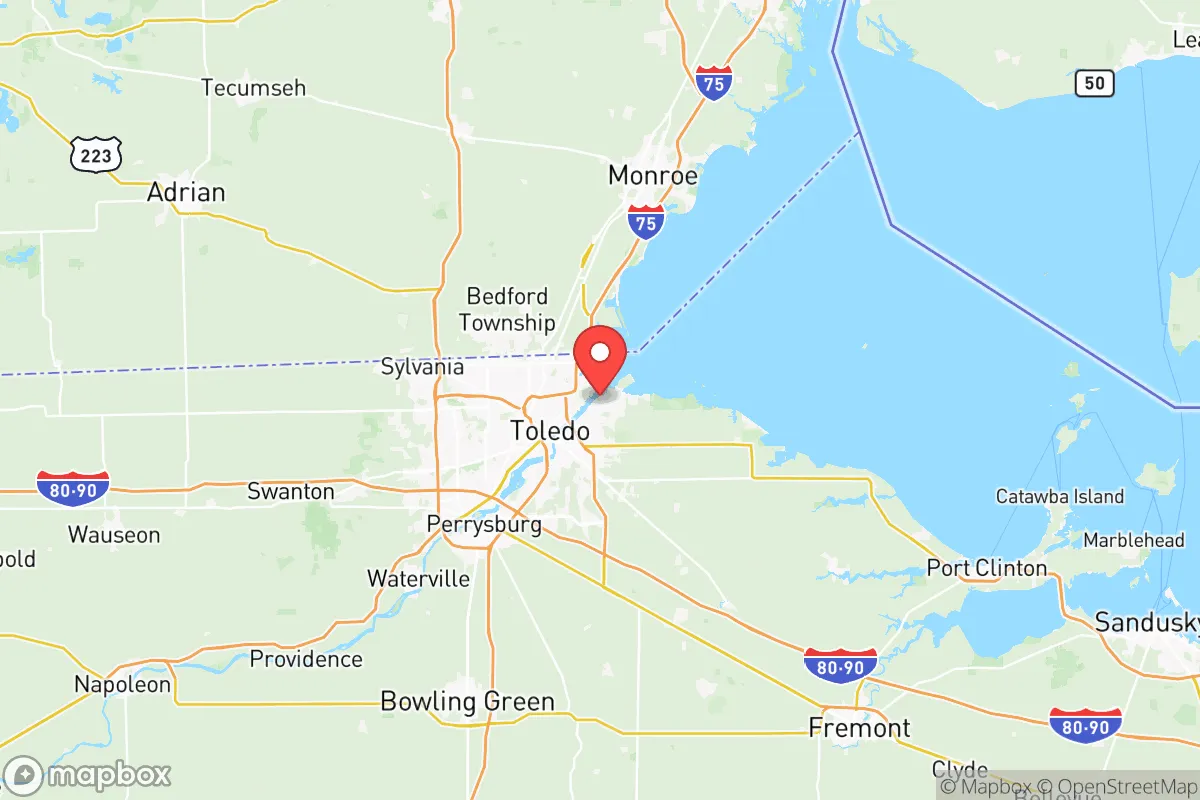
Photo: Wikipedia
Political ClimatePolitical Climate in Lucas County
Showing district-level results — no local-only data available.
Local Political AnalysisPolitical Analysis of Lucas County
Lucas County, Ohio, is a classic blue island in a reddening state, with a Cook Partisan Voting Index of R+3 that actually undersells its Democratic lean in presidential years. The county backed Joe Biden by about 12 points in 2020, while the state of Ohio as a whole shifted to R+5, meaning Lucas County is roughly 7 points more Democratic than the state average. That gap has widened over the past decade as rural and exurban areas of Ohio moved right, while Lucas County’s urban core held steady or shifted slightly left. The real story isn’t just the county vs. the state—it’s the sharp divide within the county itself.
How it compares
Ohio’s R+5 PVI reflects a state that has become reliably Republican in statewide races, with Donald Trump winning it by 8 points in 2020 and 11 points in 2024. Lucas County’s R+3 label is misleading because it’s a composite of two very different worlds. The city of Toledo, which makes up about 60% of the county’s population, is heavily Democratic—think precincts in the Old West End and central neighborhoods that routinely deliver 75-80% of the vote for Democrats. But drive 15 minutes southwest to Maumee or 20 minutes west to Sylvania Township, and you’ll find precincts that vote Republican by 10-15 points. The swingiest areas are the inner-ring suburbs like Ottawa Hills and parts of West Toledo, where independent voters and moderate Republicans often decide local races. In the 2024 election, Lucas County’s overall margin was about 12 points Democratic, while Ohio’s was 11 points Republican—a 23-point gap that makes the county one of the most Democratic-leaning in the state outside of Cuyahoga and Franklin counties.
What this means for residents
For a liberal resident, Lucas County feels like a safe space in a red state. Toledo’s city council and school board are reliably progressive, and the county government has been Democratic-controlled for decades. You’ll find strong support for labor unions, public transit, and affordable housing initiatives. For a conservative resident, it’s a different experience. While you can find like-minded neighbors in Perrysburg, Waterville, or the rural townships north of the Maumee River, you’ll often feel outnumbered in countywide elections. The local GOP is active but rarely wins county-level races; their influence is felt more in state legislative districts that stretch into the surrounding counties. The practical upshot is that Lucas County residents live under a Democratic county commission and a Republican state government, which creates tension on issues like gun laws, abortion access, and education funding. Toledo’s city ordinances on paid sick leave and minimum wage often clash with state preemption laws, leading to ongoing legal battles.
Culturally, Lucas County is more Midwestern industrial than the rest of Ohio. The strong union presence—especially from the United Auto Workers and the Toledo Federation of Teachers—gives the area a blue-collar, pro-labor identity that you don’t see as much in the Columbus suburbs or Cincinnati’s exurbs. The county also has a higher percentage of Black residents (about 20%) than the state average (12%), which shapes local politics around issues like police reform and economic equity. Policy-wise, Lucas County has been an early adopter of needle exchange programs and mental health diversion courts, reflecting a more harm-reduction approach than the state’s conservative legislature typically supports. The county’s Democratic lean means it often serves as a testbed for progressive policies in Ohio, but those policies rarely survive contact with the statehouse in Columbus. For anyone moving here, the key takeaway is that Lucas County offers a distinctly urban, union-friendly, and politically engaged environment that feels a world apart from the rest of Ohio—even if you’re only a 20-minute drive from the nearest red precinct.

State Political ClimatePolitical Climate in Ohio
State Political AnalysisPolitical Environment in the State
Ohio is a classic swing state that has shifted rightward over the past decade, now carrying a Cook PVI of R+5. The state voted for Donald Trump by 8 points in both 2016 and 2020, and by 11 points in 2024, marking a clear departure from its bellwether status when it twice backed Barack Obama. The dominant coalition is a mix of working-class voters in small cities and rural areas, combined with a growing conservative exurban base around Cincinnati and Columbus, while the Democratic strongholds are shrinking in relative population. For a relocator, this means the state is reliably Republican at the statewide level, but local politics vary dramatically depending on which county you land in.
Urban vs. rural divide
The political map of Ohio is a textbook study in geographic polarization. The three major metros—Cleveland, Columbus, and Cincinnati—are Democratic islands in a red sea. Cuyahoga County (Cleveland) delivered 66% for Biden in 2020, while Franklin County (Columbus) gave him 62%. Hamilton County (Cincinnati) is the most competitive of the three, flipping from Obama in 2012 to Trump in 2016, then back to Biden by a slim 52-46 margin in 2020. The real story is the exurban and rural counties that have swung hard right. Delaware County, north of Columbus, went from a 60-40 Romney win in 2012 to a 58-40 Trump win in 2020—a massive shift for a county that was once a classic swing suburb. Butler County (north of Cincinnati) and Warren County (south of Dayton) are now deep red, with Trump winning both by 30+ points. The Appalachian counties in the southeast, like Belmont and Monroe, have flipped from blue-dog Democrat to solid Republican as cultural issues overtook economic ones. The result is a state where the urban cores are increasingly isolated, and the growing suburbs and rural areas drive the statewide Republican lean.
Policy environment
Ohio’s policy environment is a mix of conservative fiscal management and moderate social policies, with a strong local-control bent. The state has a flat income tax rate of 3.5% as of 2025, down from a progressive top rate of nearly 5% a decade ago, and the state sales tax is 5.75% (local add-ons push it to 7-8% in most cities). Property taxes are relatively high, averaging about 1.5% of home value, but there is a homestead exemption for seniors and disabled veterans. The regulatory posture is business-friendly, with right-to-work laws not on the books (a 2011 law was repealed by referendum in 2011), but the state has a low corporate income tax and a strong tort reform environment. Education policy is a battleground: the state funds public schools through a mix of local property taxes and state aid, but the system was ruled unconstitutional in 1997 and has never been fully fixed. School choice is robust, with a statewide voucher program (EdChoice) that has expanded significantly since 2020, now covering families up to 400% of the federal poverty level. Charter schools are common, especially in Cleveland and Columbus. Election laws are moderately restrictive: voter ID is required (a photo ID or a utility bill), early voting starts 28 days before Election Day, and no-excuse absentee voting is available. The state purges inactive voters from rolls every two years, a practice upheld by the Supreme Court in 2018.
Recent policy direction
Ohio’s recent legislative direction has been a sharp turn to the right on cultural and social issues, while maintaining a moderate-to-conservative economic posture. In 2023, the state passed a six-week abortion ban (Senate Bill 23), which was then superseded by a 2023 voter-approved constitutional amendment (Issue 1) enshrining abortion rights up to fetal viability. This creates a tense standoff: the amendment is law, but the legislature has passed a 24-hour waiting period and mandatory ultrasound requirements that are being challenged in court. Gun laws have been significantly loosened: in 2022, Ohio passed permitless carry (House Bill 99), allowing any adult 21 or older to carry a concealed firearm without a license or training. Stand-your-ground laws have been on the books since 2008, and there is no red-flag law. On education, the state passed the Parental Bill of Rights (House Bill 8) in 2023, requiring schools to notify parents of any changes to a student’s health or well-being, and banning instruction on sexual orientation or gender identity in grades K-3. Property rights are strong: Ohio is a “right-to-farm” state, limiting nuisance lawsuits against agricultural operations, and there is no statewide rent control. On privacy, the state has no comprehensive data privacy law, but a 2024 law (Senate Bill 29) restricts the use of facial recognition by law enforcement without a warrant. On voting, the legislature passed a 2023 law (House Bill 458) that shortened the absentee ballot application window and banned ballot drop boxes, though early voting hours remain generous. The overall direction is toward more individual liberty on guns and parental rights, with tighter restrictions on voting access and a continued push to limit local control on issues like housing and land use.
Civil unrest & political movements
Ohio has seen its share of political flashpoints, particularly around racial justice and election integrity. The 2020 murder of George Floyd sparked large protests in Columbus and Cincinnati, with some property damage and a heavy police response. The 2023 abortion amendment campaign saw intense grassroots organizing on both sides, with Issue 1 passing by 57-43, a clear signal that the state’s electorate is more moderate on abortion than the legislature. Election integrity has been a hot-button issue since 2020: the state’s Republican Secretary of State, Frank LaRose, has pushed for stricter voter ID and ballot security measures, while Democrats have accused him of voter suppression. There have been no major secession or nullification movements, but there is a strong rural-urban tension, with some counties exploring “sanctuary county” resolutions against state gun laws (though none have passed). Immigration politics are less visible than in border states, but there is a small but vocal movement in Dayton and Springfield around refugee resettlement, with some local pushback against the state’s relatively welcoming stance (Ohio is a “welcoming state” for refugees, with resettlement agencies active in Columbus and Cleveland). A new resident would notice the political divide most in the yard signs and local news: deep red in the exurbs, deep blue in the cities, with a lot of “I don’t care” in between.
Projection
Over the next 5-10 years, Ohio is likely to become more Republican at the statewide level, driven by continued out-migration from the urban cores and in-migration of conservative-leaning retirees and remote workers to the exurbs and small cities. The Columbus metro is the main wildcard: it’s growing fast (adding about 30,000 people per year) and is politically moderate, with a mix of tech workers, state government employees, and Ohio State University faculty. If Columbus continues to trend blue, it could offset some of the rural red shift, but the state’s overall PVI is likely to settle at R+6 or R+7 by 2030. The legislature will remain firmly Republican, with supermajorities in both chambers, meaning the policy direction on guns, education, and taxes will continue rightward. The abortion amendment will remain a flashpoint, with ongoing legal battles over the 24-hour waiting period and ultrasound requirements. A new resident moving in now should expect a state where the political culture is increasingly conservative outside the major cities, but where local elections in the suburbs can still be competitive. The practical takeaway: if you’re conservative, you’ll find a welcoming policy environment and a growing network of like-minded communities; if you’re liberal, you’ll find strong urban enclaves but a state government that is often hostile to your priorities.
For a relocator, the bottom line is that Ohio offers a stable, increasingly conservative political environment with low taxes and a business-friendly regulatory climate, but with significant local variation. The state’s trajectory is toward more individual liberty on guns and education, with tighter voting laws and a continued cultural battle over abortion. If you’re looking for a place where your vote will matter in statewide races, Ohio is still competitive enough that your ballot counts, but the trend is clearly rightward. The best advice is to visit the specific county you’re considering—Delaware County feels very different from Cuyahoga County, and the political climate will shape everything from your property taxes to your children’s school curriculum.
* Values derived from national, state, county, city and local statistics and may differ in a specific area. Last updated: 2026-08-25T00:22:55.000Z
Narrative content on this page is AI-generated and may contain mistakes. Verify any details that matter before acting on them.
ReloMaps may earn a commission from affiliate links at no extra cost to you.

