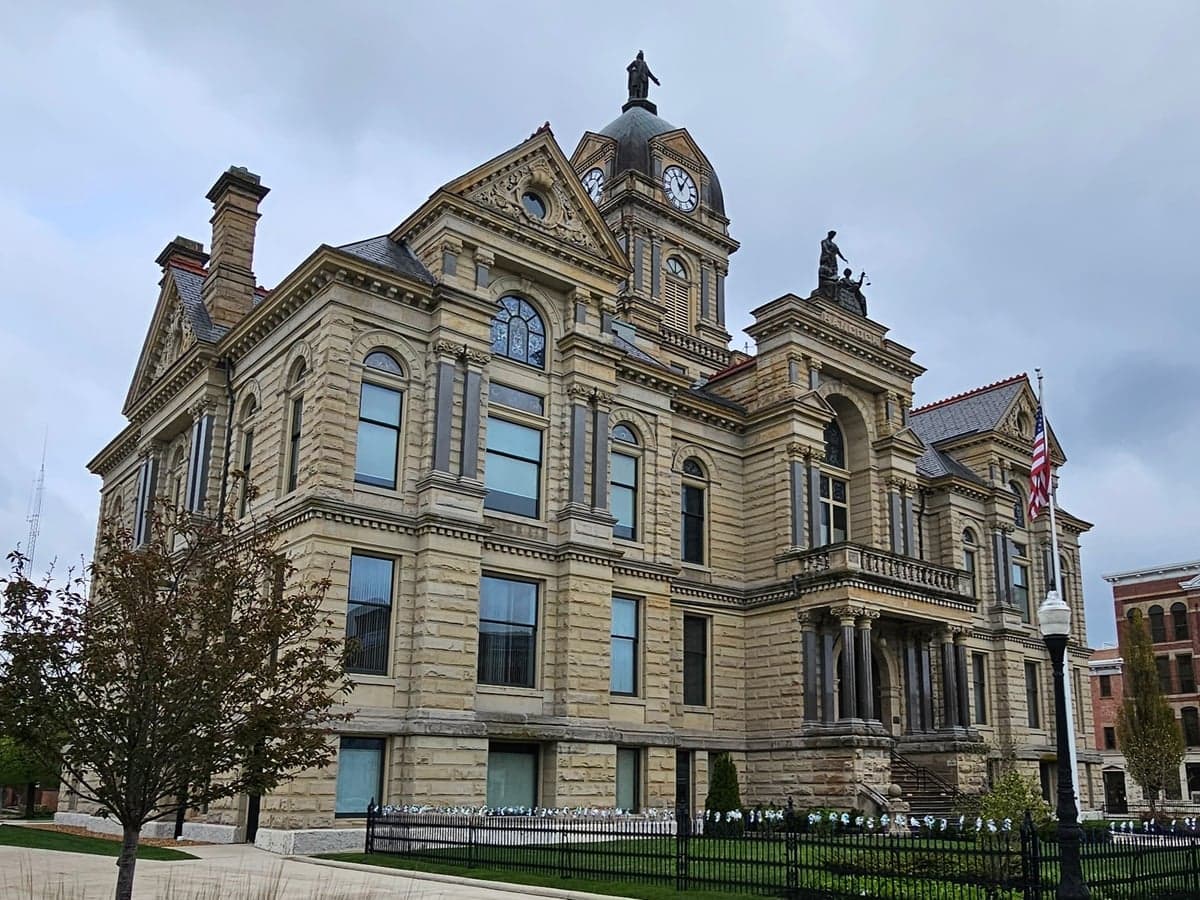
Photo: Wikipedia
Political ClimatePolitical Climate in Hancock County
Showing district-level results — no local-only data available.
Local Political AnalysisPolitical Analysis of Hancock County
Hancock County, Ohio, is a solidly Republican area with a Cook PVI of R+14, making it significantly more conservative than the state of Ohio as a whole, which sits at R+5. That means you're looking at a place where GOP candidates typically win by double digits in most elections, and that trend has only gotten stronger over the last decade. The county seat, Findlay, is the main population center and anchors this conservative leaning, though the surrounding townships and smaller communities like Arlington, Arcadia, and Mount Blanchard tend to vote even more heavily Republican. There are a few precincts in Findlay proper—particularly around the university district near the University of Findlay and some of the older neighborhoods closer to downtown—that can swing more purple or even lean slightly Democratic in local races, but those are the exceptions that prove the rule.
How it compares
Ohio as a state is a classic swing state with a slight Republican tilt, but Hancock County is roughly 9 points more conservative on the Cook PVI scale. That gap has widened in recent years as rural and exurban areas across Ohio have shifted right while the state's major metros and college towns have pulled left. In practice, this means that while a statewide Democrat like Sherrod Brown could still win Ohio in a close race (as he did in 2018 and 2012), that candidate would likely lose Hancock County by 15 to 20 points or more. The gap is most noticeable in presidential years: in 2020, Donald Trump carried Hancock County with about 68% of the vote, compared to his statewide margin of 53%—a 15-point difference that reflects the county's deep Republican roots. Local races are rarely competitive at the county level, with Republicans holding nearly every elected office from commissioner to prosecutor to recorder.
What this means for residents
For conservative residents, the political climate is very comfortable. Most local policies—especially around taxes, zoning, and development—align with Republican priorities, and the county government is consistently friendly to business interests, including the major manufacturing and logistics employers like Marathon Petroleum Corporation and Whirlpool. Liberal residents aren't exactly marginalized, but they do face a practical reality: their votes rarely sway local elections, and most public discourse leans red. That said, the University of Findlay brings in a more diverse and occasionally more progressive student population, which softens the hard edges. Political signs and yard flags are overwhelmingly Republican, but the culture isn't aggressively partisan day-to-day. Most people just get along, and the economy—driven by energy, manufacturing, and agriculture—tends to dominate local conversation more than hot-button cultural issues.
Cultural and policy distinctions
One notable local distinction is the county's strong law-and-order stance. Hancock County has a long-standing tradition of supporting law enforcement and tough sentencing, which aligns with its politics but is also rooted in a practical, small-town emphasis on safety. You'll see that reflected in local ballot measures and school board races, where support for resource officers and school security is nearly universal. The Brewery District in Findlay and the Flag City identity (the county leans hard into its patriotic branding) are small but telling signals of the local culture. Compared to more diverse or urbanized parts of Ohio—like Franklin or Cuyahoga counties—Hancock County is more homogeneous politically and socially, which some residents see as stability and others see as insular. Either way, the trajectory is clear: barring a major demographic or economic shift, Hancock County will remain one of Ohio's reliably red strongholds for the foreseeable future.

State Political ClimatePolitical Climate in Ohio
State Political AnalysisPolitical Environment in the State
Ohio is a classic swing state that has shifted decisively rightward over the past decade, now carrying a Cook Partisan Voting Index of R+5. The state voted for Donald Trump by 8 points in 2020 and by an even wider margin in 2024, a stark contrast from the 2000s and 2010s when it was the ultimate bellwether, backing the winner in every presidential election from 1964 to 2016. The dominant coalition today is a mix of working-class voters in small cities and rural areas, combined with a growing conservative exurban base around Cincinnati and Columbus, while the Democratic strongholds have shrunk to the urban cores of Cleveland, Columbus, and Toledo, plus a handful of college towns like Athens and Oberlin.
Urban vs. rural divide
The political map of Ohio is a study in contrasts. The three major metros — Cleveland, Columbus, and Cincinnati — each tell a different story. Cuyahoga County (Cleveland) is the Democratic anchor, delivering margins of 60-65% for the party, but its population has been stagnant or declining for decades, reducing its statewide influence. Franklin County (Columbus) is the fastest-growing Democratic stronghold, fueled by Ohio State University and a booming tech and insurance sector, but it's surrounded by rapidly reddening suburbs like Delaware and Union counties that are now reliably Republican. Hamilton County (Cincinnati) has become a true battleground within the state, with the city proper trending blue while the sprawling exurbs of West Chester, Mason, and Liberty Township vote heavily Republican. The real story is the rural and small-town vote: counties like Mercer, Holmes, and Putnam in the northwest routinely give Republicans 75-80% of the vote, while the Appalachian counties in the southeast — once reliably Democratic — have flipped hard to the GOP on cultural and economic populism. The I-71 corridor from Cincinnati to Cleveland is the state's political spine, but the vast majority of Ohio's 88 counties are now deep red.
Policy environment
Ohio's policy environment is broadly conservative but with notable pragmatic exceptions. The state has a flat income tax rate of 3.5% as of 2025, down from a progressive top rate of nearly 5% a decade ago, and the state legislature has been on a multi-year tax-cutting spree. There is no state-level property tax, though local levies vary widely. The regulatory posture is business-friendly, with right-to-work laws not on the books but a generally low-unionization private sector outside of manufacturing holdouts. Education policy is a flashpoint: Ohio has one of the nation's largest school voucher programs, the EdChoice scholarship, which has been expanded repeatedly and now covers most families regardless of income, making it a national model for school choice advocates. Healthcare is mixed — the state expanded Medicaid under the Affordable Care Act in 2014, and roughly 3 million Ohioans are covered by the program, but the legislature has added work requirements and other restrictions. Election laws have tightened: voter ID requirements were strengthened in 2023, absentee ballot drop boxes are limited to one per county, and early voting hours have been standardized. The state also passed a 2018 law banning sanctuary cities, though no major city had declared itself one.
Recent policy direction
The last five years have seen Ohio move decisively on several fronts that matter to relocators. On gun rights, Ohio became a permitless carry state in 2022, meaning any adult who can legally possess a firearm may carry it concealed without a license — a significant shift from its previous "shall issue" regime. Stand Your Ground language was already on the books. On parental rights and education, the state passed the Parents' Bill of Rights in 2023, requiring schools to notify parents of curriculum changes and allowing them to opt their children out of certain instruction. The state also banned transgender athletes from female sports in 2022 and restricted gender-affirming care for minors in 2024, overriding a veto from Governor Mike DeWine. On speech and privacy, Ohio has no broad surveillance law, but local police use of automated license plate readers and drones is common and largely unregulated. Medical and bodily autonomy is sharply divided: abortion remains legal up to about 22 weeks after voters passed Issue 1 in 2023 with 57% support, enshrining reproductive rights in the state constitution — a rare progressive victory that has held despite legislative attempts to undermine it. Property rights are generally strong, with no statewide rent control and relatively permissive zoning in most areas, though Columbus and Cleveland have begun exploring upzoning. On voting and ballot access, the 2023 law requiring photo ID for in-person voting and proof of residency for absentee ballots has been controversial but has withstood legal challenges.
Civil unrest & political movements
Ohio has seen its share of political flashpoints. The 2020 protests in Columbus and Cleveland over George Floyd's death were large but largely peaceful, though property damage occurred in downtown Columbus. The state has been a battleground over election integrity since 2020, with ongoing lawsuits over voter roll maintenance and drop box access. Immigration politics are less heated than in border states, but the 2023 train derailment in East Palestine became a national story about regulatory oversight and corporate accountability, with both parties scrambling to claim the issue. Organized activist movements are active on both sides: the Ohio Right to Life organization is one of the most powerful lobbying groups in the state, while the 2023 abortion rights campaign showed the strength of grassroots progressive organizing. There is no serious secession or nullification movement, though some rural counties have passed symbolic resolutions asserting local control over gun laws and health mandates. A new resident would notice the prevalence of yard signs and bumper stickers during election years, but day-to-day political conversations are generally civil outside of social media.
Projection
Over the next 5-10 years, Ohio is likely to continue its rightward drift, but with important caveats. The Columbus metro area is growing and diversifying, which could slowly shift the statewide balance if that growth outpaces rural decline — but for now, the rural and exurban vote is expanding faster in relative terms. The state's population is aging and growing slowly, meaning in-migration from other states will be a key factor; Ohio is seeing net domestic out-migration, but the people leaving tend to be younger and more liberal, while those moving in from the Northeast and Midwest are often retirees or remote workers seeking lower costs. The Republican supermajority in the legislature is likely to persist, meaning continued tax cuts, school choice expansion, and cultural conservatism on education and medical policy. The 2023 abortion rights amendment is a wild card — it could energize Democratic turnout in presidential years, but it's unclear if that will be enough to flip statewide offices. For a new resident, the practical takeaway is that Ohio will remain a reliably red state in most elections, with a conservative policy environment that is stable and predictable, but with a progressive anchor in the cities that ensures some policy battles will continue.
For someone moving to Ohio, the bottom line is straightforward: you'll find a state that is broadly conservative on taxes, guns, and education, but where the cities offer a genuine counterbalance on social issues and cultural amenities. The political climate is less volatile than in many other states — Ohioans tend to be pragmatic rather than ideological, and the state's laws change slowly and deliberately. If you're looking for a place where your vote will matter in a meaningful way, Ohio is still a state where every election feels consequential. If you're looking for a place where the political temperature is manageable and the policy environment is stable, Ohio delivers that too. Just know that the further you get from the I-71 corridor, the more conservative things get — and that's a feature, not a bug, for many of the people who choose to call it home.
* Values derived from national, state, county, city and local statistics and may differ in a specific area. Last updated: 2026-06-24T23:40:00.000Z
Narrative content on this page is AI-generated and may contain mistakes. Verify any details that matter before acting on them.
ReloMaps may earn a commission from affiliate links at no extra cost to you.

