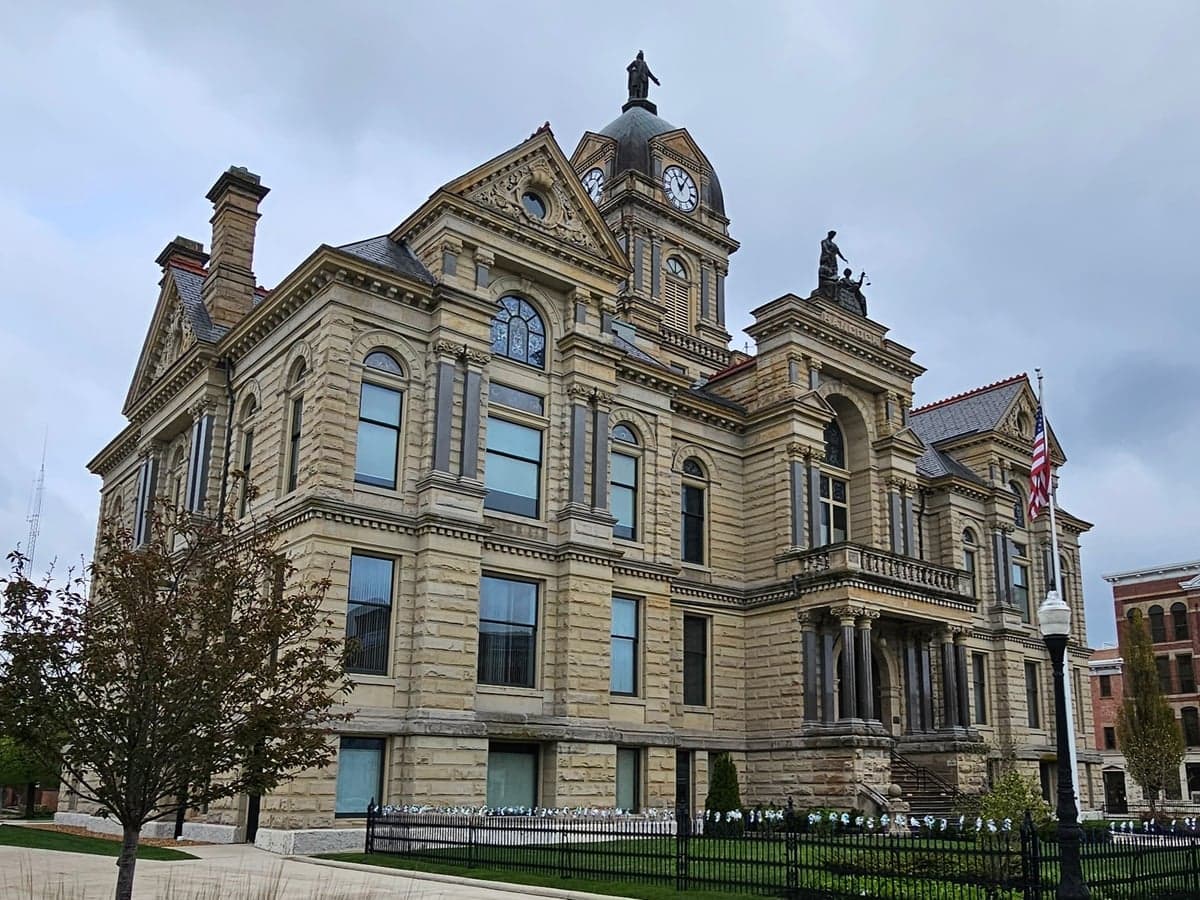
Photo: Wikipedia
Demographics of Hancock County
Affluence Level in Hancock County
A middle-class area roughly in line with national averages across income, home values, education, and employment.
People of Hancock County
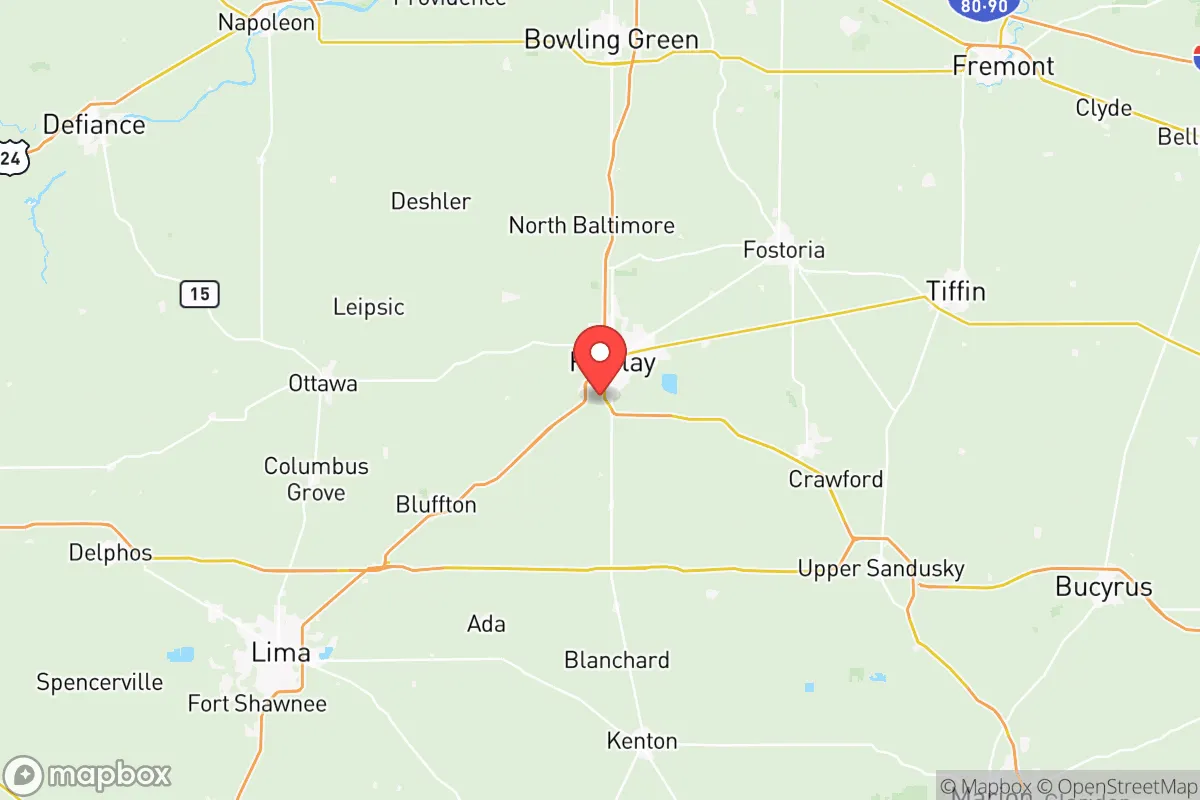
Hancock County, Ohio, with a population of 74,885, remains a predominantly white (87.5%) and culturally Midwestern community, anchored by the county seat of Findlay. The county’s identity is shaped by a deep German Lutheran heritage, a strong manufacturing and agricultural economy, and a notably low foreign-born population of 2.1%. Today, residents value stability, community involvement, and a slower pace of life, with a slightly conservative leaning evident in local politics and social norms.
Settlement & growth (pre-1960)
The land that became Hancock County was originally home to the Wyandot and Ottawa Native American nations, who used the Blanchard River watershed for hunting and trade. American settlement began in earnest after the War of 1812 and the Treaty of Fort Meigs (1817), which ceded the region to the United States. The first permanent white settlers arrived in the late 1810s and 1820s, primarily from Pennsylvania, New York, and New England, seeking cheap farmland. These early Americans, largely of English and Scots-Irish descent, founded the first communities such as Findlay (laid out in 1821), Arcadia, and Mount Blanchard. The construction of the Miami and Erie Canal through the county in the 1840s spurred growth, making Findlay a key shipping point for grain and lumber.
A second, far more transformative wave came with German immigration in the 1840s through 1880s. German Lutherans and Catholics, pushed by economic hardship and political unrest in the German states, were drawn to Hancock County by the availability of farmland and the establishment of German-speaking churches and schools. They settled heavily in the northern and western parts of the county, founding or heavily populating German Township, Bluffton, and Pandora. Bluffton, in particular, became a stronghold of Swiss-German Mennonites and Amish-Mennonites who established Bluffton University (then Central Mennonite College) in 1899. This German influence remains the county’s strongest cultural marker, evident in surnames, church affiliations, and the annual Findlay German Festival.
The discovery of natural gas and oil in the 1880s – the "Findlay Gusher" in 1886 – triggered a third wave, an industrial boom that attracted skilled laborers from across the Midwest and a smaller influx of Irish and Italian railroad workers. Findlay’s population exploded from under 5,000 in 1880 to over 18,000 by 1890. This boom established Findlay as a manufacturing hub, with industries like glass production (notably the Findlay Glass Company) and later automotive parts (Cooper Tire & Rubber, founded 1914) anchoring the economy. However, the oil boom subsided by the 1910s, and the county reverted to a stable, primarily agricultural and small-scale industrial economy through the mid-20th century. By 1960, the population had reached just over 65,000, with a demographic makeup that was nearly all white and predominantly German-American.
Modern era (post-1965)
The post-1965 period, including the Hart-Cellar Act, had relatively little direct impact on Hancock County’s demographics compared to larger metropolitan areas. The county’s foreign-born population remains very low at 2.1%, and the major story is not immigration but domestic patterns. The county experienced modest growth through the 1970s and 1980s, driven by the expansion of Marathon Petroleum (originally a local oil refiner, now a Fortune 500 company headquartered in Findlay). This corporate anchor has attracted a steady stream of domestic white-collar professionals, but largely from neighboring Ohio counties and the broader Midwest, not from outside the United States.
The most significant demographic shift has been the gradual diversification through Hispanic and some Asian settlement. The Hispanic population now stands at 5.9%, up from negligible levels in 1990. This growth is overwhelmingly Mexican-American, drawn by jobs in food processing, agriculture, and construction. These families have concentrated in Findlay and the rural areas of Liberty Township, where a growing number of Spanish-language church services and small tiendas have appeared. The East/Southeast Asian population (1.6%) is smaller and largely concentrated among professional workers at Marathon Petroleum, the University of Findlay, and local hospitals, with no distinct ethnic enclave. The Black population (1.8%) and Indian subcontinent population (0.3%) remain tiny, with Black residents having a long but very small presence dating to the Great Migration but with no concentrated neighborhood. Suburbanization has played out modestly: Findlay’s outer edges have seen new subdivisions, and the Van Buren area and Arlington have grown as commuter hamlets, but the county lacks the large-scale suburban sprawl of a Columbus or Cincinnati exurb. The county has actually lost some rural population to consolidation, with small hamlets like Jenera and Williamstown seeing slight declines.
The future
Hancock County’s population is projected to remain stable or grow very slowly, with the Ohio Development Services Agency forecasting a slight increase to around 75,000 by 2035. The county is becoming slightly more diverse: the Hispanic share is expected to rise gradually as families grow and some new migration continues in food and manufacturing sectors. However, the county is not likely to become a major immigrant destination. The white population is projected to decline modestly as an aging cohort passes away, offset by Hispanic and biracial children in younger families. The East/Southeast Asian and Indian populations will likely remain niche, tied directly to Marathon Petroleum and healthcare professional recruitment.
The cultural identity is slowly evolving. Findlay, with its 29.7% college-educated rate, is becoming more politically and socially moderate, especially among younger professionals and University of Findlay affiliates. In contrast, the rural townships (like Biglick and Madison) and smaller communities like Mount Cory and Rawson remain very conservative, with strong church and family ties and resistance to progressive social changes. This urban-rural split mirrors national trends but is less pronounced due to the county’s small size. New housing developments are almost exclusively in Findlay and along the I-75/US 68 corridors, while the far northern and southern townships continue to depopulate as farms consolidate.
For someone moving in now, Hancock County offers a stable, safe, and affordable environment with low crime, good schools (especially Findlay City Schools and Bluffton Exempted Village), and a strong sense of community rooted in its German-American heritage. The trade-off is a limited diversity of experience: residents should expect a culturally homogeneous area where newcomers are welcomed but are expected to integrate into existing local institutions like churches, community festivals, and volunteer fire departments. The future is not revolutionary but evolutionary: a slowly diversifying, still predominantly white and conservative county where Marathon Petroleum’s fortunes remain the central economic fact, and where the legacy of German settlement and the canal era still shapes the social landscape.

* Values derived from national, state, county, city and local statistics and may differ in a specific area. Last updated: 2026-06-24T23:40:00.000Z
Narrative content on this page is AI-generated and may contain mistakes. Verify any details that matter before acting on them.
ReloMaps may earn a commission from affiliate links at no extra cost to you.

