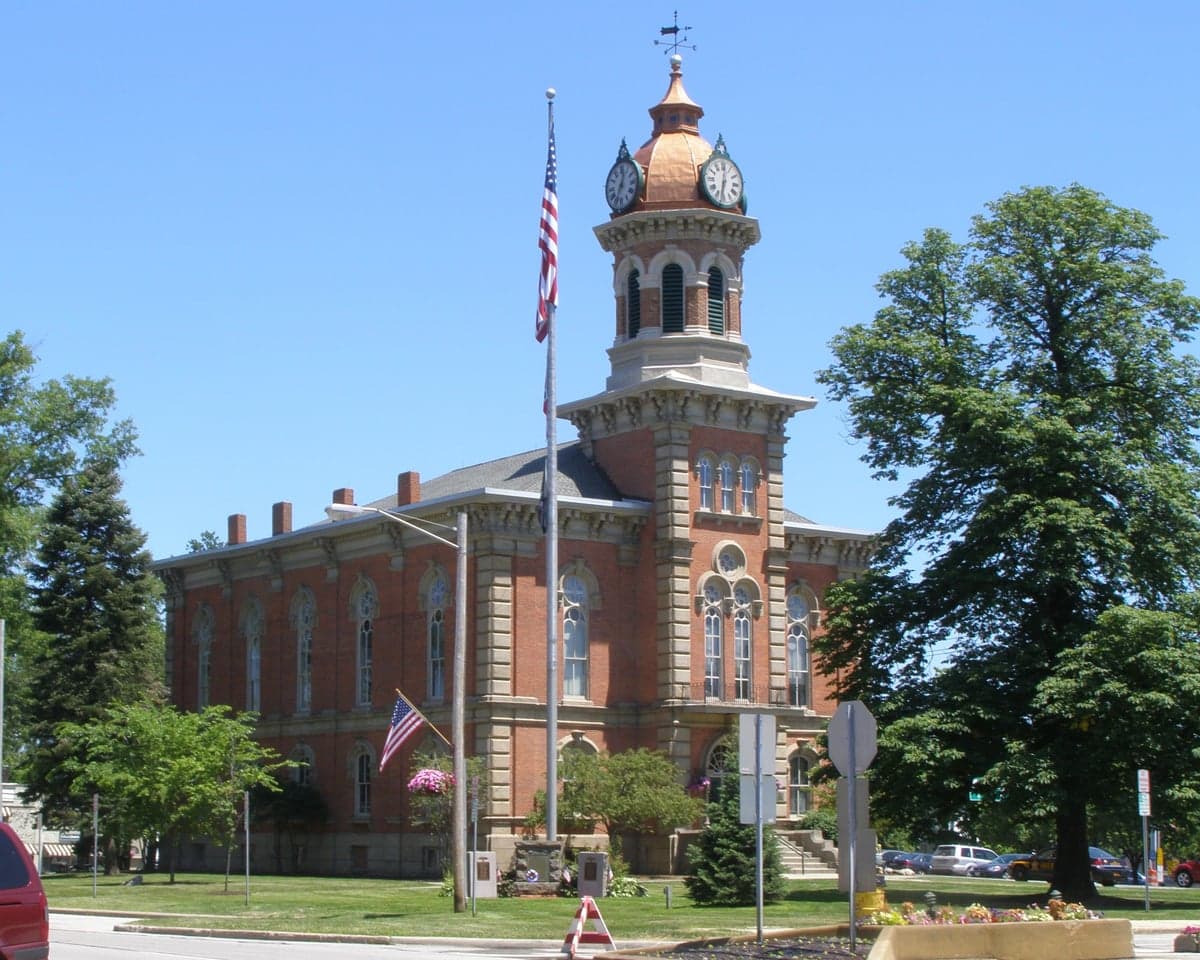
Photo: Wikipedia
Demographics of Geauga County
Affluence Level in Geauga County
An upper-middle-class area. Household wealth, education levels, and homeownership run ahead of national benchmarks.
People of Geauga County
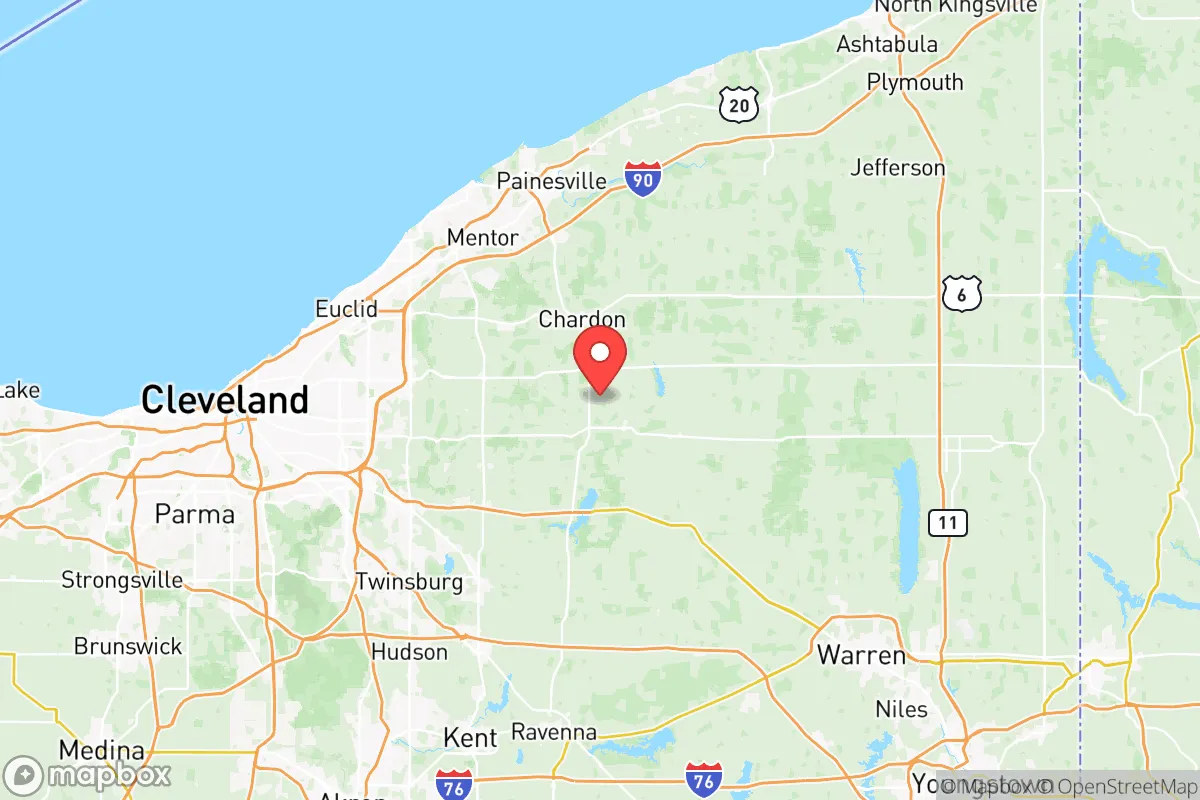
Geauga County, Ohio, is home to roughly 95,500 residents, making it one of the state's most rural and least densely populated counties east of Cleveland. The population is overwhelmingly white (93.2%) and native-born, with a foreign-born share of just 0.6% — one of the lowest in the nation. The county's identity is shaped by deep-rooted New England and German heritage, a strong conservative tilt, and a landscape of small towns, working farms, and commuter hamlets that have resisted the suburban sprawl of neighboring Lake and Cuyahoga counties.
Settlement & growth (pre-1960)
Before European settlement, the area that is now Geauga County was part of the Western Reserve, a territory claimed by Connecticut after the American Revolution. The region was sparsely inhabited by the Erie and later the Seneca and other Iroquoian peoples, who used the area for hunting and seasonal camps but maintained no permanent large villages. The Connecticut Land Company surveyed the land in the 1790s, and the first permanent white settlers — primarily of English and Scots-Irish stock from Connecticut and Massachusetts — arrived around 1798. They founded the townships of Chardon (the county seat), Burton, and Painesville (which later split off into Lake County). These early settlers were Congregationalist and fiercely abolitionist; Geauga County became a notable stop on the Underground Railroad, with safe houses concentrated in Chesterland and Parkman.
Through the 1820s and 1830s, a second wave of settlers arrived from New York and New England, drawn by cheap land and the promise of dairy farming. The county's landscape of rolling hills and glacial till proved ideal for grazing, and by the 1850s Geauga was a major cheese-producing region. The town of Middlefield began to grow as a market center, but its character changed dramatically after the Civil War. Starting in the 1870s, a wave of German-speaking Mennonite and Amish families from Pennsylvania and directly from Europe settled in the southern part of the county, particularly around Middlefield and Burton. They were drawn by affordable farmland and the region's isolation, which allowed them to maintain their religious and cultural practices. Today, the Middlefield Amish settlement is one of the largest in Ohio, with an estimated 5,000 to 6,000 Amish and Mennonite residents, and it remains the county's most distinctive demographic feature.
Unlike many industrial counties in Ohio, Geauga saw almost no immigration from Southern or Eastern Europe. The county's economy remained agricultural and small-scale through the early 20th century, with no major factories or coal mines to attract Polish, Italian, or Hungarian laborers. The population peaked at around 26,000 in 1900 and then stagnated for decades, as young people left for Cleveland and other cities. The post-World War II era brought modest suburban growth to the western edge of the county, particularly in Bainbridge and Russell Township, where Cleveland commuters began building homes on large lots. But the county's rural zoning laws and lack of public water and sewer infrastructure kept development slow compared to Lake and Summit counties.
Modern era (post-1965)
The 1965 Hart-Cellar Act had almost no direct effect on Geauga County. The foreign-born population remains minuscule at 0.6%, and the county has not developed any immigrant enclaves. Instead, the demographic story of the last 50 years is one of domestic migration: white, middle-class families moving outward from Cleveland and its inner-ring suburbs in search of larger lots, lower taxes, and better schools. This wave accelerated in the 1980s and 1990s as crime and school quality concerns pushed families from Cuyahoga County eastward. The townships of Concord, Hambden, and Thompson saw significant new-home construction, while Chardon grew as a commuter town with a walkable historic square.
The county's racial and ethnic composition has remained remarkably stable. The Hispanic share is 1.9%, the Black share is 0.9%, and East/Southeast Asian communities make up 0.5%. The Indian-subcontinent population is negligible at 0.1%. These small numbers are concentrated almost entirely in the western townships closest to Cleveland, particularly Bainbridge and Chesterland, where a handful of professionals have settled. The Amish and Mennonite population in and around Middlefield has grown steadily through high birth rates, and they now represent a significant and culturally distinct minority within the county — conservative, German-speaking, and largely separate from the English-speaking majority.
Suburbanization has been limited by design. Geauga County has some of the strictest zoning regulations in Ohio, with minimum lot sizes of one to five acres in most townships. This has preserved the county's rural character but also kept housing prices high and excluded lower-income and rental populations. The result is a county that is whiter, wealthier, and more politically conservative than the state average. In the 2024 presidential election, Geauga County voted Republican by a margin of roughly 35 points, one of the highest in Ohio.
The future
Geauga County's population is projected to remain flat or grow very slowly over the next 20 years. The county's aging white population — the median age is 47, well above the national average — and low birth rates among the non-Amish population mean that natural increase will be minimal. The Amish community in Middlefield and Burton will continue to grow through high fertility, but their numbers are still small enough that they will not dramatically shift the county's overall demographics. In-migration will likely continue from the Cleveland suburbs, but at a slower pace as housing costs rise and available land becomes scarcer.
The county is not becoming more diverse in any meaningful sense. The small Hispanic and Asian populations are expected to grow slightly, but from such a low base that the county will remain overwhelmingly white and native-born for the foreseeable future. The cultural identity of Geauga County — rural, conservative, family-oriented, and shaped by both New England traditions and Amish agrarian life — is likely to persist. The main tension will be between long-time residents who want to preserve the county's rural character and newer arrivals who bring suburban expectations for services, schools, and infrastructure.
For someone moving in now, Geauga County offers a stable, safe, and culturally homogeneous environment with strong schools and low crime, but also limited diversity, few rental options, and a housing market that favors buyers with significant capital. It is a place where the past is still very much present, and where change comes slowly — by design.

* Values derived from national, state, county, city and local statistics and may differ in a specific area. Last updated: 2026-06-30T18:34:21.000Z
Narrative content on this page is AI-generated and may contain mistakes. Verify any details that matter before acting on them.
ReloMaps may earn a commission from affiliate links at no extra cost to you.

