
Photo: Wikipedia
Personal Sovereignty in Delaware County
Viable for self-reliance. Generally workable, though some barriers may limit total independence.
What does Personal Sovereignty tell us?
Personal Sovereignty measures your capacity for self-reliance and independence with minimal government friction. Higher scores mean fewer barriers between you and the way you want to live... but it assumes you have the space you need and good neighbors.
What does this tell us?
Personal Sovereignty measures your capacity for self-reliance and independence with minimal government friction. Higher scores mean fewer barriers between you and the way you want to live... but it assumes you have the space you need and good neighbors.
State Policy
Energy independence: Importer (40% of energy produced in-state)
Personal Liberty
Homesteading

Personal Liberty Analysis
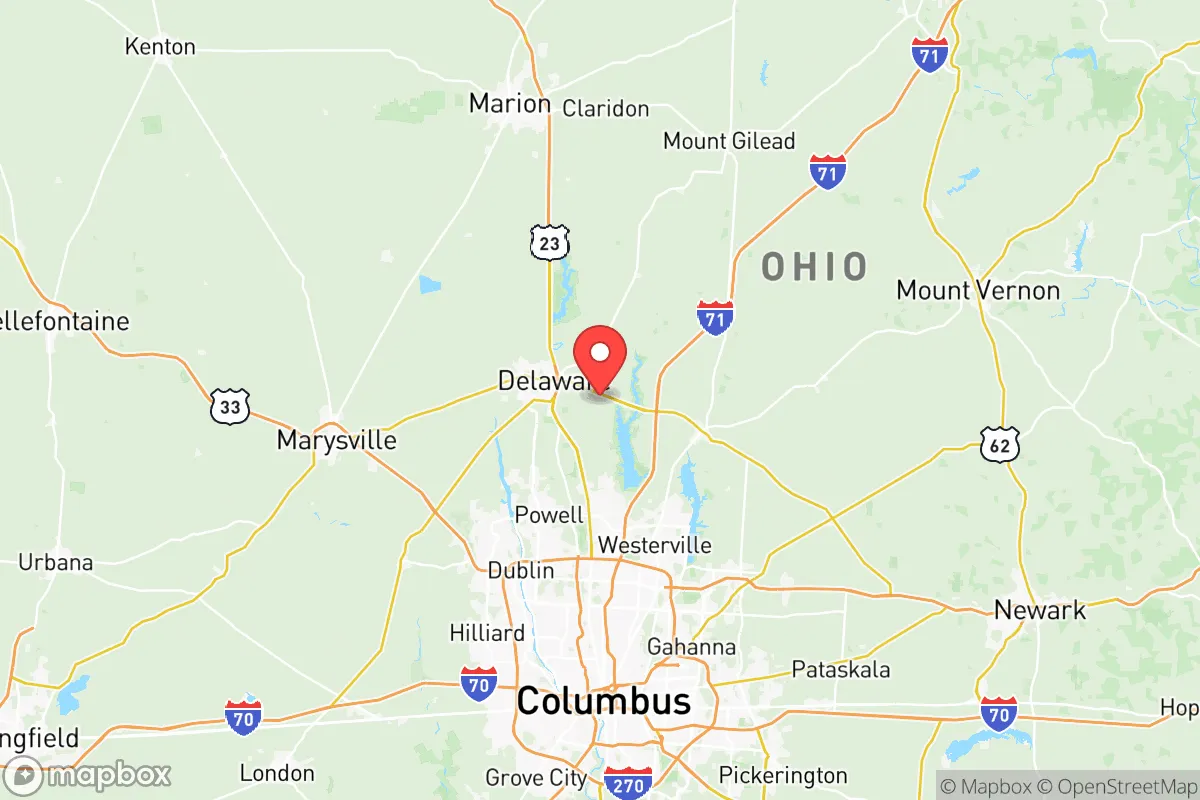
Delaware County, Ohio, offers a notably high degree of personal sovereignty relative to much of the Columbus metro area, blending a conservative-leaning local governance culture with the practical freedoms of a rapidly growing suburban and exurban region. For individuals and families prioritizing autonomy—whether in financial decisions, self-defense, or lifestyle choices—the county provides a regulatory environment that is generally light-touch, though with important variations between its urbanizing southern townships and its more rural northern reaches. The key trade-off is proximity to Columbus’s economic opportunities versus the preservation of a self-reliant, lower-regulation lifestyle found in communities like Sunbury, Ashley, and Ostrander.
Tax burden and regulatory posture: How Delaware County compares to Columbus and Franklin County
Delaware County’s tax and regulatory posture is significantly more favorable to personal financial sovereignty than neighboring Franklin County. The county’s combined sales tax rate is 7.25%, lower than Columbus’s 8.0%, and property taxes, while not low by national standards, are moderated by Ohio’s 2.5% property tax cap on annual increases for owner-occupied homes. This cap provides predictability for long-term homeowners, a key advantage for those seeking to control their housing costs. The county government maintains a generally pro-business stance, with zoning that is less restrictive than in Columbus, particularly in unincorporated areas. For example, Orange Township and Berlin Township have more flexible commercial and residential zoning than the city of Delaware itself, allowing for home-based businesses and small-scale agricultural uses with fewer bureaucratic hurdles. The city of Delaware has its own income tax of 1.85%, but residents in unincorporated townships or villages like Galena and Sunbury pay only the county’s 0.25% earnings tax, a substantial savings for self-employed individuals or remote workers. Overall, the regulatory environment is light-touch compared to Columbus, but homeowners should verify specific township zoning, as some areas like Genoa Township have more restrictive covenants in newer subdivisions.
Self-defense and gun law specifics: A strong Second Amendment environment with practical carry options
Delaware County is a strong Second Amendment environment, reflecting Ohio’s status as a “constitutional carry” state since June 2022. Lawful adults 21 and older may carry a concealed handgun without a permit, and open carry is legal without a license. The county’s sheriff, Sheriff Russell Martin, has publicly stated his office will not enforce any federal gun control measures it deems unconstitutional, a stance that resonates with the county’s conservative base. For those who prefer a permit for reciprocity while traveling, the Delaware County Sheriff’s Office issues concealed carry licenses with a typical turnaround of 30-45 days. The county has no local ordinances restricting magazine capacity or firearm types, and there are no “sensitive places” laws beyond state-level restrictions on carrying in schools, government buildings, and airports. Shooting ranges are accessible, with Delaware Wildlife Area offering a public range and Briar Rabbit Shooting Sports in Zanesfield providing a private facility. The practical effect is that residents in Sunbury, Ashley, and Ostrander can carry without local interference, while those in the city of Delaware or Powell should be aware that private businesses and homeowners’ associations may post “no guns” signs, though these carry the force of trespassing law, not criminal penalty.
Self-reliance and homesteading viability: Lot sizes, zoning, and off-grid feasibility across the county
Homesteading and self-reliance viability varies dramatically across Delaware County, driven by zoning and lot size differences. In the northern and western townships—Brown Township, Oxford Township, and Kingston Township—agricultural zoning allows for minimum lot sizes of 5 to 10 acres, making small-scale farming, livestock, and gardening feasible. The city of Delaware and its southern suburbs like Powell and Lewis Center have minimum lot sizes of 0.25 to 1 acre, with homeowners’ associations often restricting livestock, outbuildings, and even vegetable gardens. Off-grid living is legally possible in unincorporated areas, but Ohio’s building codes require a septic system and well permit, and solar panels must comply with local utility interconnection rules. Ashley, a village in the county’s northern tier, is particularly homestead-friendly, with a rural character and a village government that does not actively discourage alternative energy or rainwater collection. However, residents should note that Delaware County’s health department requires a minimum of 0.5 acres for a septic system, effectively barring off-grid living on smaller lots. For those seeking maximum self-reliance, Ostrander and Radnor offer the best combination of low density, permissive zoning, and affordable land, while Sunbury provides a middle ground with larger lots and a more community-oriented feel.
Personal liberties: Parental rights, medical autonomy, speech, and property rights in practice
Delaware County’s personal liberties environment is shaped by Ohio’s state-level laws and a local culture that values parental authority and property rights. Parental rights are strong: Ohio law requires parental consent for minors’ medical procedures, including vaccinations and mental health treatment, and the county’s school boards—particularly in Buckeye Valley Local Schools and Big Walnut Local Schools—have been responsive to parental concerns about curriculum transparency. Medical autonomy is less clear-cut; while Ohio has no state-level vaccine mandate, private employers and healthcare systems in the county may require immunizations. The county’s Delaware General Health District has not imposed local health orders beyond state guidance, a contrast to Franklin County’s more aggressive approach during the pandemic. Free speech is robust, with no local ordinances restricting public assembly or protest, and the county’s conservative majority ensures that political speech—even controversial viewpoints—is generally tolerated. Property rights are well-protected under Ohio’s “takings” laws, and the county has not pursued aggressive eminent domain actions. However, homeowners in subdivisions with homeowners’ associations should review covenants carefully, as HOAs in Powell and Genoa Township can restrict everything from fence height to paint colors, effectively limiting property autonomy. For those who prioritize maximum personal liberty, unincorporated Brown Township or Kingston Township offer the fewest restrictions on property use and personal conduct.
Overall, Delaware County offers a high degree of personal sovereignty relative to the Columbus metro area, with a tax burden that is manageable, a regulatory environment that is generally light-touch, and strong protections for gun rights, parental authority, and property ownership. The county’s northern and western townships—Ashley, Ostrander, and Radnor—provide the most freedom for self-reliant lifestyles, while the southern suburbs like Powell and Lewis Center offer more amenities but with greater HOA and zoning restrictions. For the conservative-leaning individual or family seeking a balance of economic opportunity and personal autonomy, Delaware County ranks among the top choices in central Ohio, though those seeking the absolute maximum in off-grid or unregulated living may find more freedom in neighboring Union or Morrow counties.

* Values derived from national, state, county, city and local statistics and may differ in a specific area. Last updated: 2026-07-24T13:03:04.000Z
Narrative content on this page is AI-generated and may contain mistakes. Verify any details that matter before acting on them.
ReloMaps may earn a commission from affiliate links at no extra cost to you.

