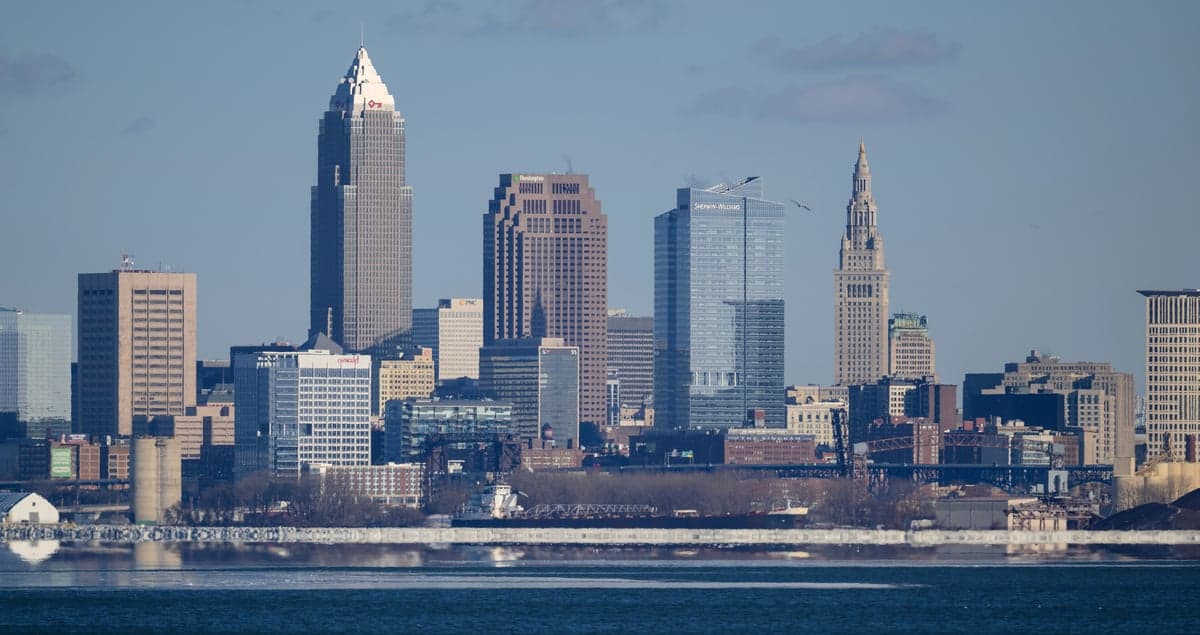
Photo: Wikipedia
Demographics of Cuyahoga County
Affluence Level in Cuyahoga County
A middle-class area roughly in line with national averages across income, home values, education, and employment.
People of Cuyahoga County
The people of Cuyahoga County today form a dense, historically layered population of 1,249,418 residents, concentrated in the urban core of Cleveland and its inner-ring suburbs. The county is notably diverse, with a population that is 57.0% White, 28.6% Black, 6.8% Hispanic, 1.8% East/Southeast Asian, and 1.5% Indian (subcontinent), yet it is also one of the least foreign-born major counties in the nation at just 2.9%. This is a region shaped by heavy 19th- and early 20th-century immigration, followed by decades of domestic migration, suburbanization, and population decline, giving it a distinctive character of established ethnic enclaves, a strong African American cultural and political presence, and a slowly diversifying but still majority-White and majority-native-born population.
Settlement & growth (pre-1960)
Before American settlement, the area that is now Cuyahoga County was home to several Native American nations, including the Erie, the Seneca, and later the Wyandot and Ottawa, who used the Cuyahoga River as a key portage route between Lake Erie and the Ohio River. The region was part of the Connecticut Western Reserve, a land claim that drew the first permanent American settlers from New England in the 1790s. Moses Cleaveland founded the city of Cleveland in 1796 at the mouth of the Cuyahoga River, and the early population was overwhelmingly of English and Scots-Irish stock, bringing with them a Yankee cultural and political framework.
The transformative wave began in the 1830s with the opening of the Ohio & Erie Canal, which connected Cleveland to the Ohio River and made it a commercial hub. This drew a massive influx of German immigrants, who settled heavily in the near-west side neighborhoods of Cleveland, particularly in Ohio City and Tremont, and in the emerging industrial suburb of Lakewood. By 1850, Germans made up roughly a quarter of Cleveland's population. Simultaneously, Irish immigrants fleeing the Great Famine arrived to work on the canal and railroads, settling in the Flats and the Detroit-Shoreway neighborhood.
The late 19th and early 20th centuries saw the peak of immigration, driven by Cleveland's rise as a manufacturing powerhouse in steel, oil refining (John D. Rockefeller's Standard Oil was based here), and automotive parts. Polish immigrants arrived in large numbers from the 1880s onward, creating a dense enclave in Slavic Village on the southeast side. Italian immigrants concentrated in Little Italy near University Circle and in Murray Hill. Czech, Hungarian, Slovak, and Slovenian communities formed in neighborhoods like Brooklyn and Parma, which would later become the largest Slovak-American community in the United States. By 1920, Cleveland was the sixth-largest city in the nation, with a population that was over 70% foreign-born or of foreign-born parentage.
The Great Migration of African Americans from the rural South began during World War I and accelerated through the 1940s and 1950s, as the steel mills and auto plants of Cleveland, Euclid, and Warrensville Heights offered industrial jobs. Black migrants, primarily from Alabama, Mississippi, and Georgia, settled in the Central, Hough, and Fairfax neighborhoods of Cleveland, and later in the eastern suburbs of East Cleveland and Shaker Heights. This wave fundamentally reshaped the county's racial demographics, laying the groundwork for the 28.6% Black population seen today.
Modern era (post-1965)
The 1965 Hart-Cellar Act had a relatively muted effect on Cuyahoga County compared to coastal or Sun Belt regions, because the county's industrial base was already in decline. The foreign-born population today is just 2.9%, far below the national average. However, the post-1965 period did bring new immigrant groups. Hispanic communities, primarily of Puerto Rican origin, began arriving in the 1950s and 1960s, settling in the Clark-Fulton and Detroit-Shoreway neighborhoods of Cleveland. Later waves added Mexican and Central American populations, growing the county's Hispanic share to 6.8%. The East/Southeast Asian community (1.8%) is concentrated in the suburbs of Solon and Beachwood, driven by professional and tech-sector employment. The Indian (subcontinent) population (1.5%) is also suburban, with notable clusters in Westlake and Strongsville, often working in healthcare, IT, and engineering.
The dominant demographic story of the modern era, however, is domestic: white flight and suburbanization. From 1950 to 2020, Cleveland's population fell from 914,808 to 372,624, while the inner-ring suburbs grew. Parma became a heavily White, working-class suburb; Shaker Heights and Cleveland Heights became models of intentional racial integration. The eastern suburbs, including Warrensville Heights and Bedford, saw significant Black middle-class migration. The county as a whole has lost population since 1970, declining from 1.72 million to 1.25 million, as manufacturing jobs vanished and residents moved to the Sun Belt or outer-ring exurbs. The White population has fallen from over 80% in 1970 to 57.0% today, while the Black share has risen from roughly 15% to 28.6%.
The future
Cuyahoga County's population is projected to continue a slow decline, with the Census Bureau estimating a loss of roughly 3-5% by 2030. The county is becoming more diverse, but slowly. The White population is aging and shrinking, while the Hispanic and Asian (East/Southeast Asian) shares are growing modestly, driven by immigration and higher birth rates. The Black population is stabilizing, with some out-migration to the South (a reverse Great Migration) offset by natural increase. The Indian (subcontinent) population is the fastest-growing group, albeit from a small base, concentrated in professional suburbs like Westlake and Solon.
The cultural identity of the county is evolving from a classic Rust Belt, industrial-ethnic mosaic to a more diverse, post-industrial, and suburbanized region. The city of Cleveland is seeing a modest revival in its downtown and near-west side neighborhoods, attracting younger, college-educated residents (35.9% of the county holds a bachelor's degree or higher). However, the county's population remains overwhelmingly native-born and rooted in multi-generational ethnic and racial communities. The next 10-20 years will likely see continued suburbanization of diversity, with new immigrant groups dispersing rather than forming dense urban enclaves, while the older White ethnic neighborhoods in Cleveland and inner-ring suburbs continue to gray and shrink.
For someone moving in now, Cuyahoga County offers a deeply established, affordable urban environment with strong neighborhood identities, a significant African American cultural and political infrastructure, and a slowly diversifying population. The region is not a high-growth, high-immigration destination, but rather a stable, mature community where the cost of living is low and the sense of place is strong. The demographic future is one of gradual diversification within a framework of population stability and suburban spread.

* Values derived from national, state, county, city and local statistics and may differ in a specific area. Last updated: 2026-07-27T02:20:11.000Z
Narrative content on this page is AI-generated and may contain mistakes. Verify any details that matter before acting on them.
ReloMaps may earn a commission from affiliate links at no extra cost to you.

