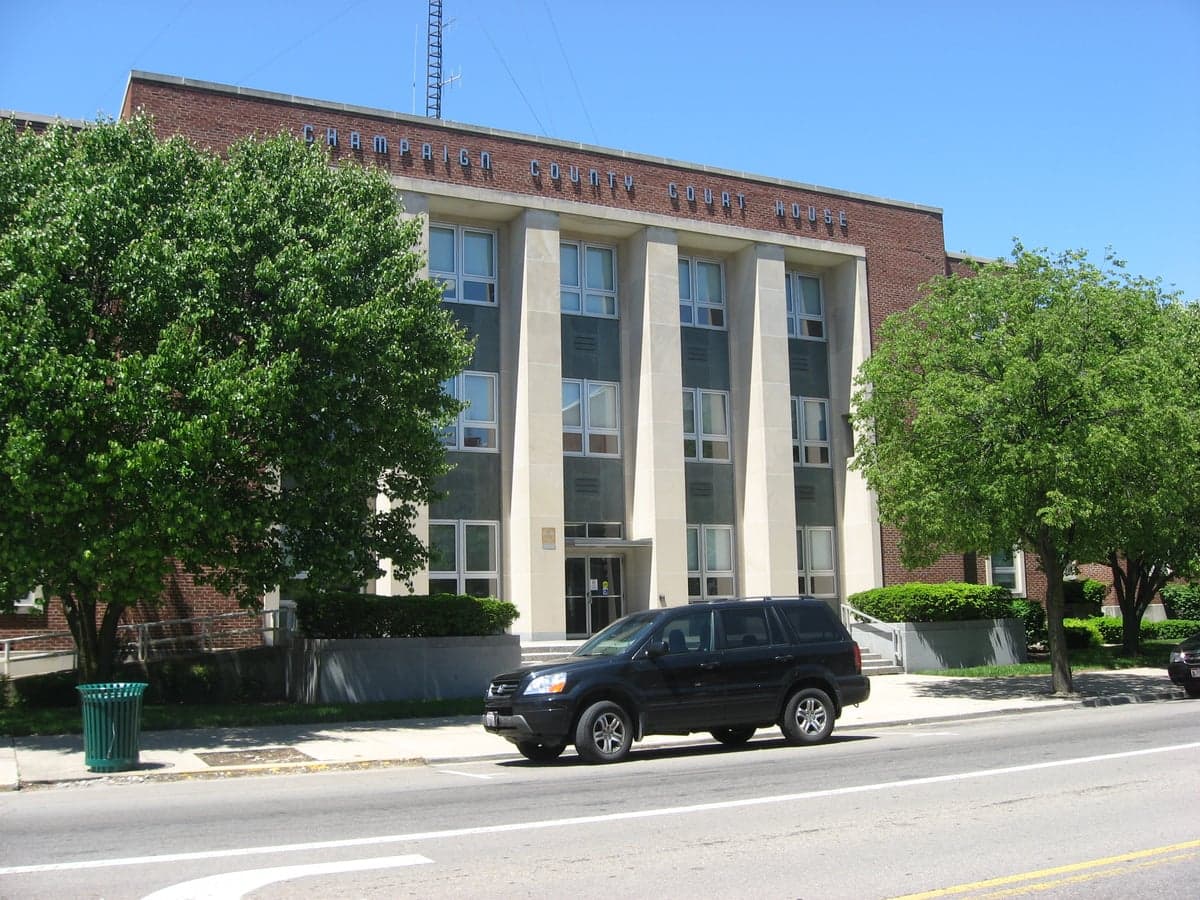
Photo: Wikipedia
Demographics of Champaign County
Affluence Level in Champaign County
A middle-class area roughly in line with national averages across income, home values, education, and employment.
People of Champaign County
Today, Champaign County, Ohio, is a predominantly white, rural community of 38,772 residents, characterized by its small-town agricultural roots and a population density of roughly 60 people per square mile. The county’s identity is shaped by a deep-seated, conservative-leaning culture, with a foreign-born population of just 0.3% and a racial composition that is 92.1% white, 1.8% Hispanic, 1.7% Black, 0.3% East/Southeast Asian, and 0.1% Indian (subcontinent). This is a place where the legacy of 19th-century settlement patterns remains visible, and where the population is slowly aging and shrinking, presenting a stable but unchanging demographic picture.
Settlement & growth (pre-1960)
Before American settlement, the area now known as Champaign County was part of the traditional hunting grounds of the Shawnee and Miami nations, who used the fertile Mad River Valley for seasonal camps and travel routes. The region saw no permanent European colonial settlements, though French fur traders passed through in the 1700s. The first permanent American settlers arrived shortly after the War of 1812, drawn by the promise of cheap, fertile land under the Land Act of 1820. These initial pioneers were primarily of Scots-Irish and English descent, migrating from Kentucky, Virginia, and Pennsylvania. They established the county’s earliest communities, including Urbana (the county seat, founded 1805), Mechanicsburg (1814), and St. Paris (1831), which became centers for grain farming and milling.
The next major wave came with the completion of the Mad River & Lake Erie Railroad in the 1840s, which connected Urbana to the Great Lakes and opened markets for local wheat and corn. This period saw an influx of German immigrants in the 1840s and 1850s, who were attracted by affordable farmland and the region’s growing agricultural economy. Many settled in the northern part of the county, particularly around North Lewisburg and Woodstock, where they established Lutheran and Catholic churches that remain active today. A smaller number of Irish immigrants arrived during the same period, working on railroad construction and settling in Urbana’s emerging working-class neighborhoods. By 1860, the county’s population had reached roughly 16,000, with a nearly entirely white, native-born majority.
The post-Civil War era brought a modest but notable wave of freed African Americans, who moved into the county as part of the broader Great Migration’s early stages. They concentrated in Urbana and Mechanicsburg, forming small but stable communities centered on the AME and Baptist churches. However, the Black population never exceeded 3% of the total, as the county’s agricultural economy offered limited industrial jobs compared to nearby Dayton or Columbus. The 20th century saw little additional immigration; the county’s population peaked at around 34,000 in 1950, then began a slow decline as younger residents left for urban manufacturing jobs. The Dust Bowl Okies and Appalachian migrants who moved into Ohio’s industrial cities largely bypassed Champaign County, which remained a quiet, agricultural backwater.
Modern era (post-1965)
The 1965 Hart-Cellar Act had virtually no impact on Champaign County. The foreign-born population today is a mere 0.3%, and the county has not experienced the waves of immigration that reshaped urban Ohio. Instead, the modern era has been defined by domestic out-migration and aging in place. Since 1970, the county’s population has fluctuated between 33,000 and 39,000, with a slight decline from a 2010 peak of 40,097. The Hispanic population, now at 1.8%, has grown slowly, primarily through the arrival of Mexican-American families working in agriculture and food processing, with small clusters forming in Urbana and Mechanicsburg. The Black population (1.7%) has remained stable, with most residents living in Urbana, where a small but historic community persists. The East/Southeast Asian population (0.3%) and Indian subcontinent population (0.1%) are negligible, consisting of a handful of professionals employed at local hospitals or the University of Illinois’s nearby research facilities.
Suburbanization has been minimal. Unlike the explosive growth of Ohio’s Columbus or Cincinnati suburbs, Champaign County has seen only modest development along the U.S. Route 36 corridor, with a few new subdivisions near Urbana and St. Paris attracting retirees and commuters who work in Springfield (Clark County) or Dayton (Montgomery County). The county’s college-educated population is just 19.1%, well below the national average of 33%, reflecting a workforce concentrated in agriculture, manufacturing, and retail. The largest employers are the Champaign County government, Mercy Health-Urbana Hospital, and local school districts, with no major corporate headquarters or tech sector presence.
The future
Champaign County’s population is projected to continue its slow decline, with the Ohio Development Services Agency estimating a drop to roughly 37,000 by 2040. The county is becoming older and less diverse, as younger residents leave for urban job markets and the remaining population ages. The median age has risen from 37 in 2000 to 42 in 2024, and the share of residents over 65 now exceeds 20%. The Hispanic population may grow modestly, potentially reaching 3-4% by 2040, driven by agricultural labor demand, but the overall racial composition will remain overwhelmingly white. No new immigrant enclaves are forming, and the county’s cultural identity—rooted in rural conservatism, church attendance, and agricultural fairs—is likely to persist without significant change. The college-educated share may inch upward as remote work attracts a few professionals to the area’s low cost of living, but this will be a trickle, not a wave.
For someone moving in now, Champaign County offers a stable, predictable, and deeply traditional community. It is not a place of rapid growth, demographic transformation, or cultural flux. The population is what it has been for generations: white, rural, and rooted in the land. New residents will find a county where neighbors know each other, where the pace of life is slow, and where the biggest changes are the annual corn harvest and the high school football season. If you are seeking diversity, urban amenities, or a dynamic job market, this is not the place. But if you value quiet, safety, and a community that looks much as it did fifty years ago, Champaign County remains a reliable choice.

* Values derived from national, state, county, city and local statistics and may differ in a specific area. Last updated: 2026-08-19T01:47:36.000Z
Narrative content on this page is AI-generated and may contain mistakes. Verify any details that matter before acting on them.
ReloMaps may earn a commission from affiliate links at no extra cost to you.

