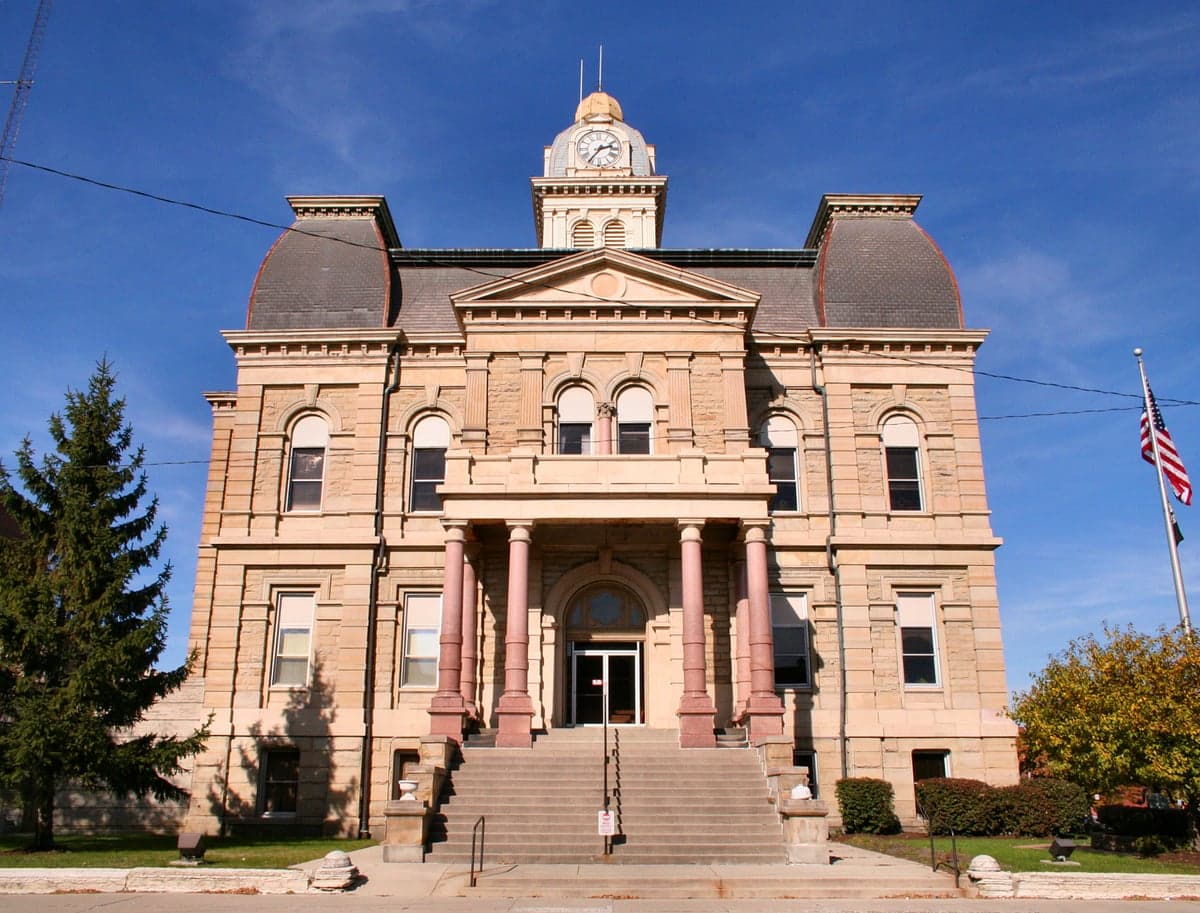
Photo: Wikipedia
Political ClimatePolitical Climate in Allen County
Showing district-level results — no local-only data available.
Local Political AnalysisPolitical Analysis of Allen County
Allen County, Ohio, is a reliably Republican stronghold with a Cook PVI of R+18, making it significantly more conservative than the state of Ohio as a whole, which sits at R+5. This isn't a recent shift; the county has voted for the GOP presidential candidate in every election since 2000, often by margins exceeding 20 points. The political center of gravity is firmly in the rural and suburban areas, but the city of Lima provides a notable Democratic-leaning counterweight, creating a distinct urban-rural split that defines the local political landscape.
How it compares
The R+18 rating means Allen County is about 13 points more Republican than the state average. To put that in perspective, while Ohio is a competitive swing state where both parties invest heavily, Allen County is a safe Republican seat where the primary election is often the more contested race. The contrast is most visible within the county itself. Lima's 1st, 2nd, and 3rd wards consistently vote Democratic, with precincts near the university and downtown often breaking 60-40 for Democrats. Meanwhile, towns like Elida, Shawnee Township, and Bath Township are deeply red, routinely delivering 70-80% of the vote for Republican candidates. The swing precincts are few and far between, but you'll find them in the more mixed-income areas of American Township and parts of Delphos, where local economic concerns can sometimes override party loyalty.
What this means for residents
For conservative residents, the political climate is comfortable and affirming. Local offices—from county commissioners to judges to school boards—are overwhelmingly held by Republicans. Policy debates tend to center on tax cuts, Second Amendment rights, and local economic development, with a general skepticism of state-level mandates from Columbus. For liberal residents, it can feel like swimming upstream. Democratic candidates rarely win countywide races, and progressive policy proposals face an uphill battle. However, the Democratic stronghold in Lima means there is a vocal, organized minority that focuses on issues like public education funding, labor rights (Lima has a strong union history), and affordable housing. The practical effect is that most residents, regardless of party, find their daily lives shaped more by local economic conditions than by partisan gridlock—the county's unemployment rate and the health of the Lima refinery are the real political issues people talk about at the diner.
Culturally, Allen County's conservatism is of a practical, Midwestern variety—less about culture war flashpoints and more about a preference for local control and fiscal caution. You won't see the same level of ideological intensity you might in suburban Columbus or Cincinnati. The biggest policy distinction is in land use and development: the county is generally pro-growth, with minimal zoning restrictions outside Lima, which appeals to conservatives but can frustrate liberals who want more environmental oversight or planned development. For newcomers, the key takeaway is that while the county is solidly red, it's not a monolith—the Lima-Elida axis creates a genuine, if lopsided, political conversation that reflects the area's industrial heritage and rural roots.

State Political ClimatePolitical Climate in Ohio
State Political AnalysisPolitical Environment in the State
Ohio is a classic bellwether state with a Cook PVI of R+5, meaning it leans about five points more Republican than the nation as a whole. But that number only tells part of the story. Over the past 20 years, the state has shifted from a true purple battleground—where both parties competed fiercely in presidential elections—to a solidly red-leaning state in federal races, while simultaneously passing progressive ballot measures on issues like marijuana and abortion rights. The dominant coalition is a mix of rural and exurban conservatives, working-class voters who have drifted right, and a shrinking but resilient Democratic base anchored in the three C’s: Cleveland, Columbus, and Cincinnati. The trajectory is one of slow, steady reddening at the statehouse level, even as voters show a willingness to buck party lines on specific ballot issues.
Urban vs. rural divide
The political map of Ohio is a textbook study in the urban-rural split. The three major metros—Cuyahoga County (Cleveland), Franklin County (Columbus), and Hamilton County (Cincinnati)—are the Democratic strongholds, delivering margins of 20-40 points for Democrats. But outside these islands, the landscape turns deep red. The rural counties of southeast Ohio, like Meigs and Vinton, routinely vote 70-80% Republican, while the western and northwestern farm counties, such as Mercer and Auglaize, are even more conservative. The real action is in the suburbs. Places like Delaware County (north of Columbus) and Warren County (north of Cincinnati) have become reliably Republican, while the inner-ring suburbs of Cleveland, like Shaker Heights and Cleveland Heights, remain liberal. A notable shift is in Mahoning County (Youngstown), which was once a Democratic stronghold but has trended sharply right, flipping from Obama to Trump and staying there. The Miami Valley region around Dayton and Stark County (Canton) are classic swing areas that now lean Republican, driven by working-class voters who feel left behind by the national Democratic Party.
Policy environment
Ohio’s policy environment is a mixed bag that reflects its purple-to-red trajectory. The state has a flat income tax rate of 3.5% (as of 2025, down from a top rate of nearly 5% a decade ago), and sales tax is around 5.75% with local add-ons. Property taxes are moderate but vary widely by district. The regulatory posture is generally business-friendly, with a right-to-work law (though not a full right-to-work state) and a tort reform system that caps non-economic damages. On education, Ohio has a robust school choice program, including the EdChoice voucher system that allows students in low-performing districts to attend private schools, and a growing number of charter schools. Healthcare is a patchwork: the state expanded Medicaid under the Affordable Care Act, but the legislature has passed restrictions on abortion (a six-week ban was enacted in 2019, though it’s currently blocked by court order after the 2023 Issue 1 vote). Election laws have tightened: voter ID is now required (with a limited list of acceptable IDs), and early voting and absentee ballot drop boxes have been restricted. The state also has a Republican-drawn congressional map that has been repeatedly challenged in court but remains in place.
Recent policy direction
The last few years have seen Ohio move decisively in a conservative direction on several fronts, while voters have pushed back on others. In 2023, voters passed Issue 1 (codifying abortion rights into the state constitution) and Issue 2 (legalizing recreational marijuana), both by comfortable margins, overriding the legislature’s preferences. On gun rights, Ohio became a permitless carry state in 2022, allowing any adult who can legally own a firearm to carry it concealed without a license. The state also passed a “stand your ground” law in 2021. On education, the legislature passed the Parents’ Bill of Rights (HB 8) in 2023, requiring schools to notify parents of any changes to a student’s health or well-being, and banning instruction on sexual orientation or gender identity in grades K-3. On speech and privacy, the state has no broad surveillance law, but local police use of license plate readers and drones is common. Property rights are strong, with no state-level rent control and limited eminent domain abuse. On taxes, the trend is toward lower rates: the income tax has been cut repeatedly, and there’s talk of eliminating it entirely. Voting access has tightened, but absentee and early voting remain available. The overall direction is toward a more conservative, low-tax, high-local-control environment, tempered by direct democracy on social issues.
Civil unrest & political movements
Ohio has seen its share of political flashpoints. The 2020 protests in Columbus and Cincinnati over George Floyd’s death were large but mostly peaceful, though there were isolated incidents of property damage. The state has a visible and active pro-life movement, particularly in rural and suburban areas, which has been energized by the 2023 Issue 1 fight. On the right, the Ohio Freedom Alliance and local Tea Party groups remain active in school board races and county party politics. Immigration politics are less heated than in border states, but there have been controversies over sanctuary policies: Cleveland and Columbus have “welcoming city” ordinances that limit cooperation with ICE, while the state legislature has passed laws threatening to withhold funding from such cities. Election integrity has been a hot topic since 2020, with the Republican secretary of state conducting a limited audit of the 2020 election (finding no widespread fraud) and the legislature passing stricter voter ID laws. A notable flashpoint was the 2023 August special election on Issue 1 (a proposal to raise the threshold for future constitutional amendments to 60%), which was defeated by a wide margin after a massive campaign. New residents will notice that political yard signs and bumper stickers are common, especially in rural areas, and that local news covers statehouse politics heavily.
Projection
Over the next 5-10 years, Ohio is likely to continue its slow reddening at the state level, driven by out-migration from the Democratic-leaning cities and in-migration of conservative-leaning retirees and remote workers to places like Hocking Hills and Lake Erie shoreline communities. The Democratic base in the three C’s is shrinking in relative terms, though Columbus continues to grow. The state’s electoral votes will likely remain out of reach for Democrats in presidential races, barring a major national shift. However, the success of Issue 1 and Issue 2 shows that voters are willing to split tickets on social issues, so future ballot measures on things like minimum wage or redistricting reform could pass even in a red state. The legislature will likely continue to push tax cuts, school choice expansion, and restrictions on local government authority. A new resident moving in now should expect a state that is reliably Republican in statewide elections, but with a strong independent streak on specific issues, and a political culture that is more pragmatic and less polarized than in the Deep South or the coasts.
For a new resident, the bottom line is that Ohio offers a politically comfortable environment for conservatives, with low taxes, strong gun rights, and a legislature that reflects their values. For liberals, the state provides a functional democracy where ballot initiatives can override the legislature, and where the major cities offer a blue oasis with progressive policies on housing, transit, and social services. The key practical takeaway is that your experience will depend heavily on where you live: choose a suburb like Dublin or Mason for a conservative-friendly environment, or a city neighborhood like Columbus’s Clintonville or Cincinnati’s Northside for a liberal one. The state’s politics are stable, predictable, and unlikely to surprise you—which is exactly what most relocators want.
* Values derived from national, state, county, city and local statistics and may differ in a specific area. Last updated: 2026-07-17T02:53:26.000Z
Narrative content on this page is AI-generated and may contain mistakes. Verify any details that matter before acting on them.
ReloMaps may earn a commission from affiliate links at no extra cost to you.

