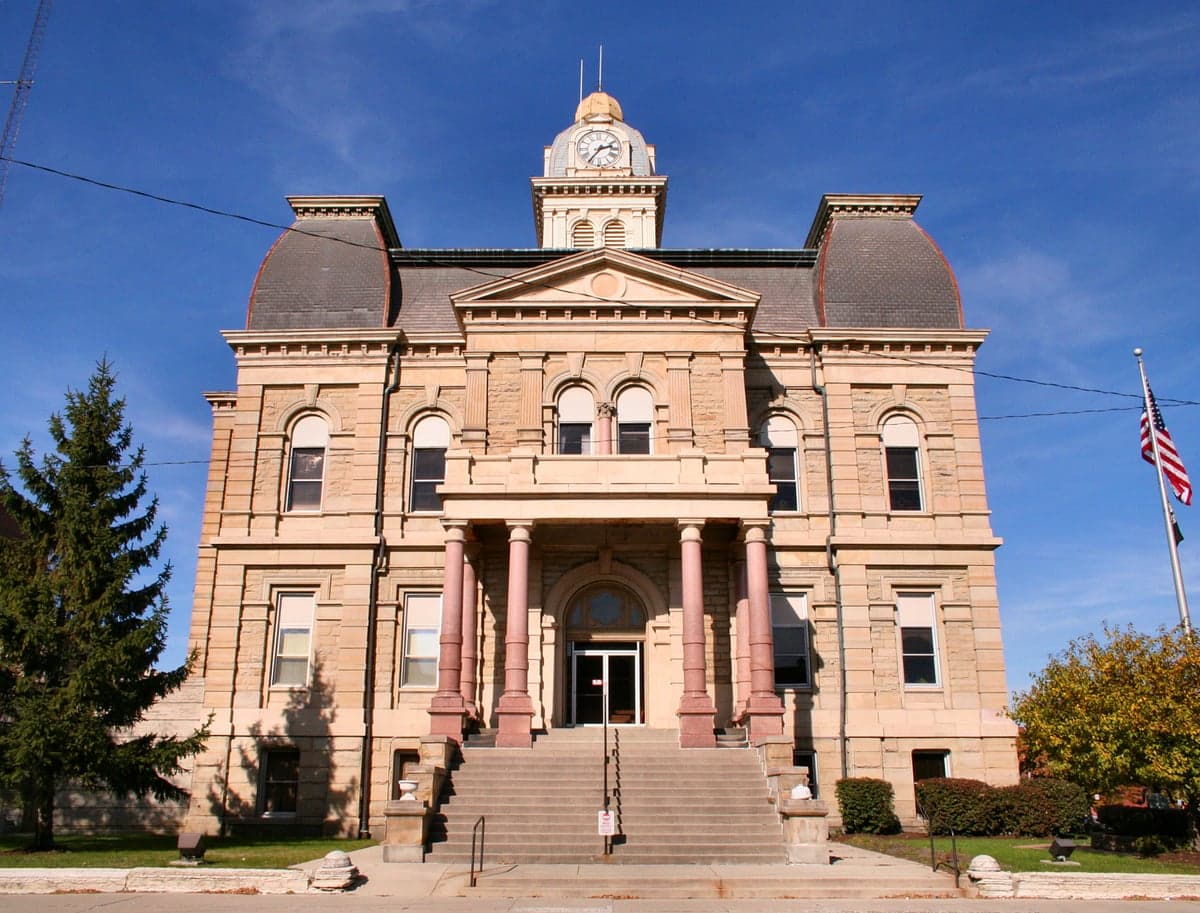
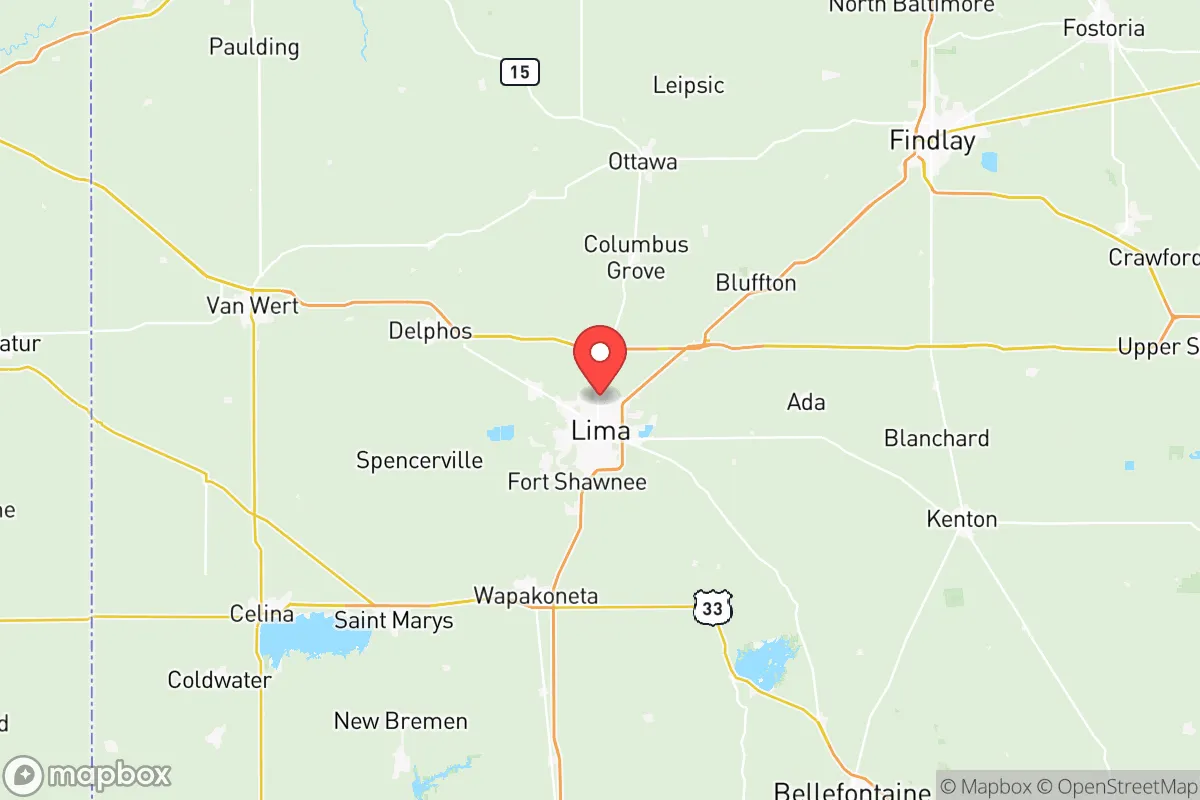
Photo: Wikipedia
Demographics of Allen County
Affluence Level in Allen County
A middle-class area roughly in line with national averages across income, home values, education, and employment.
People of Allen County
Today, Allen County, Ohio, is home to roughly 101,685 residents who form a predominantly white (79.6%) and politically conservative community centered on the city of Lima and its surrounding townships. With a foreign-born population of just 0.8% and a college attainment rate of 19.9%, the county retains a strong working-class character rooted in manufacturing and agriculture. Its people are notably stable — many families have lived here for generations — and the area’s identity is shaped by a blend of Midwestern pragmatism, industrial heritage, and a growing but still modest racial diversity.
Settlement & growth (pre-1960)
Before American settlement, the land that is now Allen County was home to the Shawnee and Miami nations, who used the region for hunting and seasonal villages. The area was part of the larger Ohio Country contested by the French and British during the 18th century, but no permanent European colonies were established here until after the War of 1812. The Treaty of Maumee Rapids (1817) forced the Shawnee and Miami to cede most of their lands, opening the territory for American settlers.
The first major wave of American settlers arrived in the 1820s and 1830s, primarily from Pennsylvania, Virginia, and Kentucky. These were largely Scots-Irish and English yeoman farmers drawn by the promise of cheap, fertile land in the newly surveyed townships. The county was officially formed in 1831, and the town of Lima was platted that same year as the county seat. Early settlers also clustered in Bath Township and Shawnee Township, where farming and small-scale milling dominated the economy.
A second, larger wave came with the completion of the Miami and Erie Canal in 1845, which connected the county to Lake Erie and the Ohio River. This canal transformed Lima into a transportation hub and attracted a surge of German and Irish immigrants. German Catholics and Lutherans settled heavily in Lima’s south side and in the village of Delphos (part of which lies in Allen County), where they built churches, breweries, and schools. Irish laborers, many of whom had worked on the canal itself, formed a smaller but distinct community in Elida and along the canal corridor. By 1850, the county’s population had reached roughly 12,000, with Germans making up about 15% of the total.
The discovery of oil and natural gas in the Lima-Indiana field in 1885 triggered a third major wave. The oil boom brought thousands of domestic migrants — mostly from Pennsylvania, West Virginia, and other parts of Ohio — who worked in the refineries and drilling operations. The city of Lima swelled from 8,000 in 1880 to over 30,000 by 1910. This period also saw a small influx of Polish and Italian immigrants, who found work in the oil refineries and the newly established Lima Locomotive Works. These groups concentrated in Lima’s east side and in the working-class neighborhoods near the rail yards. The boom subsided by the 1920s, but manufacturing — particularly locomotive building, steel fabrication, and auto parts — remained the economic backbone through the 1950s.
The Great Migration brought a notable African American population to Allen County, primarily between 1940 and 1960. Black families from the rural South (especially Alabama, Mississippi, and Tennessee) moved to Lima for jobs at the Lima Tank Plant (opened 1941) and other defense-related factories. By 1960, the Black population had grown to roughly 6% of the county total, concentrated in Lima’s central and northeast neighborhoods. This wave was smaller than in Ohio’s major industrial cities (Cleveland, Toledo, Dayton), but it established a lasting African American community that remains centered in Lima today.
Modern era (post-1965)
The 1965 Hart-Cellar Act had a minimal direct effect on Allen County. Unlike larger Ohio cities that saw significant immigration from Latin America and Asia after 1965, Allen County’s foreign-born population remains extremely low at 0.8% — far below the national average of roughly 14%. The county did not develop the kind of immigrant enclaves seen in Columbus or Cleveland. Instead, the post-1965 demographic story is one of domestic migration and suburbanization.
Manufacturing decline hit Allen County hard after 1970. The Lima Locomotive Works closed in 1969, and the Ford Lima Engine Plant (opened 1957) shed thousands of jobs in the 1980s and 1990s. This led to a net population loss: the county peaked at roughly 112,000 in 1970 and has declined to 101,685 today. Many younger residents left for Sun Belt states or larger Ohio cities, leaving an aging population. The white share of the population dropped from about 88% in 1970 to 79.6% today, driven primarily by an increase in the Black population (now 10.6%) and a small but growing Hispanic population (3.4%).
Hispanic residents — mostly of Mexican and Puerto Rican ancestry — began arriving in the 1990s, drawn by remaining manufacturing jobs at the Ford plant and at food-processing facilities in Lima and Fort Shawnee. They have not formed a single concentrated enclave but are dispersed across the county, with slightly higher numbers in Lima’s south side and in the village of Harrod. The East/Southeast Asian population (0.6%) and Indian subcontinent population (0.3%) are very small, consisting mainly of professionals employed at the area’s hospitals (Mercy Health-St. Rita’s Medical Center) and at the University of Northwestern Ohio in Lima.
Suburbanization has been modest compared to fast-growing regions. The townships surrounding Lima — Bath Township, Shawnee Township, and American Township — have seen some new housing development since 2000, but the county as a whole has not experienced the sprawling exurban growth seen in central Ohio. Most residents still live in Lima proper (about 37,000) or in the county’s small villages: Elida (1,900), Delphos (7,100, partly in Van Wert County), Spencerville (2,200), and Bluffton (4,100, partly in Allen County).
The future
Allen County’s population is projected to continue a slow decline over the next 10-20 years, mirroring trends across much of rural and small-city Ohio. The county’s birth rate is below replacement level, and out-migration of young adults to larger metro areas is likely to persist. The population is also aging: roughly 19% of residents are 65 or older, compared to 17% nationally.
Diversity will increase modestly but remain low by national standards. The Hispanic share is expected to grow from 3.4% to perhaps 5-6% by 2040, driven by continued migration for manufacturing and agricultural work. The Black population share may hold steady or rise slightly, while the white share will continue to edge downward. The East/Southeast Asian and Indian populations will likely remain very small, as the county lacks the professional job base and university infrastructure to attract significant numbers of these groups.
Culturally, Allen County is likely to remain a conservative, predominantly white, working-class community. The political lean is solidly Republican — Donald Trump won Allen County by 27 points in 2020 — and this is unlikely to shift dramatically. New residents moving in will tend to be domestic migrants from other parts of Ohio or the Midwest, often drawn by lower housing costs (median home value around $120,000) and family ties. The county will not become a destination for international immigrants or coastal transplants.
For someone moving in now, Allen County offers a stable, affordable, and culturally homogeneous environment where community ties run deep and change comes slowly. The population is not growing, but it is not collapsing either — it is a place where people stay, and where the past remains a strong presence in daily life.

* Values derived from national, state, county, city and local statistics and may differ in a specific area. Last updated: 2026-07-17T02:53:26.000Z
Narrative content on this page is AI-generated and may contain mistakes. Verify any details that matter before acting on them.
ReloMaps may earn a commission from affiliate links at no extra cost to you.

