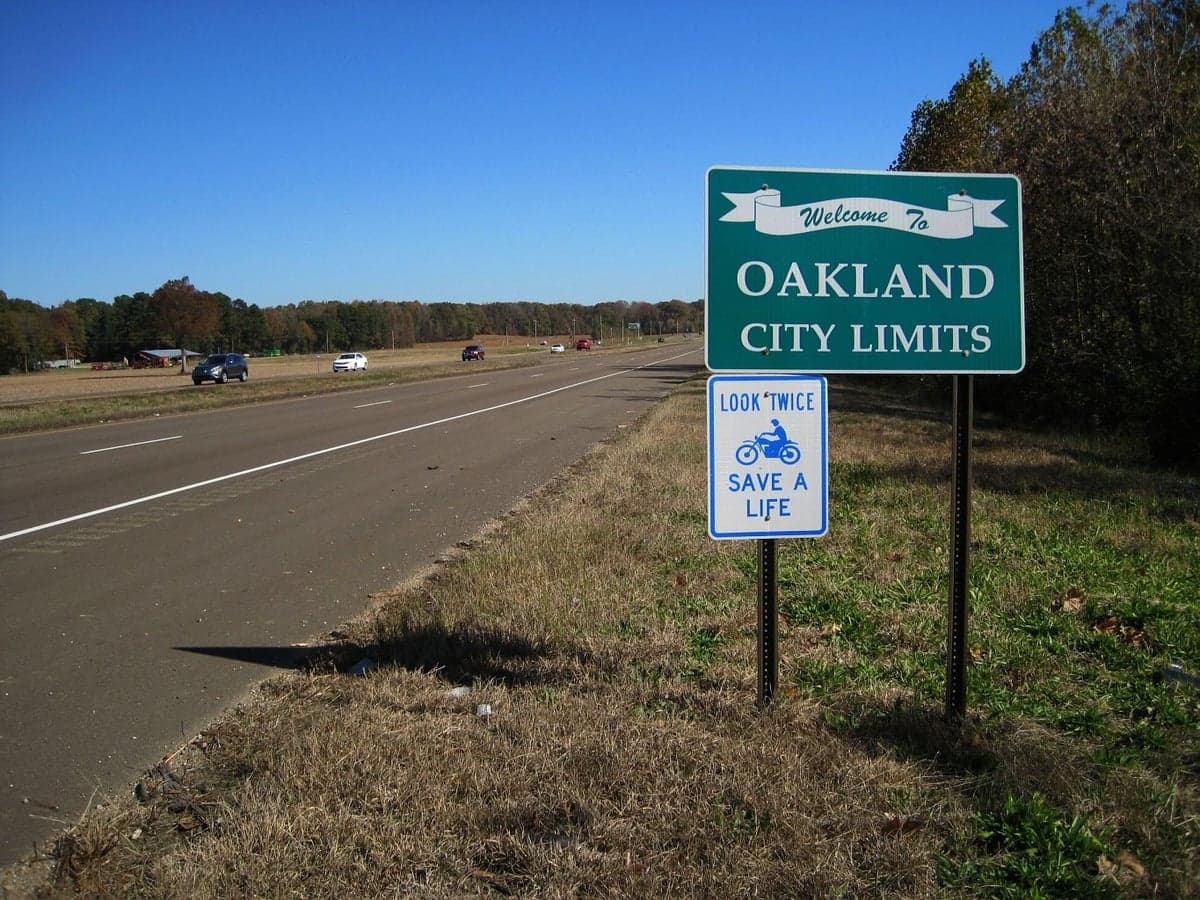
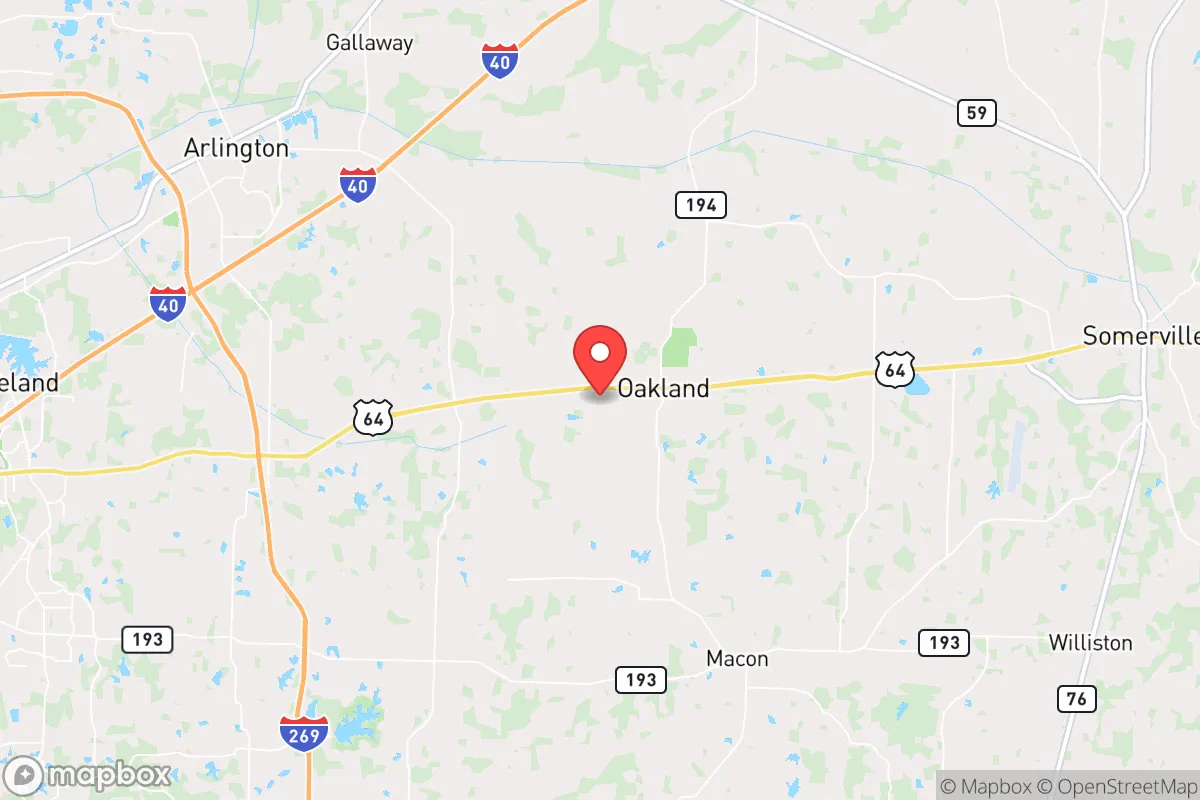
Photo: Wikipedia
Political ClimatePolitical Climate in Oakland, TN
District shown is the primary district for this city’s centroid. Cities may span multiple districts.
Local Political AnalysisPolitical Analysis of Oakland, TN
Oakland, Tennessee, sits deep in Republican territory, with a Cook PVI of R+21 that makes it significantly more conservative than the state of Tennessee as a whole, which sits at R+13. This isn't a recent shift—it's been a steady trend for decades, driven by the town's growth as a bedroom community for Memphis and the influx of families seeking larger lots and lower taxes. The local political culture is reliably red, with Republican candidates routinely winning by margins that would be considered landslides in more competitive areas. If you're looking at election maps, Oakland is part of the solid conservative bloc that stretches from the Memphis suburbs eastward through Fayette County.
How it compares
The R+21 PVI means Oakland is about 8 points more Republican than Tennessee statewide, a gap that shows up clearly in local voting patterns. For context, nearby Collierville (R+15) and Germantown (R+12) are also conservative but lean less heavily red, while Memphis proper (D+25) is a Democratic stronghold just 30 minutes west. This creates a sharp political divide within a short drive: you can go from a precinct where Trump won 75% of the vote in Oakland to one in Memphis where he got under 20%. The surrounding Fayette County is similarly conservative, with a PVI around R+20, so Oakland isn't an outlier—it's the norm for this part of West Tennessee. Statewide, Tennessee's R+13 reflects a mix of deep-red rural areas and more moderate suburbs around Nashville and Knoxville, but Oakland's R+21 puts it in the same league as the state's most conservative rural counties.
What this means for residents
For conservative residents, Oakland's political climate means local policies align closely with their values: low taxes, limited regulation, and a strong emphasis on Second Amendment rights and school choice. The town's rapid growth—population nearly doubled between 2010 and 2020—has been fueled partly by this reputation, attracting families from more liberal areas who want a conservative community. For liberal residents, the reality is more nuanced. You won't find many openly progressive candidates on local ballots, and social issues like LGBTQ+ rights or environmental regulations often face an uphill battle. However, the proximity to Memphis means you're never far from a more diverse political environment, and many Oakland liberals simply commute to Memphis for work and social life. The practical effect is that local government tends to be low-drama and focused on growth management—zoning, schools, and infrastructure—rather than hot-button cultural fights, though those do surface during election cycles.
Culturally, Oakland feels like a small town that's rapidly suburbanizing. The local schools are highly rated, and the town's identity is tied to its rural roots—there's still a strong agricultural presence, with cotton and soybean fields bordering new subdivisions. Policy-wise, the town has resisted annexation by Memphis and maintains its own police and public works departments, which residents see as a way to keep taxes low and services responsive. The biggest distinction from Tennessee's more moderate suburbs is the absence of any significant Democratic organizing—you won't find a local Democratic Party office or regular progressive meetups. For newcomers, the political climate is straightforward: if you're conservative, you'll feel at home; if you're liberal, you'll likely find your political life in Memphis or online. Looking ahead, as Oakland continues to grow and attract more diverse populations from Memphis, the political lean may soften slightly, but the R+21 baseline suggests it will remain one of Tennessee's most reliably Republican towns for the foreseeable future.

State Political ClimatePolitical Climate in Tennessee
State Political AnalysisPolitical Environment in the State
Tennessee is a solidly Republican state with a Cook PVI of R+13, meaning it votes about 13 points more Republican than the national average in presidential elections. The state has shifted rightward over the past 20 years, driven by the exodus of rural and suburban voters from the Democratic coalition and the in-migration of conservatives from other states, particularly to the Nashville and Knoxville exurbs. While Democrats still hold a few urban strongholds and the occasional state legislative seat, the GOP now holds supermajorities in both chambers of the General Assembly and all nine of the state’s U.S. House seats are held by Republicans.
Urban vs. rural divide
The political map of Tennessee is a classic story of deep red rural and exurban counties surrounding blue islands in the major metros. Nashville (Davidson County) is the state’s most reliably Democratic urban center, voting for Joe Biden by 35 points in 2020, while Memphis (Shelby County) also leans heavily Democratic, though with lower turnout and a more fragmented local Democratic machine. Chattanooga (Hamilton County) and Knoxville (Knox County) are both purple-to-light-red at the county level, with the cities themselves trending blue but the surrounding suburbs and rural areas overwhelmingly Republican. The Nashville suburbs — places like Williamson County (Brentwood, Franklin) and Rutherford County (Murfreesboro) — are among the fastest-growing and most reliably Republican areas in the state, with Williamson County voting for Trump by 30 points. The rural counties in Middle and West Tennessee, such as Weakley County and Hardeman County, routinely vote 70-80% Republican. The Tri-Cities region (Johnson City, Kingsport, Bristol) in Northeast Tennessee is ancestrally Republican and remains deeply red, with Washington County (Johnson City) being one of the few competitive areas in that region.
Policy environment
Tennessee’s policy environment is defined by a low-tax, low-regulation posture that appeals to conservative relocators. The state has no personal income tax on wages (only a Hall tax on interest and dividends, which is being phased out), and the state sales tax rate is among the highest in the nation at 7%, with local add-ons pushing it to 9.75% in some areas. Property taxes are low relative to the national average, though they vary significantly by county — Davidson County (Nashville) has higher rates than Rutherford County (Murfreesboro). The state is a right-to-work state with weak unions, and it has no state-level minimum wage above the federal $7.25. Education policy is dominated by school choice: Tennessee has a robust charter school law, a voucher program (the Education Savings Account program, currently limited to Shelby and Davidson counties but expanding), and a growing network of public charter schools, particularly in Nashville and Memphis. The state’s healthcare policy is notable for not expanding Medicaid under the Affordable Care Act, leaving a coverage gap for low-income adults. Election laws are moderately restrictive: voters must show a photo ID, and early voting is available for two weeks, but same-day registration is not allowed. The state has a closed primary system, meaning only registered Republicans can vote in GOP primaries.
Recent policy direction
Over the past five years, Tennessee has moved decisively to the right on a broad range of issues. On gun and self-defense law, the state enacted permitless carry (constitutional carry) in 2021, allowing any adult who can legally possess a firearm to carry it openly or concealed without a permit. On parental and education rights, the legislature passed the “Don’t Say Gay” style law (HB 0800/SB 0623) in 2023, restricting classroom discussion of sexual orientation and gender identity in K-8, and the “Age-Appropriate Materials Act” (2022) requiring schools to post all instructional materials online for parental review. On speech and privacy, the state passed a law in 2024 requiring social media platforms to verify the ages of users and restrict minors’ access, and it has a broad anti-doxxing law protecting personal information. On medical and bodily autonomy, Tennessee has one of the most restrictive abortion bans in the country, enacted in 2023, with no exceptions for rape or incest and only narrow exceptions to save the mother’s life. The state also passed a law in 2023 banning gender-affirming care for minors, which is currently being challenged in court. On property rights, Tennessee is a “Dillon’s Rule” state, meaning local governments have only the powers explicitly granted by the state, and the legislature has frequently preempted local ordinances on issues like short-term rentals, plastic bag bans, and anti-discrimination protections. On taxation, the state has cut the Hall tax (on investment income) from 6% to 1% in 2024, with full repeal scheduled for 2025. On voting and ballot access, the state passed a law in 2023 requiring all absentee ballots to be returned by mail (no drop boxes), and it has a strict voter ID law that was upheld by the courts.
Civil unrest & political movements
Tennessee has seen relatively low levels of large-scale civil unrest compared to states like Oregon or Minnesota, but there have been notable flashpoints. The 2020 protests in Nashville following the murder of George Floyd were large and occasionally violent, leading to property damage downtown and a heavy police response. The Tennessee Three — state representatives Justin Jones, Justin Pearson, and Gloria Johnson — were expelled from the legislature in 2023 for leading a gun control protest on the House floor after the Covenant School shooting in Nashville; Jones and Pearson were later reinstated by local commissions. This event became a national flashpoint for both gun rights and gun control activists. On the right, the Tennessee Freedom Coalition and local Moms for Liberty chapters have been active in school board races and legislative lobbying, particularly on book bans and curriculum transparency. Immigration politics are less visible than in border states, but the legislature passed a law in 2024 requiring local law enforcement to cooperate with federal immigration authorities (a “sanctuary city” ban). There is no serious secession or nullification movement in Tennessee, though some rural counties have passed symbolic “Second Amendment sanctuary” resolutions. Election integrity controversies have been minimal compared to states like Georgia or Arizona, though the state did conduct a limited audit of the 2020 election in 2021 that found no significant irregularities.
Projection
Over the next 5-10 years, Tennessee is likely to remain solidly Republican, but the nature of that conservatism may shift as in-migration continues. The state is growing fastest in the Nashville metro (especially Williamson, Rutherford, and Wilson counties) and the Knoxville metro (especially Loudon and Blount counties), attracting a mix of conservative retirees from the Midwest and Northeast, as well as younger professionals drawn to Nashville’s economy. This influx is likely to make the state’s Republican Party more suburban and less rural in its priorities — expect continued emphasis on school choice, tax cuts, and business-friendly regulation, but also potential friction over social issues like abortion and LGBTQ rights as the new arrivals may be less culturally conservative than the rural base. The Democratic Party will remain competitive only in Nashville and Memphis, and possibly in Chattanooga if the city continues to grow and diversify. The state’s demographic shift is modest — the population is aging and becoming slightly more diverse, but not fast enough to flip the state blue. A new resident moving in now should expect to find a state where conservative policies are the norm, but where the political conversation is increasingly shaped by the tension between the rural, culturally traditional base and the suburban, economically conservative newcomers.
For a new resident, the bottom line is that Tennessee offers a reliably conservative policy environment with low taxes, strong gun rights, and a business-friendly regulatory climate, but with some trade-offs: high sales taxes, limited healthcare access for low-income residents, and a political culture that can be intensely focused on social issues. If you’re a conservative, you’ll find a state that largely aligns with your values and where your vote counts in primaries. If you’re a liberal, you’ll find a few blue enclaves in Nashville and Memphis, but you’ll be living under a state government that is actively hostile to many of your policy preferences. The state is not politically volatile — it’s stable, predictable, and moving slowly but steadily to the right.
* Values derived from national, state, county, city and local statistics and may differ in a specific area. Last updated: 2026-10-07T00:56:12.000Z
Narrative content on this page is AI-generated and may contain mistakes. Verify any details that matter before acting on them.
ReloMaps may earn a commission from affiliate links at no extra cost to you.

