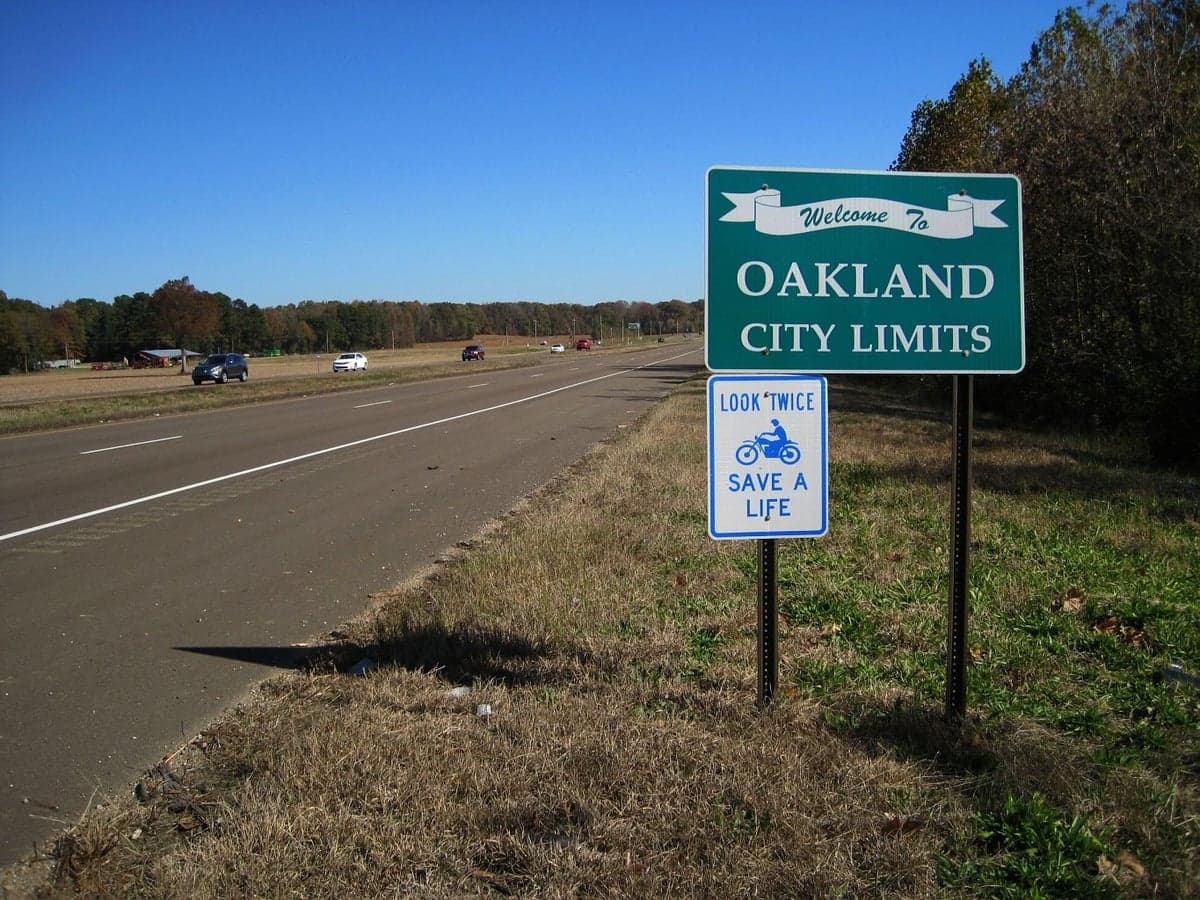
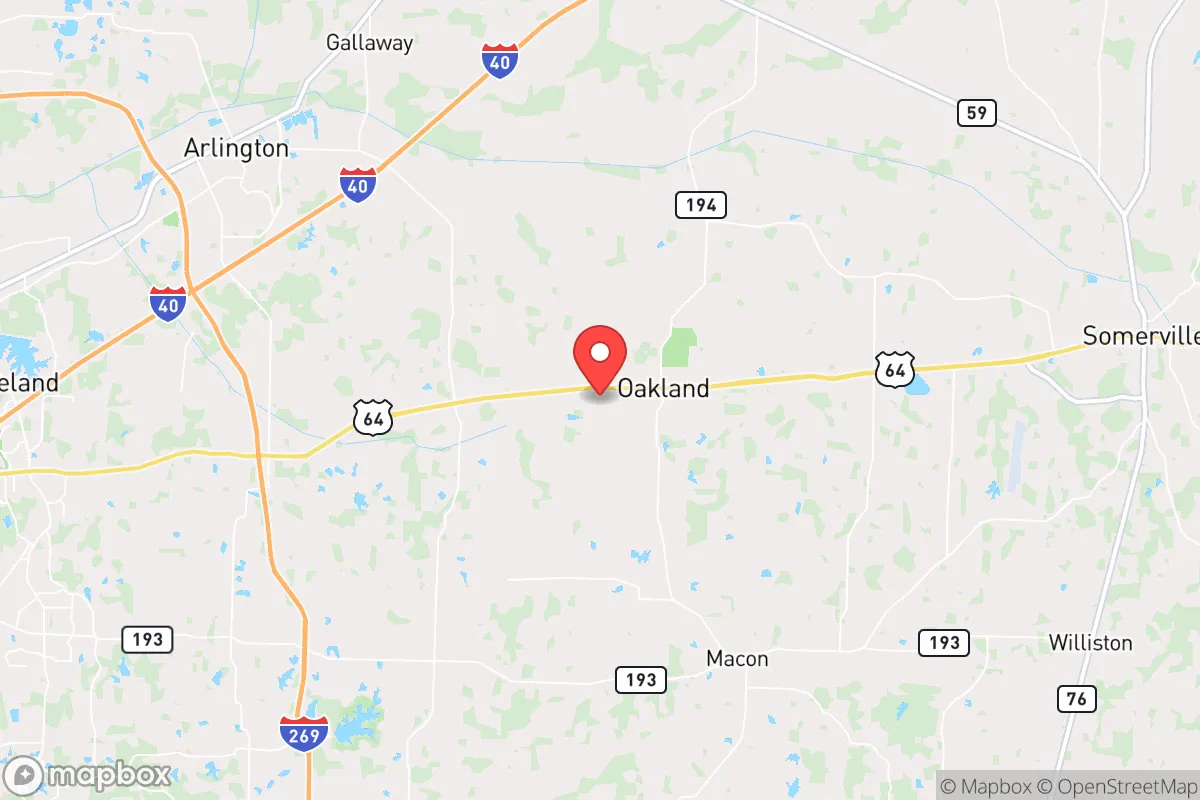
Photo: Wikipedia
Demographics of Oakland, TN
Affluence Level in Oakland, TN
A middle-class area roughly in line with national averages across income, home values, education, and employment.
People of Oakland, TN
The people of Oakland, Tennessee today form a small but rapidly growing community of roughly 9,500 residents, characterized by a predominantly white population (72.1%) with a significant Black minority (23.7%) and very small Hispanic (1.7%) and East/Southeast Asian (0.2%) communities. The foreign-born share is just 1.1%, well below the national average, reflecting a population shaped overwhelmingly by domestic migration rather than international immigration. Oakland’s identity is that of a quietly diversifying exurban bedroom community — families and retirees drawn by lower taxes, newer housing stock, and proximity to Memphis’s job market without the urban density or crime concerns.
How the city was settled and grew
Oakland’s origins trace to the mid-19th century as a railroad stop on the Memphis & Charleston line, incorporated in 1866. The earliest white settlers were small-scale cotton farmers and merchants from the Upper South — Kentucky, Tennessee, and Virginia — who established homesteads along the rail corridor. The historic Oakland Depot area, centered on the old train station, became the commercial and social hub for these early families. Enslaved Black laborers worked the surrounding cotton fields, and after emancipation, many remained as sharecroppers and tenant farmers, forming the nucleus of what would become the North Oakland community, a historically Black settlement along the railroad’s northern side. Through the early 1900s, the population hovered around 200–300, with the economy tied to cotton ginning, timber, and general stores. No major immigrant wave arrived during this period; the town remained overwhelmingly native-born and rural until the late 20th century.
Modern era (post-1965)
The 1965 Hart-Cellar Act had minimal direct effect on Oakland — the foreign-born share remains negligible. Instead, the modern population boom began in the 1990s and accelerated after 2000, driven by white and Black families leaving Memphis for newer, larger homes on larger lots. The Oakland Farms subdivision, developed in the late 1990s, was the first major master-planned community, attracting middle-class white families from east Memphis and Collierville. A second wave of Black professionals and dual-income families moved into Belle Meade Estates and Woodland Hills in the 2000s, drawn by the same calculus: better schools (Fayette County Public Schools), lower crime, and new construction at prices 20–30% below comparable Shelby County suburbs. The Hispanic population, though small (1.7%), grew from near-zero in 1990, concentrated among construction and landscaping workers living in rental duplexes near the U.S. 64 corridor. The East/Southeast Asian community (0.2%) is tiny and dispersed, with no distinct ethnic enclave. The Indian-subcontinent population is effectively zero. Today, Oakland’s Black share (23.7%) is notably higher than neighboring Piperton (12%) but lower than Memphis (64%), reflecting a pattern of moderate, class-stratified integration rather than rapid diversification.
The future
Oakland’s population is projected to continue growing steadily, likely reaching 12,000–14,000 by 2035, driven by continued spillover from Memphis and Collierville. The racial composition is expected to remain broadly stable — white share may decline slightly to the high 60s, while Black share could rise toward 28–30% as more Black professionals seek affordable exurban housing. The Hispanic share may double to 3–4% but will remain a small minority. The foreign-born share will likely stay below 3%, as Oakland lacks the rental stock, transit access, and ethnic infrastructure that attract immigrants to larger suburbs. New development is concentrating in Oakland Crossing and South Pointe, both large-lot subdivisions targeting families with school-age children. The cultural identity is evolving from a sleepy farm town into a family-oriented commuter suburb, with a growing emphasis on youth sports, church-based social life, and conservative local politics. For a newcomer, Oakland offers a predictable, low-crime environment with good schools and a population that is slowly becoming more diverse along class lines rather than through immigration.
In short, Oakland is becoming a moderately diverse, solidly middle-class exurb — whiter than Memphis, more Black than most Fayette County towns, and with minimal immigrant presence. For a family or individual moving in now, the community offers stability, new housing, and a conservative-leaning social fabric that is gradually absorbing more Black professionals while remaining largely untouched by the broader national trends of Hispanic and Asian growth.

* Values derived from national, state, county, city and local statistics and may differ in a specific area. Last updated: 2026-10-07T00:56:12.000Z
Narrative content on this page is AI-generated and may contain mistakes. Verify any details that matter before acting on them.
ReloMaps may earn a commission from affiliate links at no extra cost to you.

