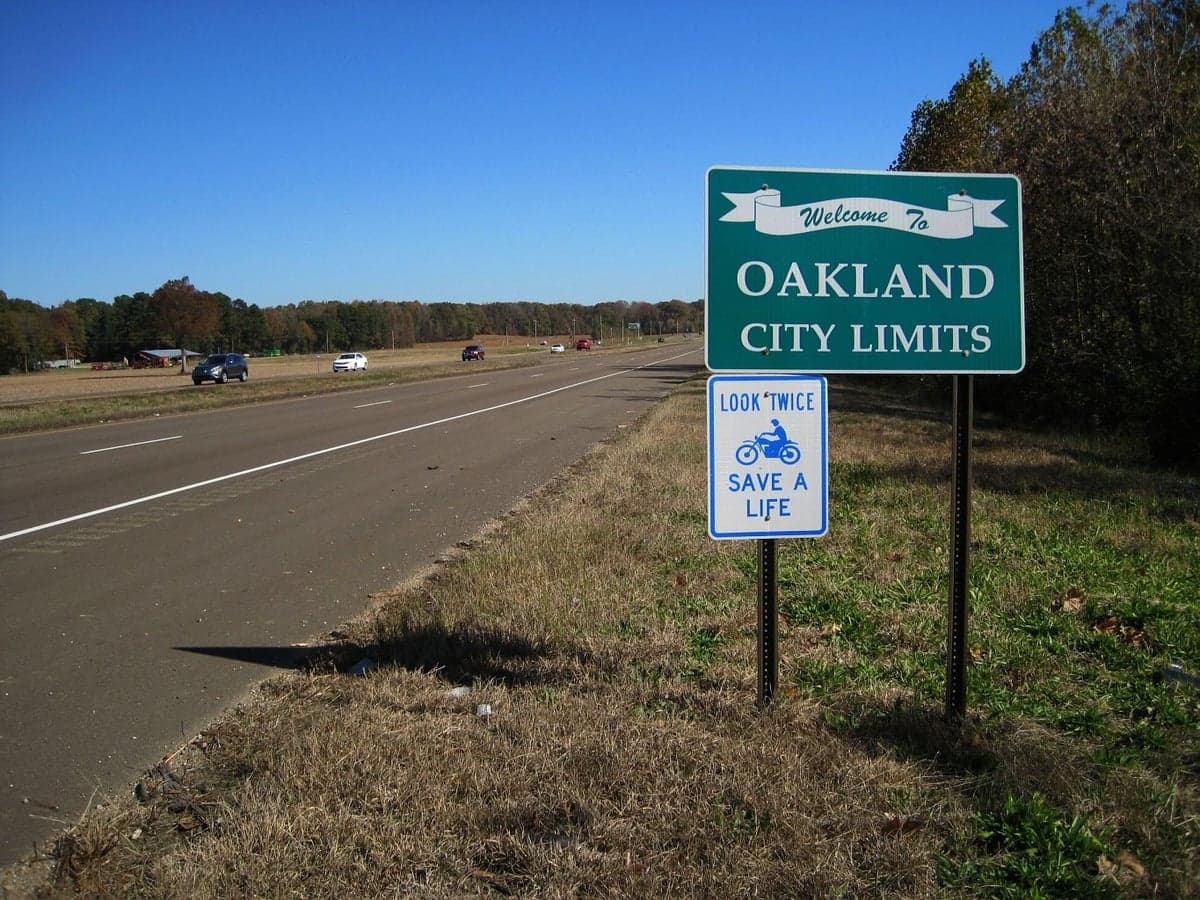
Photo: Wikipedia
Personal Sovereignty in Oakland, TN
Viable for self-reliance. Generally workable, though some barriers may limit total independence.
What does Personal Sovereignty tell us?
Personal Sovereignty measures your capacity for self-reliance and independence with minimal government friction. Higher scores mean fewer barriers between you and the way you want to live... but it assumes you have the space you need and good neighbors.
What does this tell us?
Personal Sovereignty measures your capacity for self-reliance and independence with minimal government friction. Higher scores mean fewer barriers between you and the way you want to live... but it assumes you have the space you need and good neighbors.
State Policy
Energy independence: Importer (25% of energy produced in-state)
Personal Liberty
Homesteading

Personal Liberty Analysis
Oakland, Tennessee, offers a notably high degree of personal sovereignty, grounded in Tennessee’s broader commitment to limited government, low taxation, and strong protections for individual rights. For a relocation researcher evaluating autonomy, the town’s environment is defined by a light-touch regulatory posture, permissive self-defense laws, and a culture that rewards self-reliance. While Oakland is part of a rapidly growing suburban corridor east of Memphis, its local governance and state-level policies consistently prioritize personal freedom over collective mandates, making it a compelling option for those who value independence in daily life.
Tax burden and regulatory posture: How light is the government touch?
Tennessee’s tax structure is among the most favorable in the nation for personal sovereignty. The state has no personal income tax on wages or salaries, and no state-level property tax on intangible assets. Oakland’s local property tax rate is modest, with the town’s combined county and municipal rate typically falling around $2.50–$3.00 per $100 of assessed value, depending on annual adjustments. This is lower than many suburban communities in the Mid-South, and significantly below the national average for comparable towns. Sales tax is the primary revenue source, with a combined state and local rate of 9.75% in Fayette County, which is moderate for Tennessee but higher than some neighboring states. However, the absence of income tax means residents retain more control over their earnings. Regulatory burdens are minimal: there are no county-level business licensing requirements for most home-based enterprises, and zoning in Oakland’s unincorporated areas is generally permissive. The town’s building codes align with state minimums, and there is no local rent control or landlord licensing. For a resident seeking to operate a small business, keep more of their income, or avoid bureaucratic red tape, Oakland’s regulatory environment is decidedly light-touch.
Self-defense and gun law specifics: What are your rights to protect yourself?
Tennessee is a strong Second Amendment state, and Oakland residents benefit from some of the most permissive self-defense laws in the country. The state has constitutional carry (permitless carry) for both open and concealed handguns for any law-abiding adult 21 or older (18 for military members). No permit, training, or background check beyond the point of sale is required to carry a firearm in public. Stand-your-ground laws are fully in effect, meaning there is no duty to retreat before using deadly force if a person reasonably believes it is necessary to prevent death, serious bodily injury, or a violent felony. Castle doctrine protections extend to occupied vehicles and places of work. For those who choose to obtain a concealed carry permit, Tennessee offers reciprocity with over 30 states, and the permit process is straightforward with no discretionary denial by local authorities. Oakland itself has no additional local gun ordinances beyond state law; the town does not impose waiting periods, magazine capacity limits, or registration requirements. The local sheriff’s office in Fayette County is known for a pro-Second Amendment stance, and residents report a culture where firearm ownership is common and socially accepted. For a reader prioritizing self-defense autonomy, Oakland provides a legal framework that maximizes individual discretion.
Self-reliance and homesteading viability: Lot sizes, zoning, and off-grid feasibility
Oakland’s rural character, even as it grows, supports a high degree of self-reliance. Minimum lot sizes in the town’s residential zones are typically one acre in the R-1 district, with larger parcels (2–5 acres) common in unincorporated areas. This allows for substantial gardening, small livestock (chickens, goats, bees), and even limited hobby farming without special permits. Zoning is generally permissive: accessory dwelling units (granny flats) are allowed on single-family lots, and there are no prohibitions on clotheslines, rain barrels, or composting. Off-grid feasibility is moderate. While the town requires connection to municipal water and sewer within the town limits, properties in the county can rely on private wells and septic systems. Solar panels are permitted without restrictive covenants, though homeowners’ associations (HOAs) in newer subdivisions may impose aesthetic rules. There is no county-level ban on rainwater harvesting, and Tennessee law explicitly protects the right to collect rainwater. The climate supports year-round growing (USDA Zone 7b/8a), and local feed stores and agricultural supply shops are within a 15-minute drive. For a family seeking to reduce reliance on external systems—growing food, generating power, or managing waste—Oakland’s regulatory environment is accommodating, especially compared to more urbanized areas in Shelby County to the west.
Personal liberties: Parental rights, medical autonomy, speech, and property
Tennessee has enacted strong protections for parental rights, including a 2023 law affirming that parents have the fundamental right to direct the upbringing, education, and healthcare of their minor children. Oakland’s local school board, Fayette County Public Schools, has a conservative majority that emphasizes parental involvement and transparency in curriculum. Medical autonomy is robust: Tennessee does not mandate COVID-19 or childhood vaccination for school attendance (though standard immunizations are required unless a religious or medical exemption is filed), and there is no state-level mask or quarantine mandate in effect. The state has also passed laws restricting gender-affirming care for minors and limiting abortion access, which aligns with the values of many conservative-leaning readers. Free speech protections are strong, with no local hate speech ordinances or content-based restrictions on public expression. Property rights are well-guarded: Tennessee’s eminent domain laws require a public purpose and just compensation, and Oakland has not engaged in aggressive condemnation for private development. There is no local rent control, no inclusionary zoning mandates, and no short-term rental bans (though HOAs may restrict them). For a resident who values the ability to make personal medical decisions, raise children without government overreach, and speak freely without fear of censorship, Oakland’s legal environment is highly supportive.
Overall, Oakland, Tennessee, ranks among the more sovereignty-friendly towns in the Mid-South for a conservative-leaning individual or family. Its combination of no income tax, constitutional carry, permissive zoning for self-reliance, and strong parental and property rights creates an environment where personal autonomy is the default. While the town’s growth is bringing some suburbanization—new subdivisions with HOAs, increased traffic on Highway 64—the core legal and cultural framework remains firmly pro-freedom. Compared to nearby Memphis (higher taxes, more regulation, restrictive gun laws) or even Collierville (stricter zoning, more HOA oversight), Oakland offers a lighter touch. For a reader who prioritizes independence and is willing to accept a quieter, more rural setting, Oakland provides a solid foundation for a self-directed life.

* Values derived from national, state, county, city and local statistics and may differ in a specific area. Last updated: 2026-10-07T00:56:12.000Z
Narrative content on this page is AI-generated and may contain mistakes. Verify any details that matter before acting on them.
ReloMaps may earn a commission from affiliate links at no extra cost to you.

