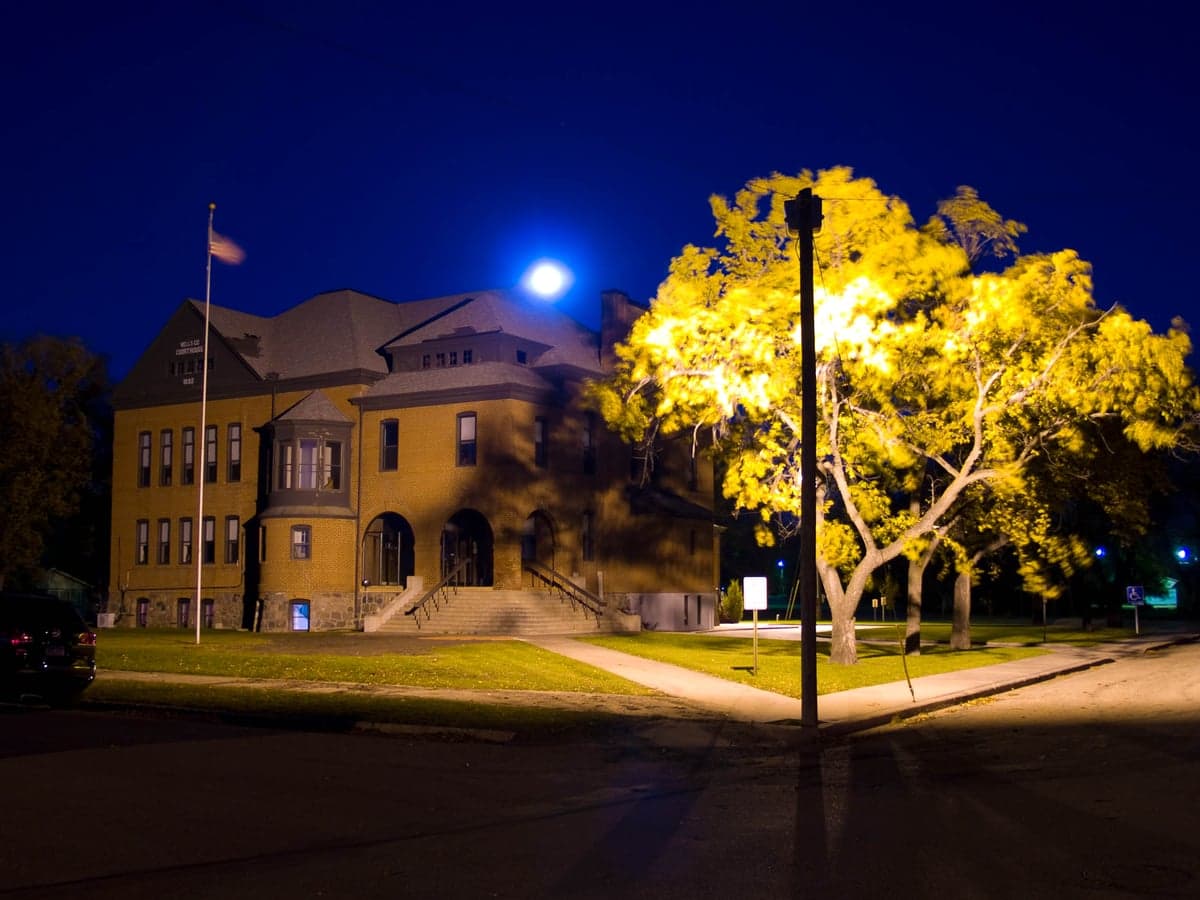
Photo: Wikipedia
Political ClimatePolitical Climate in Wells County
Showing county-level results — no local-only data available.
Lean and PVI are calculated from this county’s 2020 and 2024 presidential results, Cook-style.
Political rankings in North Dakota
- Most Conservative Cities in North Dakota
- Most Liberal Cities in North Dakota
- Best Liberal-Leaning Towns in the Midwest
- Safest Liberal-Leaning Towns in the Midwest
- Safest Conservative-Leaning Towns in the Midwest
- Affordable Small Towns for Conservatives
- Most Affordable Liberal-Leaning Small Towns in the U.S.
- Safest Conservative-Leaning Cities in the U.S.
- Most Conservative Counties in North Dakota
- Most Liberal Counties in North Dakota
Local Political AnalysisPolitical Analysis of Wells County
Wells County, North Dakota, is deeply Republican, with a voting pattern that has only grown more conservative over the past two decades. In the 2024 presidential election, the county gave Donald Trump over 80% of the vote, a margin that has widened from the low 70s in 2000. This shift mirrors the broader rural trend across the state, but Wells County’s lean is actually a bit more pronounced than the state average, driven by its aging, predominantly white, and agriculture-dependent population. The county seat, Fessenden, and the largest town, Harvey, both vote heavily red, though Harvey’s small healthcare and retail sector creates a slightly more moderate—but still solidly Republican—voting bloc.
How it compares
Compared to North Dakota as a whole, Wells County is a few points more conservative. The state’s Cook Partisan Voting Index (PVI) is not publicly available for 2024, but statewide, Trump won North Dakota by about 20 points in 2024. Wells County’s 80%+ share puts it roughly 10 points to the right of the state average. The only real variation within the county comes from the tiny village of Bowdon, which has a small number of Democratic-leaning households tied to the local school and post office, but even there, Republicans win by a 2-to-1 margin. The towns of Anamoose and Martin, both with populations under 100, are among the most conservative precincts, often hitting 85% Republican. In short, there are no swing precincts in Wells County—it’s a deep red island in an already red state.
What this means for residents
For conservative residents, the political climate is a comfortable fit. Local government, school boards, and county commissions are uniformly Republican, meaning policy debates are usually about how to manage taxes and services, not whether to cut them. The county’s strong support for the state’s oil-and-gas-driven economy and opposition to federal land-use restrictions are reflected in local resolutions and town hall meetings. For liberal residents, the reality is more isolating. There is no organized Democratic Party presence in the county; the nearest active party office is in Minot, 90 miles west. Socially, progressive views on issues like renewable energy or gun control are rarely voiced publicly, and those who hold them often keep quiet to avoid friction. That said, the county’s small population (under 4,000) means personal relationships often override political differences in daily life—neighbors still help with harvest regardless of yard signs.
Culturally, Wells County stands out for its strong Lutheran and Catholic heritage, which shapes a community ethos of self-reliance and volunteerism. Unlike the oil-boom counties to the west, Wells County has seen steady population decline since the 1930s, fostering a “stick together” mentality that tempers partisan rancor. Policy-wise, the county has been a vocal supporter of the state’s strict abortion laws and its resistance to mask mandates during the pandemic, but it also consistently votes for local school levies and hospital funding—a pragmatic streak that keeps the community functioning. For anyone moving here, the political reality is simple: you’ll find a welcoming, neighborly place where conservative values are the norm, and you’ll need to be comfortable with that if you plan to stay long-term.

State Political ClimatePolitical Climate in North Dakota
State Political AnalysisPolitical Environment in the State
North Dakota is one of the most reliably Republican states in the nation, with a partisan lean that has only deepened over the past two decades. The state hasn't voted for a Democratic presidential candidate since Lyndon B. Johnson in 1964, and in 2024, Donald Trump carried it by a margin of roughly 20 points. The dominant coalition is a blend of rural agricultural conservatives, oil-patch libertarians, and a growing number of out-of-state transplants drawn by low taxes and a hands-off regulatory environment. The trajectory over the last 10-20 years has been a steady march rightward, driven by the Bakken oil boom that transformed western counties like McKenzie and Williams into GOP strongholds, while the once-competitive eastern Red River Valley has shifted from purple to solid red.
Urban vs. rural divide
The political map of North Dakota is defined by a stark urban-rural split, though even the "urban" areas are small by national standards. Fargo, the largest city, leans slightly Democratic in local races but votes Republican in statewide and federal elections—Cass County went for Trump by about 10 points in 2024. Grand Forks and Bismarck are more conservative, with Bismarck's Burleigh County routinely delivering 65-70% GOP margins. The real engine of the state's rightward shift is the oil patch in the northwest: Williston and Watford City have seen explosive growth since 2010, bringing in a workforce that is overwhelmingly young, male, and conservative. Meanwhile, the rural farm counties along the James River Valley and the Drift Prairie remain deeply Republican, with many precincts voting 80%+ for Trump. The only reliably Democratic-leaning area is the Turtle Mountain Chippewa Reservation near Belcourt, where tribal sovereignty and federal funding issues drive a distinct political identity. The divide isn't just about party—it's about lifestyle: Fargo residents are more likely to care about downtown development and public transit, while ranchers in Hettinger or Bowman prioritize land rights and federal land access.
Policy environment
North Dakota's policy environment is a textbook example of small-government conservatism in practice. There is no state income tax—a major draw for relocators from high-tax states like California or Illinois. Property taxes are moderate, though they vary by county, with oil-rich counties like McKenzie enjoying lower rates thanks to energy revenue. The regulatory posture is business-friendly: the state has a right-to-work law, minimal occupational licensing hurdles, and a streamlined permitting process for energy and agriculture. Education policy leans toward local control, with school choice limited to charter schools and a small but growing homeschool community. Healthcare is a mixed bag: the state expanded Medicaid under the Affordable Care Act in 2013, a decision that was controversial among conservatives but has since become broadly accepted. Election laws are among the most accessible in the country—same-day voter registration, no-excuse absentee voting, and a voter ID law that requires a valid ID but accepts a wide range of documents. Gun laws are permissive: permitless carry for adults 18 and older, no magazine capacity limits, and a "stand your ground" self-defense statute. The state also has a strong property rights culture, with a "right to farm" constitutional amendment protecting agricultural operations from nuisance lawsuits.
Recent policy direction
Over the last five years, North Dakota's legislature has pushed a distinctly conservative agenda, with a focus on cultural and educational issues. In 2023, the state passed HB 1205, which restricts classroom instruction on gender identity and sexual orientation through 12th grade, and SB 2151, which prohibits transgender girls from participating in K-12 girls' sports. On gun rights, the legislature enacted HB 1340 in 2021, which prohibits state and local law enforcement from enforcing federal gun laws that conflict with state law—a form of nullification that signals the state's posture on federal overreach. Medical and bodily autonomy is limited: abortion is banned at conception with narrow exceptions for rape, incest, and life of the mother, following the trigger law that took effect after Dobbs. Privacy and surveillance are relatively light—the state has no broad data privacy law, but it does have a biometric privacy law passed in 2023. Voting access remains broad, though in 2021 the legislature tightened absentee ballot deadlines and added a signature verification requirement. Property rights were strengthened in 2024 with SB 2214, which limits the use of eminent domain for carbon capture pipelines—a direct response to the controversial Summit Carbon Solutions project. The overall direction is toward maximizing individual liberty on economic and gun issues while imposing conservative social norms on education and healthcare.
Civil unrest & political movements
North Dakota has seen its share of political flashpoints, most notably the Standing Rock protests in 2016-2017, where thousands gathered near Cannon Ball to oppose the Dakota Access Pipeline. That movement, led by the Standing Rock Sioux Tribe, drew national attention and highlighted tensions between energy development and tribal sovereignty. Since then, pipeline protests have largely subsided, but the issue remains live—the Summit Carbon Solutions pipeline has faced organized opposition from landowners and environmental groups, though it's less confrontational than Standing Rock. On the right, the state has a small but active militia movement, with groups like the North Dakota Liberty Guard advocating for constitutional carry and anti-federalist positions. Election integrity has been a minor issue—the state's decentralized voting system and small population mean fewer controversies than in larger states, though some rural counties have debated hand-counting ballots. Immigration politics are muted, as North Dakota has a very small foreign-born population (about 4%), but the state has no sanctuary policies and local law enforcement generally cooperates with federal immigration authorities. A new resident would notice that political activism is low-key compared to coastal states—most people are more concerned with weather and crop prices than protests.
Projection
Over the next 5-10 years, North Dakota's political trajectory is likely to remain solidly conservative, but with some interesting wrinkles. The oil patch is maturing—production is plateauing, and the workforce is becoming more family-oriented and settled, which could moderate some of the boomtown libertarianism. In-migration is modest but steady, with newcomers from blue states often drawn by the tax and regulatory environment, reinforcing the state's conservative lean. The biggest wild card is the Red River Valley, where Fargo's growth is attracting younger, more diverse residents—if that trend accelerates, Cass County could become a swing county within a decade, though it's unlikely to flip the state. The tribal population is growing faster than the state average, and if Native voter turnout increases, it could shift the needle in close races, particularly for the state legislature. Climate change and water access will become bigger political issues, especially as the Missouri River and Devils Lake basin face more extreme weather. A relocator moving in now should expect a state that remains deeply Republican, with a policy environment that continues to prioritize low taxes, gun rights, and local control, but with growing debates over energy transition, tribal sovereignty, and the cultural direction of public schools.
For a new resident, the bottom line is straightforward: North Dakota offers a political environment that is stable, predictable, and overwhelmingly conservative. If you're looking for a place where your taxes are low, your gun rights are broad, and your kids' schools reflect traditional values, you'll feel at home. If you're a liberal, you'll find a small but active community in Fargo and Grand Forks, but you'll be in a clear minority—and you'll need to accept that state policy will often run counter to your preferences. The state's small population and strong sense of community mean that politics is less adversarial than in larger states, but the ideological lines are drawn clearly. Come for the wide-open spaces and the lack of income tax; stay because you value a place where your vote matters and your voice is heard, even if it's not always the winning one.
* Values derived from national, state, county, city and local statistics and may differ in a specific area. Last updated: 2026-10-30T16:18:48.000Z
Narrative content on this page is AI-generated and may contain mistakes. Verify any details that matter before acting on them.
ReloMaps may earn a commission from affiliate links at no extra cost to you.

