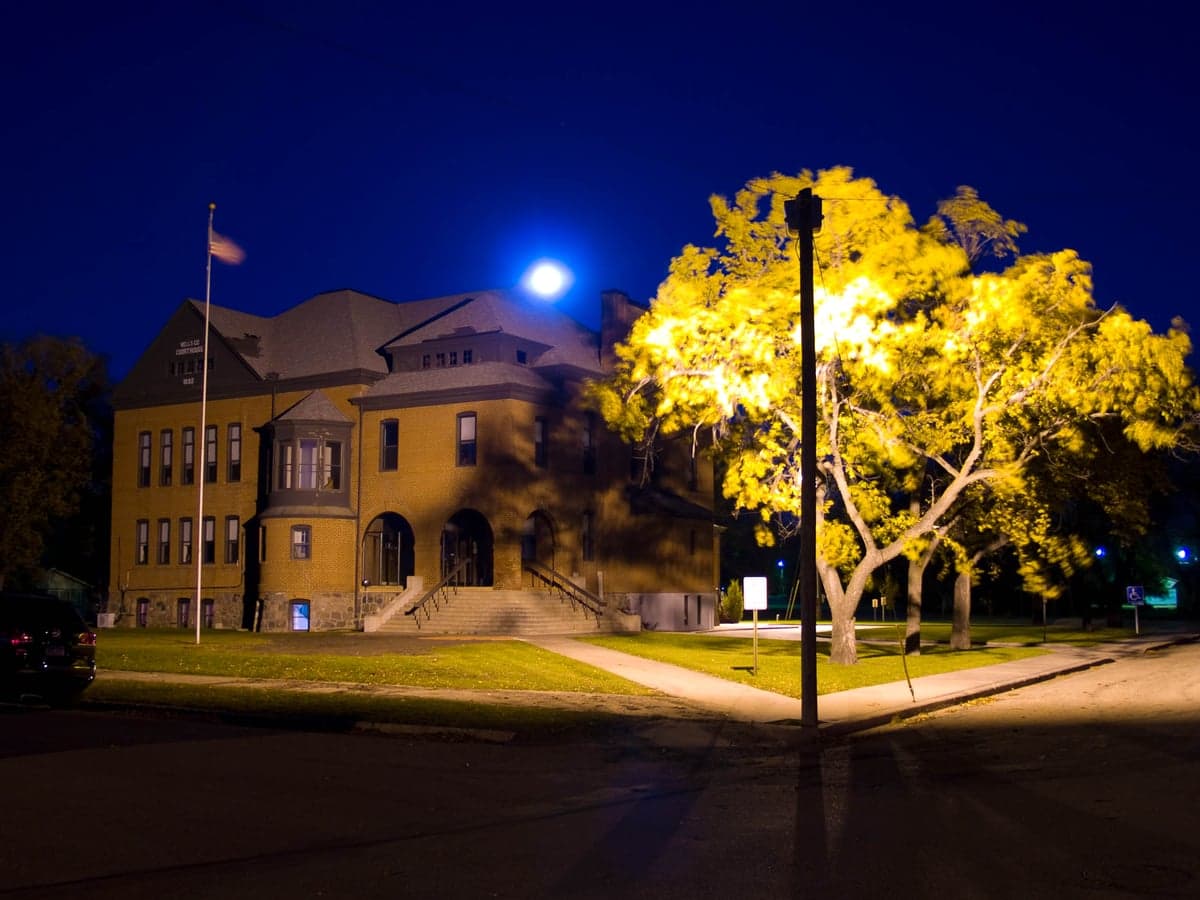
Photo: Wikipedia
Personal Sovereignty in Wells County
Strong independent fundamentals that actively favor personal liberty and low regulation.
What does Personal Sovereignty tell us?
Personal Sovereignty measures your capacity for self-reliance and independence with minimal government friction. Higher scores mean fewer barriers between you and the way you want to live... but it assumes you have the space you need and good neighbors.
What does this tell us?
Personal Sovereignty measures your capacity for self-reliance and independence with minimal government friction. Higher scores mean fewer barriers between you and the way you want to live... but it assumes you have the space you need and good neighbors.
State Policy
Energy independence: Net exporter (644% of energy produced in-state)
Personal Liberty
Homesteading

Personal Liberty Analysis
Wells County, North Dakota, offers an environment of substantial personal sovereignty, rooted in the state’s strong tradition of limited government and individual liberty. For those prioritizing autonomy—whether single individuals or families—the county provides a low-tax, lightly regulated landscape where self-reliance is not just tolerated but expected. The area’s small towns, including Fessenden, Harvey, and Bowdon, each present slightly different flavors of this independence, from gun-friendly culture to off-grid feasibility, making Wells County a compelling option for relocation research focused on personal freedom.
Tax burden and regulatory posture: How light is the government footprint?
North Dakota’s tax structure is notably favorable for those seeking to keep more of their earnings, and Wells County aligns with this state-level posture. There is no state income tax, a significant advantage for both wage earners and business owners. Property taxes in Wells County are moderate, with the county’s mill levy typically lower than in more urbanized areas like Burleigh County (Bismarck). For example, a home valued at $150,000 in Harvey might see annual property taxes around $1,800–$2,200, depending on school district levies, compared to higher rates in larger cities. The regulatory environment is similarly light-touch. Wells County does not impose county-level business licensing beyond basic state requirements, and zoning is minimal outside of the incorporated city limits of Fessenden and Harvey. In unincorporated areas, such as the rural stretches near Sykeston or Cathay, landowners face few restrictions on building, land use, or home-based enterprises. This contrasts sharply with more regulated counties in the eastern part of the state or in metropolitan areas, where permitting processes can be more involved. For a reader seeking to minimize government interaction in daily life, Wells County’s posture is decidedly hands-off.
Self-defense and gun law specifics: What are the rights and realities?
North Dakota is a strong Second Amendment state, and Wells County reflects this culture fully. The state allows constitutional carry for residents 18 and older without a permit, meaning lawful gun owners can carry concealed firearms in most public places. There is no state-level firearm registration, no magazine capacity restrictions, and no “red flag” law, which aligns with the priorities of those who view self-defense as a fundamental personal right. In practice, this means that in towns like Harvey and Fessenden, gun ownership is common and openly discussed. Local gun shops and shooting ranges, such as the Harvey Rod and Gun Club, serve a community where firearms are seen as tools for both sport and protection. The county sheriff’s office in Fessenden generally interprets state law with a permissive approach, and there are no local ordinances that further restrict carry or storage. For families, this environment supports a self-reliant approach to personal safety, though it is worth noting that rural distances mean law enforcement response times can be 15–30 minutes in remote areas, making personal preparedness a practical necessity. The legal framework here is among the most protective of individual gun rights in the Upper Midwest.
Self-reliance and homesteading viability: Lot sizes, zoning, and off-grid feasibility
Wells County is a strong candidate for those interested in homesteading or off-grid living, thanks to its agricultural character and permissive land-use rules. In unincorporated areas, there are no minimum lot size requirements for building a primary residence, though agricultural land parcels typically start at 40 acres for tax purposes. Smaller lots (1–5 acres) are available near Harvey and Fessenden, often at prices under $5,000 per acre, making entry affordable. Zoning is virtually nonexistent outside city limits; landowners can build structures, raise livestock, or install alternative energy systems without county permits. Off-grid feasibility is high: the county does not mandate grid connection for electricity or water. Many rural properties near Bowdon and Sykeston rely on private wells and septic systems, and solar panel installations are common, with no county-level restrictions. The state’s net metering policy allows excess solar power to be sold back to utilities, though rural electric cooperatives like Verendrye Electric serve the area with reasonable rates. For those seeking to minimize reliance on municipal services, Wells County’s regulatory vacuum is a significant advantage. However, note that in the city limits of Harvey and Fessenden, building codes and utility hookup requirements apply, so homesteaders should target unincorporated parcels for maximum autonomy.
Personal liberties: Parental rights, medical autonomy, speech, and property
North Dakota law generally supports broad personal liberties, and Wells County’s small-town culture reinforces this. Parental rights are strongly protected; the state has no universal vaccine mandate for schoolchildren, and parents can opt out of public school curricula with minimal pushback. Medical autonomy is similarly respected—there is no state-level mandate for COVID-19 vaccines or masks, and healthcare decisions remain largely private. In Harvey, the CHI St. Alexius Health hospital provides basic care without the bureaucratic friction seen in larger systems. Free speech is robust, with no local hate speech ordinances or content-based restrictions on public expression. Property rights are a cornerstone of the county’s identity; eminent domain is rarely used, and landowners in areas like Cathay and Sykeston enjoy clear title and minimal government easements. The county’s political climate leans conservative, with most elected officials in Fessenden and Harvey prioritizing individual freedoms over collective mandates. For families, this translates into a community where personal choices—from schooling to healthcare to how you use your land—are largely left to the individual, provided they do not infringe on neighbors. This is not a place where government oversight intrudes into daily life; it is a place where self-governance is the default.
Overall, Wells County ranks among the more sovereignty-friendly areas in North Dakota, comparable to neighboring counties like Foster or Eddy but with even lighter regulatory touch in its unincorporated areas. For a reader who values low taxes, strong gun rights, off-grid feasibility, and minimal government interference, this county offers a practical and affordable base. The trade-off is limited services and a sparse population—Harvey, the largest town, has about 1,700 residents—but for those prioritizing personal freedom over urban convenience, Wells County delivers a high degree of autonomy relative to most other regions in the United States.

* Values derived from national, state, county, city and local statistics and may differ in a specific area. Last updated: 2026-10-30T16:18:48.000Z
Narrative content on this page is AI-generated and may contain mistakes. Verify any details that matter before acting on them.
ReloMaps may earn a commission from affiliate links at no extra cost to you.

