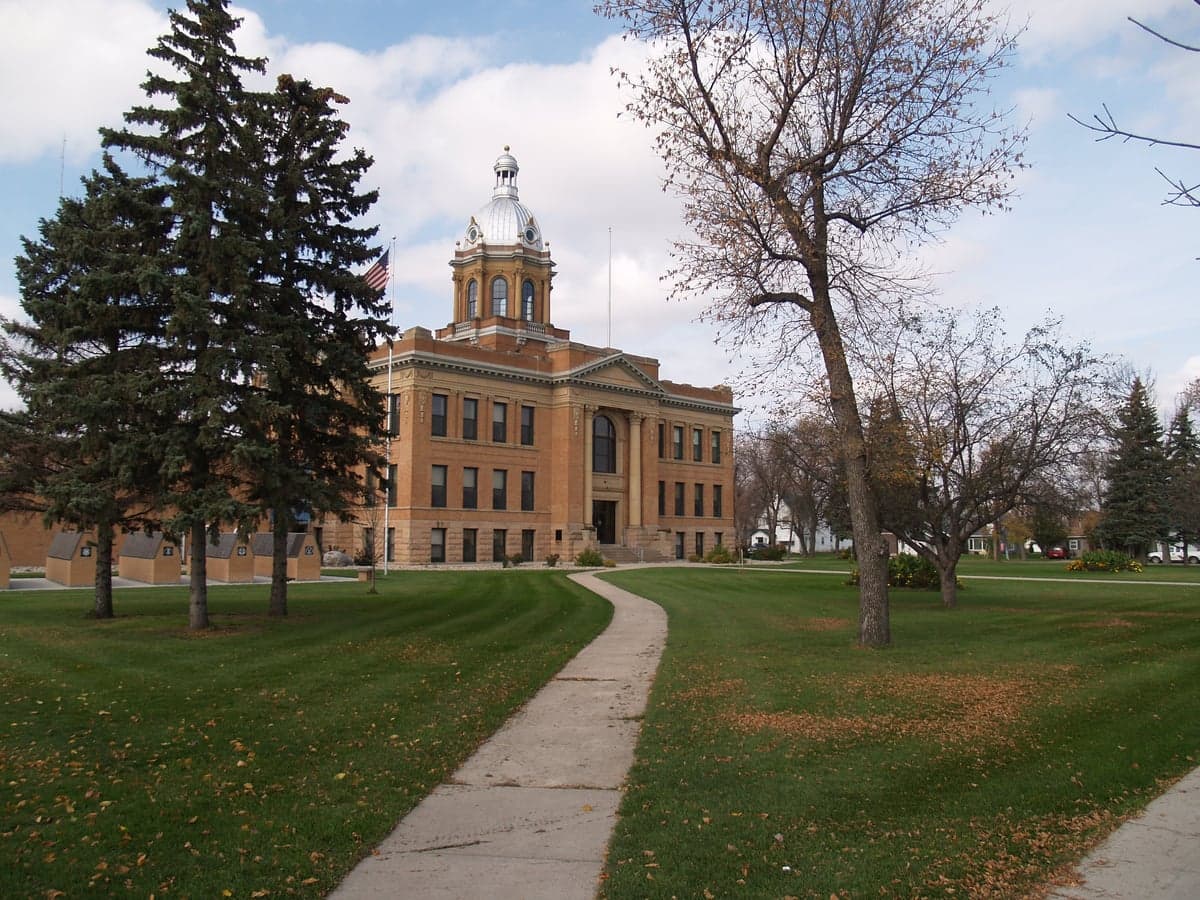
Photo: Wikipedia
Political ClimatePolitical Climate in Traill County
Showing state-level results — no local-only data available.
Local Political AnalysisPolitical Analysis of Traill County
Traill County, North Dakota, is a deeply Republican stronghold with a Cook Partisan Voting Index of R+18, meaning it votes roughly 18 points more Republican than the national average. In practice, that’s 18 to 20 points redder than the state of North Dakota as a whole, which itself leans R+20 or so. If you’re looking at election maps, Traill County has been reliably red for decades, and it’s not budging much. The county seat, Hillsboro, and smaller towns like Mayville and Portland consistently deliver Republican margins of 65-70%. The only real exceptions are a few precincts around Mayville State University, where students and faculty occasionally nudge a local race a few points toward the blue, but it’s never enough to flip a county-level seat.
How it compares
Compared to the rest of North Dakota, Traill County is actually a bit more conservative on social issues—you’ll find stronger opposition to abortion rights and gun control measures here than in, say, Grand Forks County. The state as a whole is Republican, but Traill County’s rural, agricultural base leans even harder toward traditional values and low-tax, small-government politics. In 2020, Donald Trump won Traill County by over 40 points, while statewide he won by about 33. Democratic candidates rarely spend money here, focusing instead on the state’s handful of competitive legislative districts in counties like Cass (Fargo) or Grand Forks. Locally, the county commission, school boards, and city councils are almost entirely Republican or nonpartisan conservative. Mayville, being the largest town (around 1,800 people), occasionally elects a moderate Democrat to the city council, but that’s more about personality than party—someone known for fixing potholes or running the local hardware store.
What this means for residents
For conservative residents, living in Traill County means their values are reflected in local policy: low property taxes, strong agricultural subsidies at the state level, and little to no debate over issues like gun rights or religious freedom. The county has a "Second Amendment Sanctuary" resolution, and local law enforcement won’t enforce federal red-flag laws. For liberal residents, it can feel isolating. There’s no organized activist scene, and progressive candidates rarely bother running for county office. But it’s not hostile—everyone knows each other, and political differences usually get set aside at the local coffee shop or at high school football games. The real tension shows up in state-level elections: Traill County’s solid red vote helps lock in conservative majorities in the North Dakota legislature, which affects things like school funding formulas and renewable energy mandates. A Democrat in Hillsboro once told me, "I don’t win much, but I get to speak my mind at town hall, and people listen even if they disagree." That’s the reality here—low political friction day-to-day, but a very clear direction in the voting booth.
Culturally, Traill County stands out for its strong Scandinavian Lutheran heritage, which shapes a distinct flavor of conservatism: thrifty, community-minded, and wary of big government but also quietly generous. The county has a higher rate of volunteerism and church attendance than the state average. You won’t see many political yard signs in Mayville or Hillsboro—people consider it bad form to flaunt party loyalty. Instead, local policy debates focus on practical issues like road maintenance (U.S. Highway 81 runs through the heart of the county), funding for the agricultural extension office, and keeping the local hospital in Hillsboro solvent. Despite the R+18 lean, there’s a live-and-let-live ethos that surprises outsiders. The real dividing line isn’t red vs. blue; it’s between the "old-timers" who want to keep taxes rock-bottom and the "newcomers" (often remote workers or retirees from Fargo) who want a slightly higher mill levy for better school resources. That’s the quiet, unglamorous politics of Traill County.

State Political ClimatePolitical Climate in North Dakota
State Political AnalysisPolitical Environment in the State
North Dakota is a deeply red state, with Republicans holding every statewide office and supermajorities in both legislative chambers, but its political climate is more nuanced than a simple party label suggests. The state has shifted rightward over the past 20 years, driven by a rural exodus of Democrats and the oil boom’s influx of conservative workers, though a small but persistent Democratic-Liberal Party (the state’s Democratic affiliate) holds onto a few urban and Native American strongholds. In the 2024 presidential election, Donald Trump won the state by 34 points, a margin that has widened from 26 points in 2016, reflecting a steady consolidation of conservative voters in the vast rural expanse.
Urban vs. rural divide
The political map is a study in contrasts between the state’s few population centers and its sprawling agricultural and energy-producing regions. Fargo, the largest city, is the most competitive area — Cass County voted for Trump by only 12 points in 2024, and the city itself has a visible Democratic presence, with state legislators like Josh Boschee representing downtown wards. Bismarck, the capital, leans Republican but is more moderate than the surrounding countryside, with Burleigh County voting +22 R in 2024. The real engine of the state’s conservatism is the western oil patch: Williams County (Williston) and McKenzie County voted +60 and +70 R respectively, fueled by a transient workforce that skews young, male, and libertarian-leaning. The eastern Red River Valley, including Grand Forks and Wahpeton, is reliably Republican but less intensely so, with Grand Forks County voting +18 R. The most notable Democratic holdouts are the state’s five Native American reservations — the Turtle Mountain Band of Chippewa in Rolette County and the Standing Rock Sioux in Sioux County both voted for Biden in 2020, with Rolette County being the only county to flip from Trump (2016) to Biden (2020). This urban-rural split means a resident in Fargo experiences a different political reality than someone in Watford City, with the former seeing more visible Democratic activism and the latter living in a near-monolith of conservative culture.
Policy environment
North Dakota’s policy landscape is defined by low taxes, limited regulation, and a strong cultural conservatism that shapes education and social policy. The state has no personal or corporate income tax (eliminated in phases through 2024), a 5% sales tax (with local add-ons up to 2%), and some of the lowest property tax rates in the nation, though local levies vary widely — a $300,000 home in Fargo might pay $3,500 annually, while the same home in rural Slope County pays under $2,000. The regulatory posture is business-friendly, especially for energy and agriculture, with the Department of Mineral Resources streamlining oil and gas permits. Education policy is a flashpoint: the 2023 “Parents’ Bill of Rights” (HB 1205) requires schools to notify parents of any curriculum changes involving sexuality or gender identity and allows parents to opt their children out of lessons they find objectionable. Healthcare is a mixed bag — the state expanded Medicaid under the Affordable Care Act in 2013, but the 2023 “Born Alive” law (HB 1465) requires medical care for infants born alive after an abortion, and a 2024 law (SB 2150) bans gender-affirming care for minors. Election laws are restrictive by national standards: voter ID is required with a strict list of acceptable forms, same-day registration is not allowed, and mail-in voting requires an excuse. The state also has a robust initiative process, used in 2024 to pass a measure legalizing recreational marijuana (though it was later struck down by the state Supreme Court on procedural grounds).
Recent policy direction
Over the past five years, the legislature has moved aggressively on cultural issues while maintaining a pro-business economic stance. In 2023, the state passed a near-total abortion ban (HB 1250) with exceptions only for rape, incest, and life of the mother, taking effect immediately after the Dobbs decision. Gun laws are among the most permissive in the nation: permitless carry for both open and concealed firearms was enacted in 2017, and a 2023 law (SB 2300) prohibits local governments from enforcing any federal gun regulations that conflict with state law. On education, the 2023 “School Choice” bill (HB 1532) created a tax credit for private school tuition, and the 2024 “Library Materials” law (HB 1205) allows parents to challenge and remove books they deem “sexually explicit.” Property rights are strong, with the 2023 “Eminent Domain” law (SB 2344) restricting the use of eminent domain for carbon capture pipelines, a direct response to the Summit Carbon Solutions project. Privacy and surveillance are less protected: the state has no comprehensive data privacy law, and law enforcement can access cell phone location data without a warrant under a 2022 court ruling. Voting access has tightened: the 2021 voter ID law (HB 1233) eliminated the use of student IDs from out-of-state colleges, and the 2023 “Ballot Harvesting” ban (SB 2100) makes it a felony to collect and return another person’s absentee ballot. The overall direction is toward more cultural regulation and less government interference in the economy, a mix that appeals to libertarian-leaning conservatives but can feel restrictive to those on the left.
Civil unrest & political movements
Political activism in North Dakota is low-key compared to coastal states, but there have been notable flashpoints. The most visible was the 2016-2017 Standing Rock protests against the Dakota Access Pipeline, which drew thousands of activists from across the country and resulted in over 700 arrests, creating a lasting divide between the state government (which supported the pipeline) and the Standing Rock Sioux Tribe. The state’s response — including a 2017 law (HB 1303) that increased penalties for protest-related trespassing — has been criticized by civil liberties groups. More recently, the 2023-2024 debate over the Summit Carbon Solutions pipeline sparked organized opposition from landowners and environmental groups, leading to the aforementioned eminent domain restrictions. On the right, the “North Dakota Freedom Caucus” formed in 2023, pushing for further restrictions on abortion and transgender rights, and has clashed with more moderate Republicans over budget priorities. Immigration politics are muted — the state has a small foreign-born population (about 4%), and there are no sanctuary cities, though Fargo has seen some local activism around refugee resettlement. Election integrity controversies are minimal, with the state’s Republican Secretary of State, Michael Howe, maintaining that the 2020 and 2024 elections were secure. A new resident would notice that political signs are ubiquitous in rural areas, but actual political conversations are often avoided in mixed company — the state’s culture of “North Dakota nice” tends to suppress open conflict.
Projection
Over the next 5-10 years, North Dakota’s political trajectory is likely to remain deeply red, but with growing internal tensions between the libertarian-leaning oil patch and the socially conservative eastern farming communities. Demographic trends favor the GOP: the state’s population is aging (median age 40.5), and the few young people moving in tend to be drawn to the oil industry, which reinforces conservative voting patterns. The Native American population, which makes up about 5% of the state, is growing but remains politically marginalized due to voter ID laws and rural isolation. The biggest wildcard is the energy transition — if carbon capture and renewable energy projects (like the proposed Sunflower wind farm) gain traction, they could bring in a more environmentally conscious workforce, potentially shifting the politics of places like Bismarck and Minot. However, the state’s political infrastructure is so entrenched that even a 5-point shift would still leave it solidly red. For a new resident, this means the policy environment will continue to favor low taxes, gun rights, and cultural conservatism, with little chance of major liberalization on abortion or transgender rights. The practical takeaway is that if you align with the state’s dominant political culture, you’ll find a welcoming environment with minimal friction; if you don’t, you’ll need to be comfortable being in the minority, especially outside of Fargo and the reservations.
For someone moving to North Dakota, the bottom line is that the state offers a predictable, low-tax, culturally conservative environment where your political views are likely to be in the majority if you lean right, and a respectful but clear minority if you lean left. The urban-rural divide means you can find a more moderate community in Fargo or Grand Forks, but the state’s laws and policies will reflect the priorities of the rural and oil-patch majority. If you value gun rights, low taxes, and traditional social values, you’ll feel at home. If you’re looking for a place with robust public transit, progressive social policies, or a vibrant counterculture, you’ll likely find the state frustrating. The key is to choose your community wisely — a liberal family might thrive in Fargo’s downtown, while a conservative family would find a natural fit in Bismarck or Williston.
* Values derived from national, state, county, city and local statistics and may differ in a specific area. Last updated: 2026-07-07T01:14:34.000Z
Narrative content on this page is AI-generated and may contain mistakes. Verify any details that matter before acting on them.
ReloMaps may earn a commission from affiliate links at no extra cost to you.

