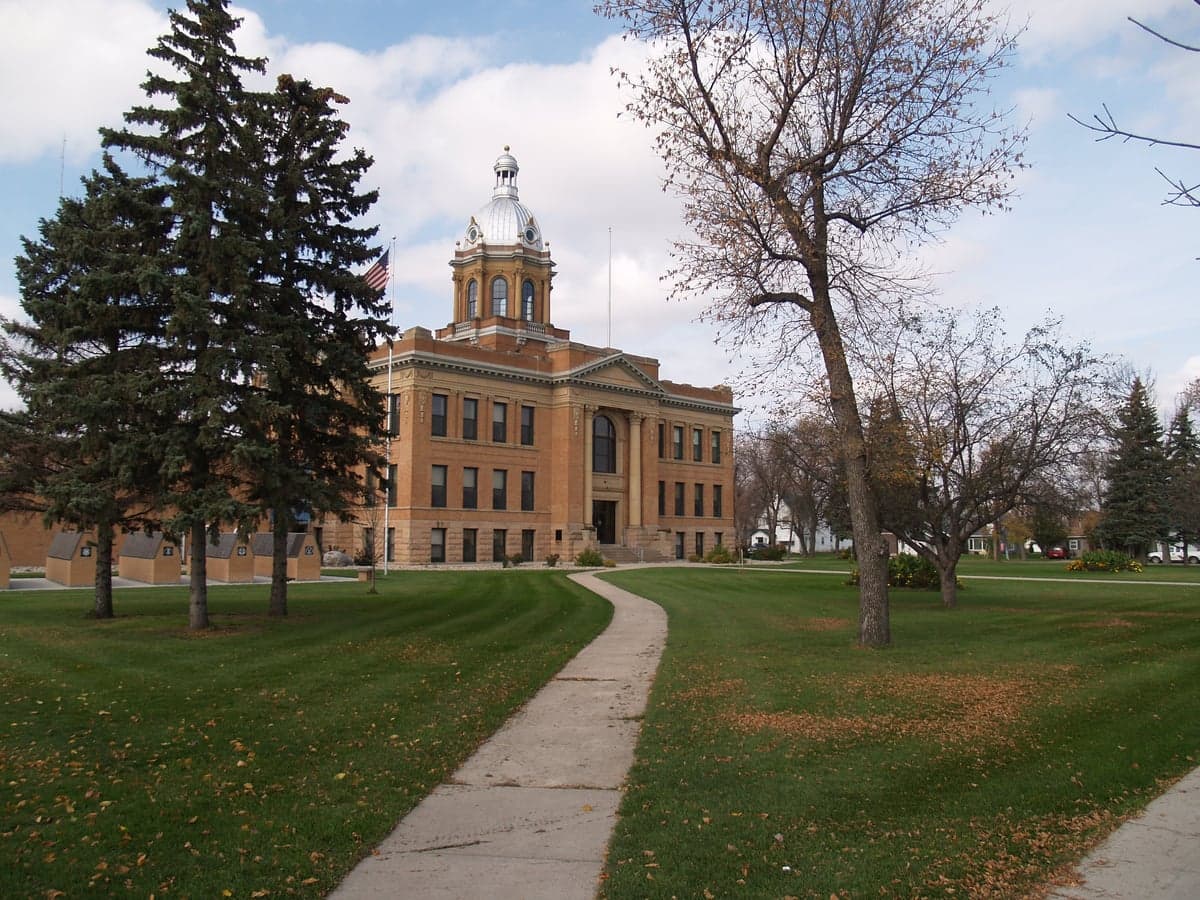
Photo: Wikipedia
Demographics of Traill County
Affluence Level in Traill County
An upper-middle-class area. Household wealth, education levels, and homeownership run ahead of national benchmarks.
People of Traill County
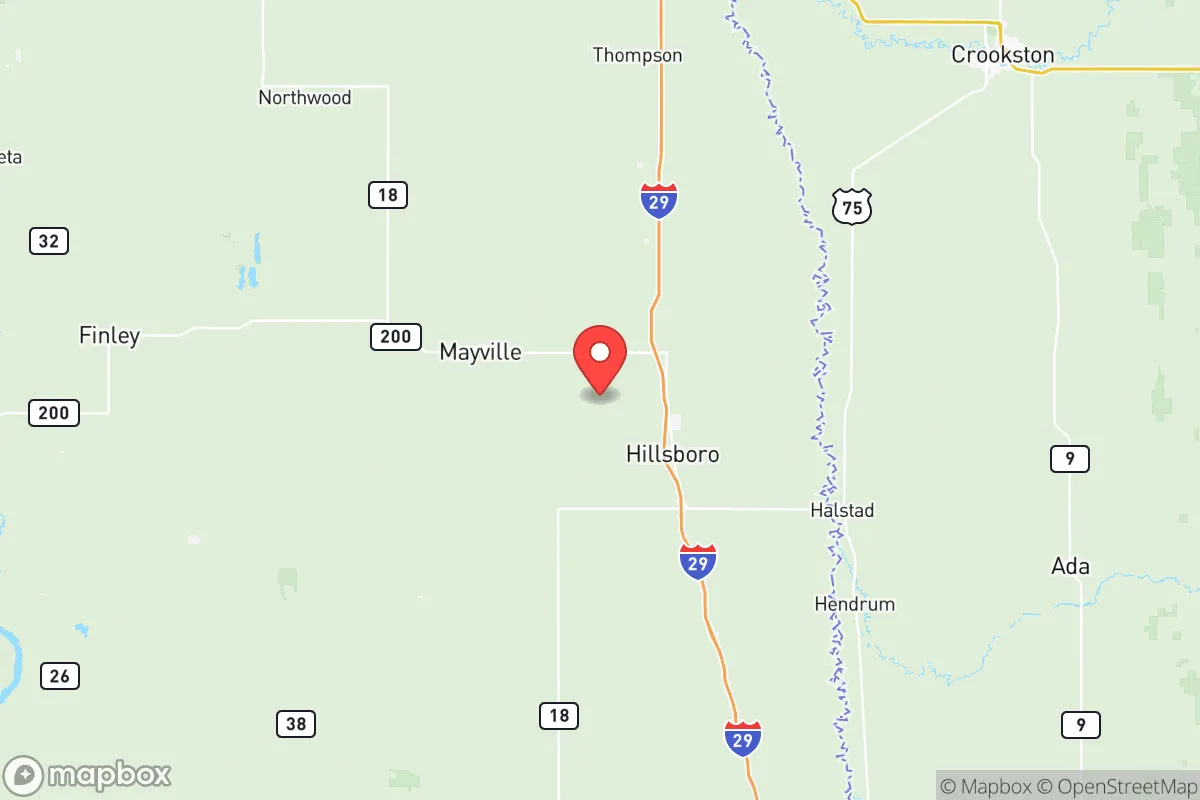
Traill County, North Dakota, is home to roughly 7,980 residents, a population that remains predominantly white (90.2%) and largely native-born (only 1.6% foreign-born), with a character shaped by deep Scandinavian and German roots. The county’s identity is one of small, tight-knit agricultural communities like Mayville, Hillsboro, and Portland, where Lutheran church steeples and family farms define the landscape. With a modest 31.2% college-educated rate and a Hispanic population of 3.7%, the county is less diverse than the state average but retains a distinct, stable cultural continuity. For those moving in now, Traill County offers a quiet, rural lifestyle where community ties run deep and the pace of life is dictated by the seasons.
Settlement & growth (pre-1960)
Before European settlement, the area that is now Traill County was part of the traditional territory of the Dakota (Sioux) people, particularly the Sisseton and Wahpeton bands. These semi-nomadic groups followed bison herds and established seasonal camps along the Red River and its tributaries, including the Goose River and the Cheyenne River. The first European incursion came with French fur traders in the 18th century, but permanent settlement did not begin until after the United States acquired the region through the Louisiana Purchase of 1803 and the subsequent 1851 Treaty of Traverse des Sioux, which forced the Dakota onto reservations.
The real wave of settlement began in the 1870s and 1880s, driven by the Homestead Act of 1862 and the arrival of the railroad. The St. Paul, Minneapolis & Manitoba Railway (later the Great Northern) pushed through the county, founding towns like Hillsboro (1879), Mayville (1881), and Portland (1881) as agricultural service centers. The first major group of settlers were Norwegian immigrants, who arrived in large numbers between 1870 and 1900, drawn by cheap land and the promise of a new life. They established farms and churches, and their influence remains strong today—Mayville is home to the Norwegian heritage-focused Mayville State University. Simultaneously, German immigrants from Russia (often called Volga Germans) arrived in the 1880s and 1890s, settling in and around Hillsboro and Grandin, where they brought their distinctive wheat-farming techniques and Lutheran faith. A smaller wave of Swedish and Irish immigrants also filtered in, but the county’s population was overwhelmingly Scandinavian and German by 1900.
By 1910, Traill County’s population peaked at roughly 12,000, reflecting the height of the homesteading era. The economy was entirely agricultural—wheat, barley, and flax—and towns like Hatton and Buxton grew as shipping points. The Dust Bowl and Great Depression of the 1930s hit hard, causing a slow population decline as farms consolidated and young people left for cities. The post-World War II period saw a modest stabilization, but the county never regained its pre-1910 numbers. The 1950s brought improved roads and mechanized farming, which further reduced the need for farm labor, and the population settled into a pattern of slow, steady loss.
Modern era (post-1965)
The 1965 Hart-Cellar Act, which reshaped U.S. immigration, had almost no direct impact on Traill County. The foreign-born population today is just 1.6%, and the county remains overwhelmingly native-born. Instead, the major demographic shift since 1965 has been domestic out-migration—young people leaving for larger cities like Fargo (just 30 miles south) or Grand Forks (40 miles north) for education and jobs. This has resulted in a gradual aging of the population, with the median age now around 44, higher than the national average.
The most notable modern change is the growth of the Hispanic population, which rose from negligible levels in 1990 to 3.7% today. This is largely driven by Mexican and Central American workers employed in the county’s meatpacking plants and agricultural processing facilities, particularly in Hillsboro and Mayville. These families have formed small but visible communities, with Spanish-language services appearing in some local churches and a few Mexican grocery stores opening in Hillsboro. The Black population remains tiny at 0.9%, and East/Southeast Asian communities are even smaller at 0.4%, with no Indian-subcontinent population recorded. The county’s white population, while still dominant at 90.2%, has declined slightly from 95% in 2000, reflecting both the Hispanic influx and the out-migration of white residents.
Suburbanization has been minimal. Unlike the booming suburbs of Fargo, Traill County’s towns have remained small and rural. The only notable growth area is the southern part of the county, near Hillsboro, where some commuters to Fargo have built homes on acreages, but this is a trickle, not a wave. The county’s population has been essentially flat since 2010, hovering around 8,000, with a slight uptick in the 2020 census due to a temporary oil-boom-related housing spillover from western North Dakota.
The future
Traill County is likely to remain a predominantly white, rural, and agricultural area for the next 10-20 years. The Hispanic population is expected to grow slowly, perhaps reaching 5-6% by 2040, as meatpacking and food-processing jobs continue to attract immigrant labor. However, the county’s overall population is projected to decline slightly, as the aging white population dies and young people continue to leave for urban centers. The towns of Mayville and Hillsboro will likely retain their roles as service hubs, but smaller villages like Portland and Hatton may see further shrinkage. There is no sign of significant Asian, Black, or Indian immigration, and the county’s cultural identity—rooted in Scandinavian and German Lutheran traditions—will remain dominant. The biggest wildcard is climate change: if the Red River Valley becomes more prone to flooding, it could accelerate out-migration, but if it becomes more agriculturally productive, it could attract new investment.
For someone moving in now, Traill County is a place of stability and tradition, not rapid change. The population is aging, but the community is tight-knit, safe, and deeply connected to the land. New residents will find a welcoming but insular culture, where church membership and volunteer fire departments are the social glue. The county is not becoming more diverse in any dramatic way, but it is slowly becoming more Hispanic, adding a subtle layer to its Scandinavian-German foundation. If you value quiet, low crime, and a strong sense of place, Traill County offers that—but don’t expect the demographic dynamism of a growing Sun Belt suburb.

* Values derived from national, state, county, city and local statistics and may differ in a specific area. Last updated: 2026-07-07T01:14:34.000Z
Narrative content on this page is AI-generated and may contain mistakes. Verify any details that matter before acting on them.
ReloMaps may earn a commission from affiliate links at no extra cost to you.

