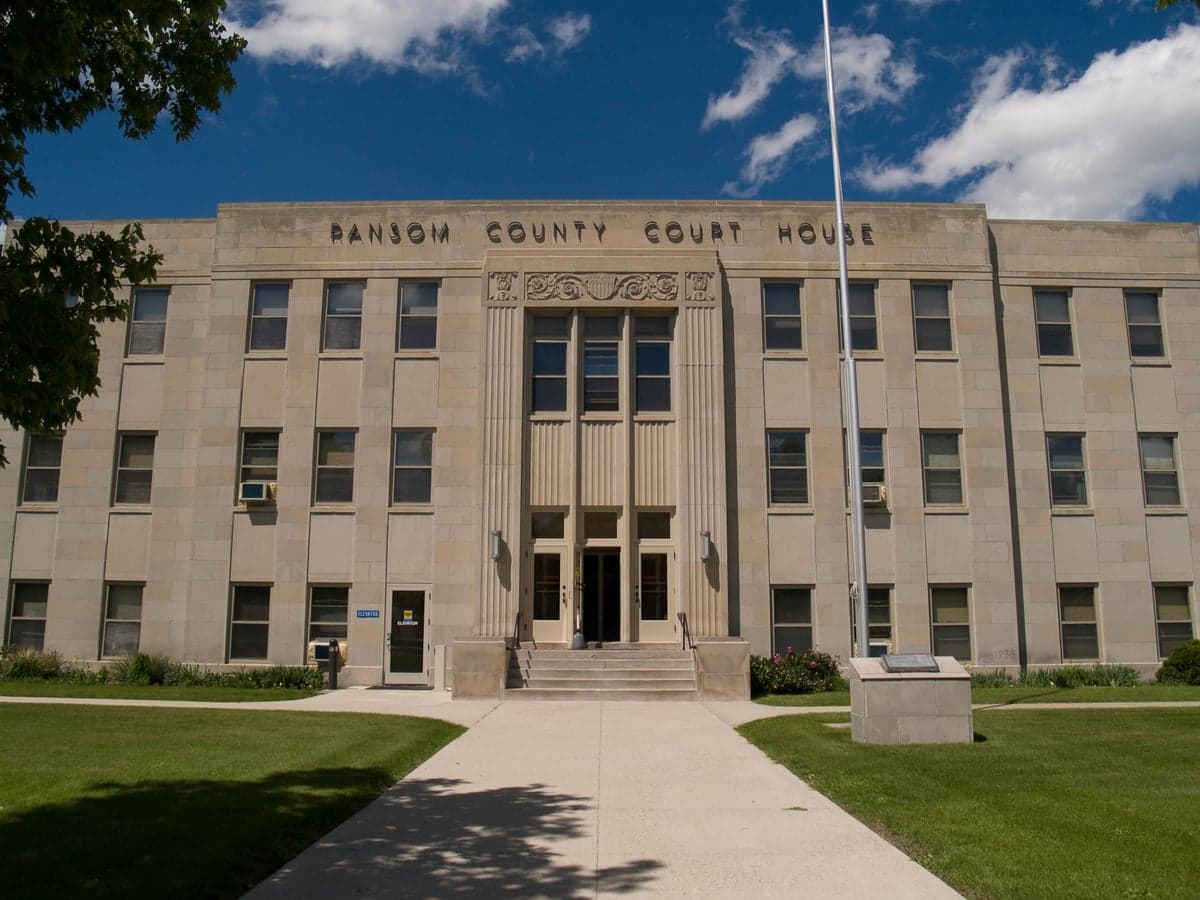
Photo: Wikipedia
Political ClimatePolitical Climate in Ransom County
Showing state-level results — no local-only data available.
Local Political AnalysisPolitical Analysis of Ransom County
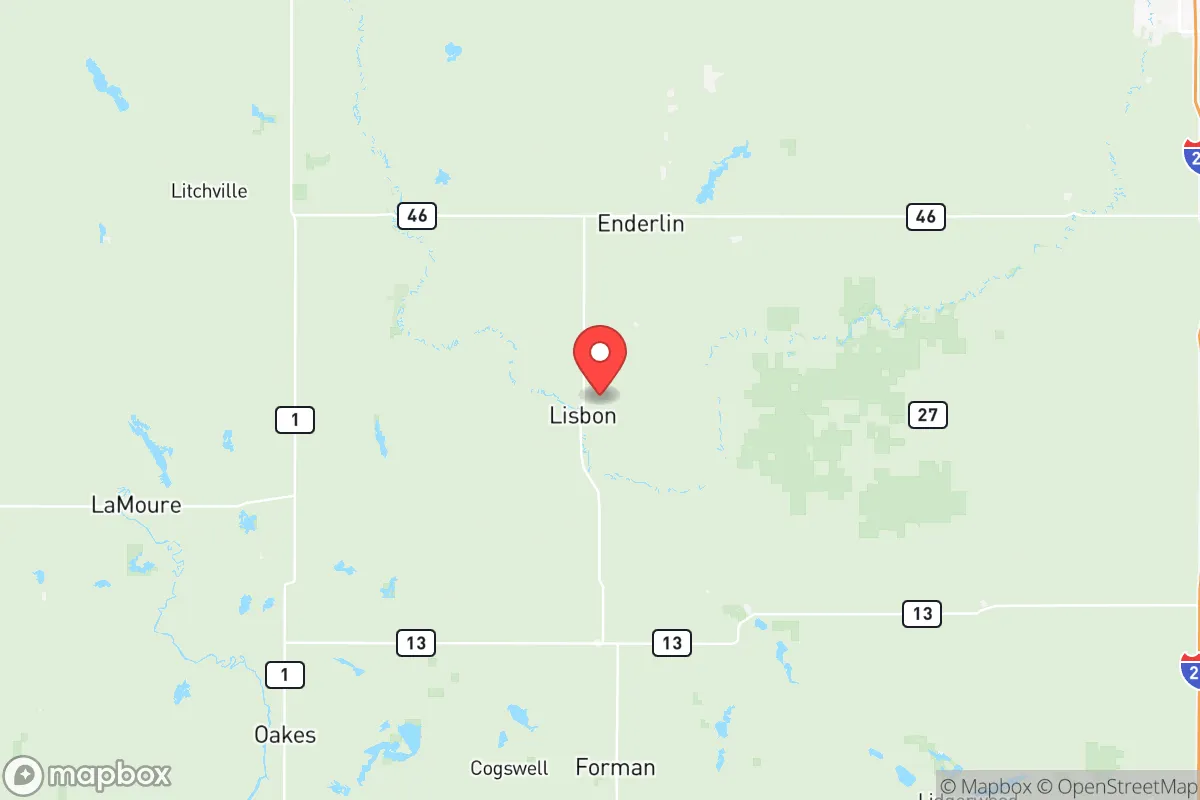
Ransom County, North Dakota, is a reliably Republican stronghold with a Cook Partisan Voting Index (PVI) of R+18, meaning it votes about 18 percentage points more Republican than the national average. This isn't a recent shift; the county has been solidly red for decades, though the margins have tightened slightly in presidential races since 2016, as rural Democratic-leaning voters in places like the county seat of Lisbon have become a smaller share of the electorate. The real story here isn't a dramatic swing but a slow, steady consolidation of Republican dominance, with the most conservative precincts clustered around the smaller towns like Sheldon and Enderlin, while Lisbon itself shows a bit more balance.
How it compares
Compared to the rest of North Dakota, Ransom County is actually a bit more Republican than the state average. While North Dakota as a whole is also deeply red—with a Cook PVI that is also strongly Republican, though the exact figure isn't publicly available—Ransom County's R+18 rating puts it in the top tier of conservative counties in the state. For context, the state's largest counties, like Cass (Fargo) and Burleigh (Bismarck), lean Republican but are less extreme, often in the R+10 to R+15 range. The difference is visible on the ground: in Ransom County, you'll find fewer of the moderate, suburban Republicans you see in Fargo and more of the old-school, agrarian conservatives who prioritize farm policy, property rights, and local control. The county's politics are also less influenced by the oil boom that has reshaped western North Dakota, so the focus stays on agriculture, small-town schools, and keeping taxes low on farmland.
What this means for residents
For conservative residents, this political climate means their values are the default in local governance. County commission meetings, school board decisions, and even the local newspaper's editorial page tend to reflect a pro-business, limited-government perspective. You'll see strong support for the Second Amendment, low property taxes, and a general skepticism of federal mandates. For liberal or moderate residents, the reality is more about navigating a landscape where their views are a distinct minority. There's no real organized Democratic Party presence in the county, so progressive voices often work through nonpartisan channels like the local library board or the Lisbon Area Chamber of Commerce. The upside is that politics rarely feels as polarized as in bigger cities; neighbors disagree on national candidates but still cooperate on the volunteer fire department and the county fair. The trajectory is toward even deeper red, as younger residents who leave for college often don't return, and those who stay tend to be more conservative than their parents.
Culturally, Ransom County's politics are woven into its identity as a place where self-reliance is prized. The county's strong Republican lean translates into a practical, no-nonsense approach to policy: roads get fixed, the sheriff's office is well-funded, and the school district in Lisbon is a point of pride. But it also means that discussions about climate change, racial equity, or public health mandates can be tense. The county's small size—about 5,500 people—means that personal relationships often override political differences, but the underlying ideological divide is real. If you're moving here, expect a community that values stability and tradition, where the biggest political debates are about the cost of a new school roof or the best way to support local farmers, not the culture wars you see on national news. That's the Ransom County way: conservative, but neighborly.

State Political ClimatePolitical Climate in North Dakota
State Political AnalysisPolitical Environment in the State
North Dakota has been a reliably Republican state for decades, but the flavor of that conservatism has shifted noticeably over the past 10-20 years. The state’s overall partisan lean is deep red — Donald Trump won it by 33 points in 2020 and by 20 points in 2024 — but the dominant coalition has moved from a pragmatic, farm-and-energy-based conservatism toward a more culturally assertive, small-government, and socially conservative posture. The oil boom in the Bakken region, centered around Williston and Watford City, injected a transient, libertarian-leaning workforce that amplified anti-tax and anti-regulation sentiment, while the eastern part of the state, anchored by Fargo and Grand Forks, has remained more moderate and institutionally Republican. Over the last decade, the state legislature has become notably more aggressive on cultural issues, even as the agricultural economy has faced headwinds.
Urban vs. rural divide
The political map breaks down along a clear urban-rural axis, but with a twist. Fargo (Cass County) is the largest metro and the most politically competitive area — it voted for Trump by only 8 points in 2024, down from 12 points in 2020, and the city itself has a growing Democratic-leaning professional class tied to healthcare, tech, and North Dakota State University. Grand Forks (Grand Forks County) leans Republican but is more moderate than the rest of the state, thanks to the University of North Dakota and a stable base of government and education workers. Bismarck (Burleigh County) and Mandan (Morton County) are reliably red, with Bismarck’s state government and energy sector workers driving a conservative but establishment-friendly vote. The real engine of the state’s rightward shift is the rural west and north: Williston, Dickinson, and Minot are among the most Republican small cities in the nation, routinely voting 75-80% for GOP candidates. The oil patch counties — McKenzie, Williams, and Dunn — are deeply red, but their politics are more libertarian than social conservative, focused on low taxes, minimal regulation, and energy independence. The rural farm counties along the Red River and the Missouri River are also solidly Republican, but with a stronger social conservative bent on issues like abortion and education.
Policy environment
North Dakota’s policy environment is defined by a few key levers. The state has no state income tax (individual income tax was eliminated in phases, with the final rate hitting zero in 2024), and property taxes are relatively low by national standards, though they vary by county. The regulatory posture is business-friendly, especially for energy, agriculture, and manufacturing — the state has a right-to-work law and a very low corporate tax rate (1.4% effective rate for most businesses). Education policy is decentralized: school districts have significant local control, and the state has a robust school choice landscape, including charter schools and a new education savings account (ESA) program passed in 2023. Healthcare is a mixed bag: the state expanded Medicaid under the Affordable Care Act in 2013, but the legislature has resisted further expansion of government-run programs. Election laws are moderately restrictive — voters must show a valid ID at the polls, and same-day registration is not allowed, but absentee voting is available without an excuse. The state has no voter ID photo requirement for mail ballots, which has been a point of contention.
Recent policy direction
The last five years have seen a clear shift toward cultural conservatism and individual liberty in specific domains. On gun and self-defense law, North Dakota is a constitutional carry state (permitless carry for both open and concealed) since 2017, and the legislature passed a "stand your ground" law in 2023. On parental and education rights, the state enacted a Parents’ Bill of Rights in 2023, requiring schools to notify parents about curriculum changes and allowing them to opt their children out of certain materials. The ESA program, passed in 2023, gives families up to $7,000 per child for private school tuition, homeschooling, or tutoring. On speech and privacy, the state has a broad anti-SLAPP law and a data privacy act that limits how tech companies can collect and sell user data. On medical and bodily autonomy, North Dakota has a near-total abortion ban (with exceptions for rape, incest, and life of the mother) that took effect in 2023 after the trigger law was activated. The state has not expanded gender-affirming care protections for minors, and in 2023, the legislature passed a ban on gender-affirming surgeries for minors. On property rights, the state has strong eminent domain protections, and the 2023 legislature passed a bill limiting the use of private property for carbon pipeline projects — a direct response to the Summit Carbon Solutions pipeline controversy. On taxation, the elimination of the individual income tax was the biggest recent change, and the state has also reduced the corporate tax rate. On voting and ballot access, the state has not moved toward stricter voter ID laws, but it did pass a law in 2023 requiring that all ballots be returned by Election Day, eliminating the three-day grace period for mail ballots.
Civil unrest & political movements
North Dakota has seen its share of political flashpoints, most notably the Dakota Access Pipeline protests (2016-2017) near the Standing Rock Reservation, which drew thousands of activists from across the country and resulted in significant law enforcement presence and legal battles. The protests were a defining moment for the state’s political identity, hardening the divide between rural conservatives who saw the pipeline as economic development and environmental activists who viewed it as a threat to water and tribal sovereignty. Since then, the state has seen smaller but persistent activism around carbon pipeline projects, with landowners in the eastern part of the state organizing against eminent domain for CO2 pipelines. On the right, the state has a strong Second Amendment movement and a growing parental rights movement that has influenced school board elections in Fargo and Bismarck. Immigration politics are relatively quiet — the state has a small foreign-born population (about 4%), and there is no sanctuary city policy. Election integrity controversies have been minimal, though the 2020 election saw some local disputes over mail ballot procedures. The state has no serious secession or nullification movement, though there is a libertarian streak in the oil patch that occasionally surfaces in anti-federal rhetoric.
Projection
Over the next 5-10 years, North Dakota’s political trajectory will be shaped by demographic and economic forces. The state’s population is aging and slowly declining in rural areas, while the Fargo metro continues to grow, attracting younger, more diverse residents. This could gradually moderate the state’s politics, especially on cultural issues, as the Fargo area becomes a larger share of the electorate. However, the oil patch is likely to remain deeply red and libertarian, and the rural farm counties are not going to shift left. The biggest wildcard is the energy transition: if carbon capture and storage projects (like the Summit pipeline) succeed, they could bring new investment and jobs to the state, reinforcing the pro-business, low-tax consensus. If they fail, the state may face a fiscal squeeze as oil revenues decline. On cultural issues, the trend is toward more conservative legislation — expect further restrictions on abortion, expansion of school choice, and continued resistance to federal mandates on climate and healthcare. A new resident moving in now should expect a state that is politically stable but not static, with a growing urban-rural divide and a legislature that is likely to remain firmly in Republican hands, but with a more pragmatic, business-friendly wing in the east and a more culturally conservative wing in the west.
For a new resident, the bottom line is this: North Dakota is a place where conservative values are the default, but the specific flavor varies by region. If you’re a conservative who values low taxes, gun rights, and local control, you’ll feel at home almost anywhere. If you’re a liberal, you’ll find a small but active community in Fargo and near the universities, but you’ll be in a clear minority in most of the state. The practical takeaway is that your day-to-day life will be shaped more by the local economy and community than by state politics — the state government is small and relatively hands-off, so your experience will depend heavily on which town you choose. The political climate is stable, but it’s not static — the next decade will see the state grapple with energy transition, demographic decline, and the growing influence of the Fargo metro, all of which will keep things interesting for anyone paying attention.
* Values derived from national, state, county, city and local statistics and may differ in a specific area. Last updated: 2026-07-24T11:49:47.000Z
Narrative content on this page is AI-generated and may contain mistakes. Verify any details that matter before acting on them.
ReloMaps may earn a commission from affiliate links at no extra cost to you.

