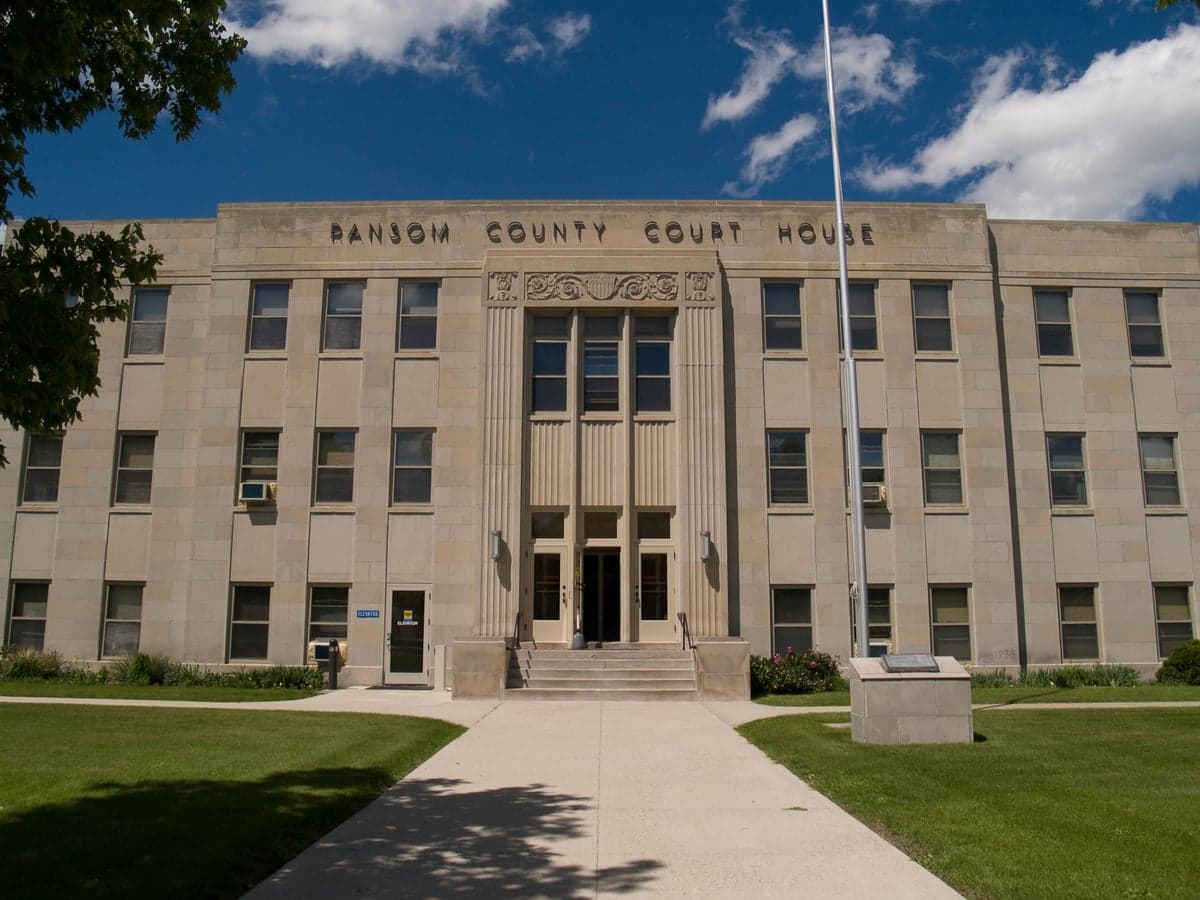
Photo: Wikipedia
Demographics of Ransom County
Affluence Level in Ransom County
A middle-class area roughly in line with national averages across income, home values, education, and employment.
People of Ransom County
Ransom County, North Dakota, is home to 5,662 residents, a population that is 92.5% white and overwhelmingly native-born, with only 0.9% foreign-born. The county’s character is defined by its small, tight-knit agricultural communities—Lisbon, Enderlin, Sheldon, and Fort Ransom—where a strong Scandinavian and German heritage remains visible in local festivals, church affiliations, and family names. With a college attainment rate of 21.0%, the workforce is rooted in farming, manufacturing, and the energy sector, creating a stable but slowly aging demographic profile.
Settlement & growth (pre-1960)
Before European settlement, the area that is now Ransom County was part of the traditional territory of the Dakota (Sioux) people, particularly the Yanktonai and Sisseton-Wahpeton bands. The land was used for seasonal hunting and gathering, with the Sheyenne River valley providing a vital corridor for bison and other game. The first permanent American presence came with the establishment of Fort Ransom in 1867, a U.S. Army post built to protect settlers and transportation routes during the Indian Wars. The fort was abandoned in 1872, but its name and legacy remain in the small town of Fort Ransom, which today has fewer than 100 residents.
The real wave of settlement began in the 1870s and 1880s, driven by the Homestead Act of 1862 and the expansion of the Northern Pacific Railroad. The railroad reached the area in 1880, and the county was officially organized in 1881. The first major group of settlers were Norwegian immigrants, who arrived in large numbers between 1875 and 1890, drawn by the promise of cheap, fertile land. They established farms and communities throughout the county, with a particularly strong concentration in and around Fort Ransom and Sheldon. The Norwegian Lutheran Church became a central institution, and Norwegian-language services persisted into the early 20th century.
Simultaneously, German immigrants from Russia—often called Germans from Russia—began arriving in the 1880s and 1890s. These were ethnic Germans who had lived for generations in the Volga River region of Russia and were attracted to the Great Plains by the promise of land and religious freedom. They settled primarily in the southern part of the county, around Lisbon and Enderlin, where they established strong farming communities. Their distinct dialect, cuisine, and religious practices (many were Lutheran or Catholic) set them apart from other German groups and remain a point of cultural pride today.
A smaller but notable wave of Irish immigrants arrived in the 1880s, many working as railroad laborers before taking up farming. They settled in and around Lisbon, the county seat, which was platted in 1880 and named after the capital of Portugal. The town of Elliott, founded in 1883, also attracted a mix of Norwegian and German settlers. By 1900, the county’s population had reached 6,919, a figure that would not be surpassed until the 2010 census. The early 20th century saw the arrival of a few Polish and Czech families, but these groups remained small. The population peaked at 9,449 in 1930, then began a long decline as mechanization reduced the need for farm labor and younger generations moved to cities.
Modern era (post-1965)
The post-1965 era, shaped by the Hart-Cellar Act, had minimal impact on Ransom County’s demographics. The county’s foreign-born population remains at just 0.9%, and the racial composition has changed only slightly. The Hispanic population, at 2.7%, is the largest minority group, but it is not concentrated in any single enclave. Instead, Hispanic residents are dispersed across the county, with a small but visible presence in Lisbon and Enderlin, often working in agriculture, meatpacking, or construction. The Asian population (East/Southeast Asian) stands at 0.7%, and the Black population at 0.9%, both too small to form distinct neighborhoods or cultural institutions.
The most significant demographic shift since 1965 has been domestic out-migration. The county’s population fell from 7,102 in 1970 to 5,451 in 2000, as young adults left for college and jobs in Fargo, Bismarck, or the oil fields of western North Dakota. This trend has stabilized somewhat in the past decade, with the population rising slightly to 5,662, driven by a modest influx of retirees and remote workers seeking a lower cost of living. The town of Lisbon, with a population of 2,204, has seen some new housing construction, but the county’s overall age structure is older than the state average, with a median age of 45.2 years.
Suburbanization has not occurred in the traditional sense, as there are no major cities within the county. Instead, the pattern has been one of rural depopulation, with the smallest towns—Fort Ransom (population 77), Sheldon (116), and Elliott (25)—losing residents to Lisbon and Enderlin, or to larger cities outside the county. The county’s economy has diversified slightly, with manufacturing and healthcare joining agriculture as major employers, but the cultural identity remains firmly rooted in its Scandinavian and German heritage.
The future
Ransom County is likely to remain one of the least diverse counties in North Dakota for the foreseeable future. The Hispanic population may grow slowly, driven by labor demand in agriculture and food processing, but it is unlikely to exceed 5-7% by 2040. The East/Southeast Asian and Black populations will probably remain below 2% each, as there are no economic or social pull factors to attract larger numbers. The Indian subcontinent population is effectively zero and is not expected to change.
The county’s future depends on its ability to retain and attract young families. The population is projected to remain stable or decline slightly, as the aging cohort of baby boomers passes away and is not fully replaced by births or in-migration. The towns of Lisbon and Enderlin are likely to see modest growth, while the smaller hamlets will continue to shrink. The county’s cultural identity will remain predominantly white and Scandinavian-German, with annual events like the Fort Ransom Corn Maze and the Lisbon Rodeo reinforcing traditional values. For a newcomer, this means moving into a community where neighborly ties are strong, but diversity is minimal, and the pace of life is slow and predictable.
For someone moving in now, Ransom County offers a stable, safe, and affordable rural lifestyle with a strong sense of heritage. The trade-off is limited economic opportunity, a lack of ethnic diversity, and a population that is slowly aging. It is a place best suited for those who value quiet, community, and wide-open spaces over urban amenities or cultural variety.

* Values derived from national, state, county, city and local statistics and may differ in a specific area. Last updated: 2026-07-24T11:49:47.000Z
Narrative content on this page is AI-generated and may contain mistakes. Verify any details that matter before acting on them.
ReloMaps may earn a commission from affiliate links at no extra cost to you.

